A Bead on a Balance: Catching the Decay of a Single Atom express
A tiny glass sphere floats in a laser beam like a speck of dust in sunlight. Inside it is radioactive lead, which decays from time to time. Each decay ejects charged particles, and the sphere loses or gains a tiny electric charge.
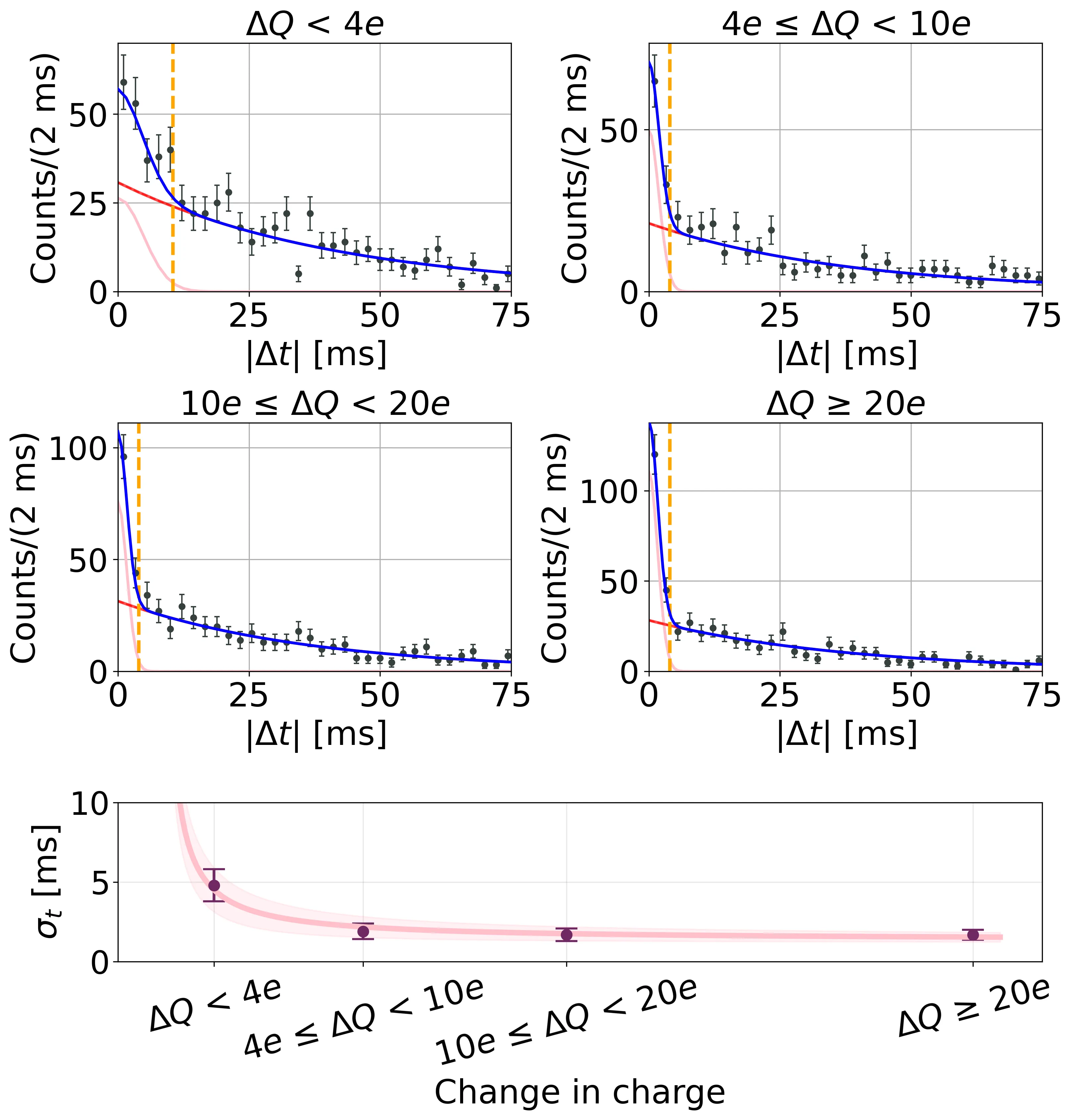
Scientists made the sphere oscillate in an alternating electric field and, from those oscillations, computed its charge a thousand times per second. A nearby detector caught the escaping particles. When the detector fired, the sphere's charge changed in a jump — by less than the charge of a single electron. In this way, they linked each decay to a change in charge.
It turned out that alpha decays and beta decays knock out different sets of charges from the sphere. Alpha particles, heavy and fast, carry away more charge, while beta particles carry away less. Moreover, the alpha decay of radon, which is born from the lead, knocks out a whole shower of slow electrons from the sphere's surface.
This method opens the door to studying the faintest radioactive emissions — one decay at a time. It's as if we learned to hear each raindrop hitting the glass, rather than just the overall noise of the storm.
Original abstract
as written by the authors arXiv:2603.14979
We measure event-by-event discrete changes in the net electric charge of an optically levitated silica microsphere arising from individual radioactive decays within the sphere, in coincidence with energy depositions in a nearby scintillation detector. The net charge of the levitated sphere is continuously monitored by measuring its driven response to an oscillating electric field, allowing individual charge-change events to be resolved on millisecond timescales with precision below an elementary charge. Simultaneously, $$\alpha$$ and $$\beta$$ particles emitted during decays of implanted $$^{212}$$Pb and its daughters are detected using a scintillator read out with an array of silicon photomultipliers. By correlating reconstructed charge-change times with the scintillator response, we can directly attribute abrupt changes in the sphere's net charge to individual nuclear decays, and identify differences in the distribution of charges ejected for $$\alpha$$ and $$\beta$$ decays. These results establish a new approach for studying low energy charged particles emitted by radioactive decays at the single-decay level, and identify showers of radiogenically produced low-energy electrons emitted by $$\alpha$$-decaying radon daughters implanted near solid surfaces.
The sphere is so sensitive to charge that it notices the loss of even a fraction of an electron's charge — less than the charge of any known free object.