Quantum Carbon Rings: Magnetism by the Rules of Aromaticity express
A ring of magnetic atoms resembles a round dance where each participant holds hands with their neighbors. In ordinary magnets, each atom has its own permanent magnetic moment, and they interact like little arrows striving to align opposite to each other. But in the new carbon rings synthesized on a surface, things are different: strong interactions between radical centers cause the number of unpaired electrons to change, and the magnetism goes beyond the familiar Heisenberg model.
The round dance can be even or odd. For even rings, a rule familiar to chemists from benzene applies: if the number of links is 4n+2, the system is aromatic and stable; if it's 4n, it's antiaromatic and unstable. Here, this rule carries over to magnetism: even rings with 4n+2 links exhibit antiferromagnetic ordering, while those with 4n break it. Odd rings, like a round dance with an odd number of participants, end up in a frustrated state: all neighbors want to align opposite, but that's impossible, leading to a degenerate ground state with a high degree of disorder.
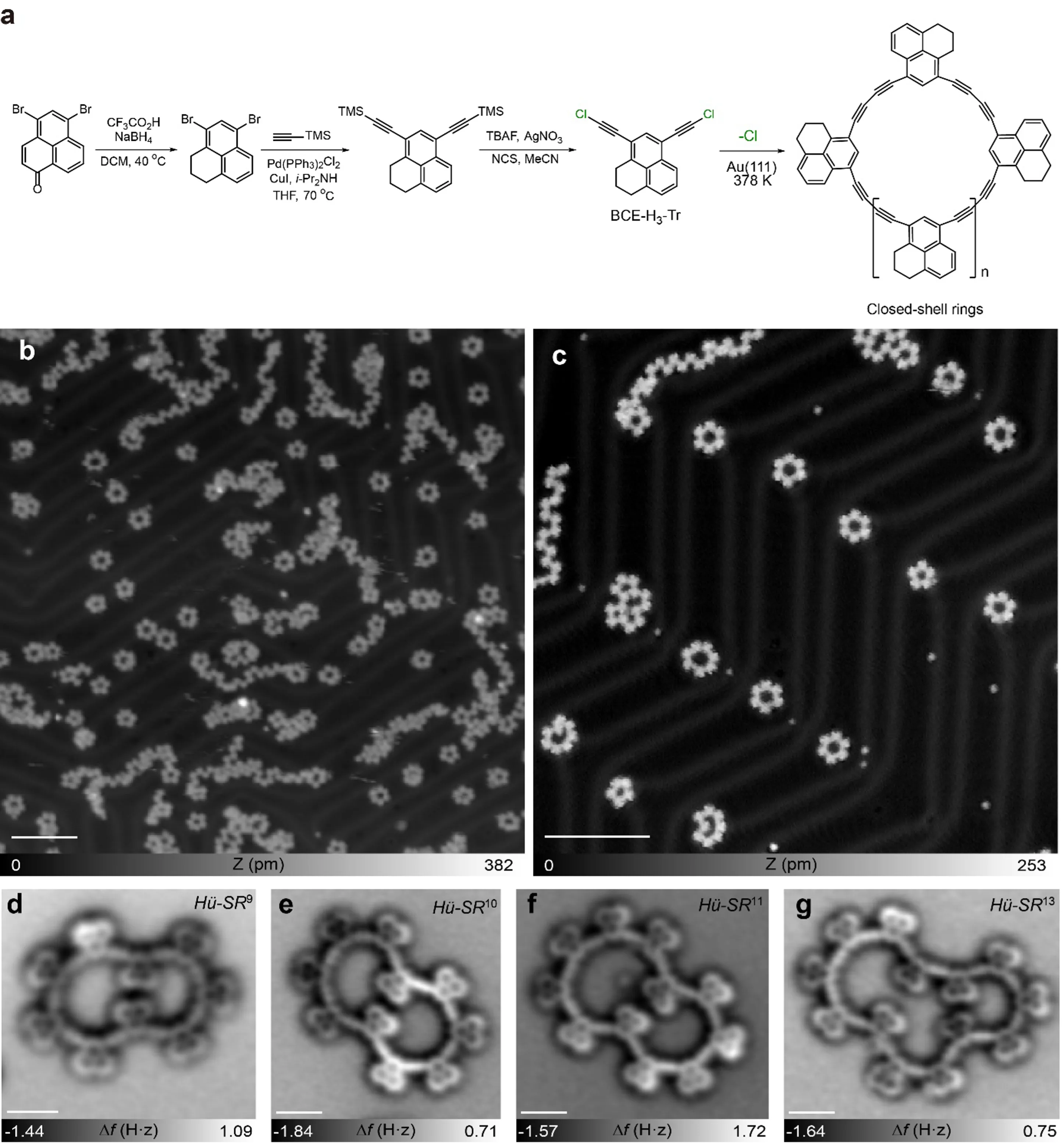
Experimentally, the rings were assembled on a gold substrate from individual [2]triangulene building blocks — tiny triangular pieces of graphene with unpaired electrons at their edges. Scanning tunneling spectroscopy revealed how electronic states depend on ring size, and multireference calculations confirmed the picture. This approach allows designing magnetic materials with tailored properties simply by changing the number of links in the ring.
The magnetic carbon round dance is not just a pretty analogy but a real platform for future quantum technologies: qubits, spin logic elements, and sensors could be built from these rings. And once again, a rule discovered for aromatic molecules finds new life in the world of quantum magnetism.
Aromaticity is a concept from organic chemistry describing the special stability of cyclic molecules with 4n+2 π-electrons. Now it also governs magnetic order in carbon rings.
In Robert Ibatullin's novel 'The Rose and the Worm,' quantum computers use exotic states of matter — carbon spin rings could be a real step toward such devices.