Gas Clouds Dance Around the Galactic Center express
In the very center of the Milky Way, hidden behind a thick veil of dust, lies a giant accumulation of gas — the Central Molecular Zone. You can't see it with the naked eye: dust absorbs visible light, much like dense fog hides the lights of a city. But radio waves and infrared radiation pass through this veil, allowing astronomers to make out individual clouds.
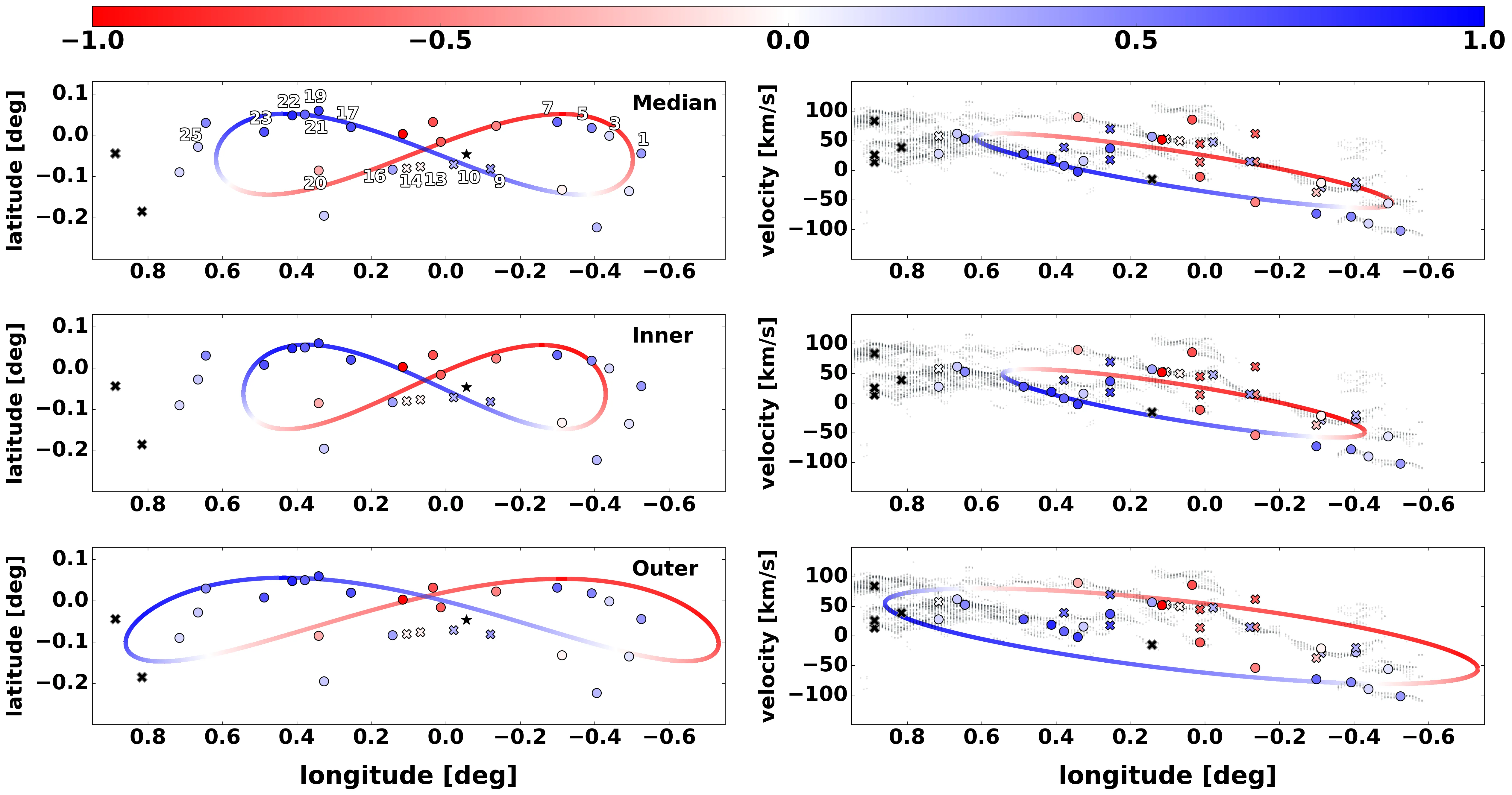
Previously, scientists knew only the approximate positions of these clouds on the sky but couldn't tell which were nearer and which farther. Now, by combining data from various telescopes, from radio observations to X-ray flares, researchers have calculated the likely position of each of the 31 clouds in three-dimensional space. It turns out that most clouds lie on the near side of the galactic center, rather than being evenly distributed.
These orbits are not perfectly circular: their major axes range from 72 to 146 parsecs (one parsec is about 3.26 light-years). So the largest of these "rings" stretch across hundreds of light-years. This picture helps explain how gas gradually loses energy and spirals inward toward the supermassive black hole at the center, feeding its accretion disk.
The new three-dimensional map is an important step toward understanding the life cycle of matter in the galactic center. As clouds come together, they can collide and compress, triggering the birth of new stars. And some of the gas will eventually fall into the black hole, causing a bright flare. Now astronomers can better predict where and when this will happen.
Original abstract
as written by the authors arXiv:2603.23327
The 3D structure of The Milky Way's Central Molecular Zone (CMZ) informs our understanding of star formation cycles, black hole accretion, and the evolution of galactic nuclei. However, a comprehensive 3D model has remained elusive, as no singular dataset nor theory contains the requisite information to describe the orbital motion of the gas. We implement a Bayesian framework to flexibly combine datasets across the electromagnetic spectrum for molecular clouds in our CMZ catalog. We develop near/far metrics for each dataset, including dust extinction, absorption, stellar densities, X-ray echoes, and proper motions; and report a posterior positional probability density function (PPDF) for each cloud. We then use the posterior PPDF distributions for all CMZ clouds to search for a best fitting x$$_2$$ orbit. We find that no single orbit is a perfect fit, but the structure can overall be represented by nested x$$_2$$ orbits, with major axes ranging from about $$72 < a < 146$$ pc. We also present projected line of sight distance estimates for all 31 clouds in the catalog. Our results highlight asymmetries along the line of sight, with most clouds lying on the near side of the Galactic Center, and agree overall with current near/far assumptions for most CMZ clouds, including those in the Sgr A region, which may be much closer to the center. We conclude that the CMZ can be well-described by x$$_2$$ orbital families, and that the overall gas distribution is more complex than a single closed or open elliptical orbit.
If our Sun were located in the Central Molecular Zone, the night sky would be dotted with thousands of bright stars, and gas clouds would obscure entire constellations.
In Isaac Asimov's novel "Foundation," the galactic center is described as a place where stars are so densely packed that night is as bright as day. The new map shows that the real galactic center is even more chaotic.