Superconductivity in Graphene: A Dance of Electrons express
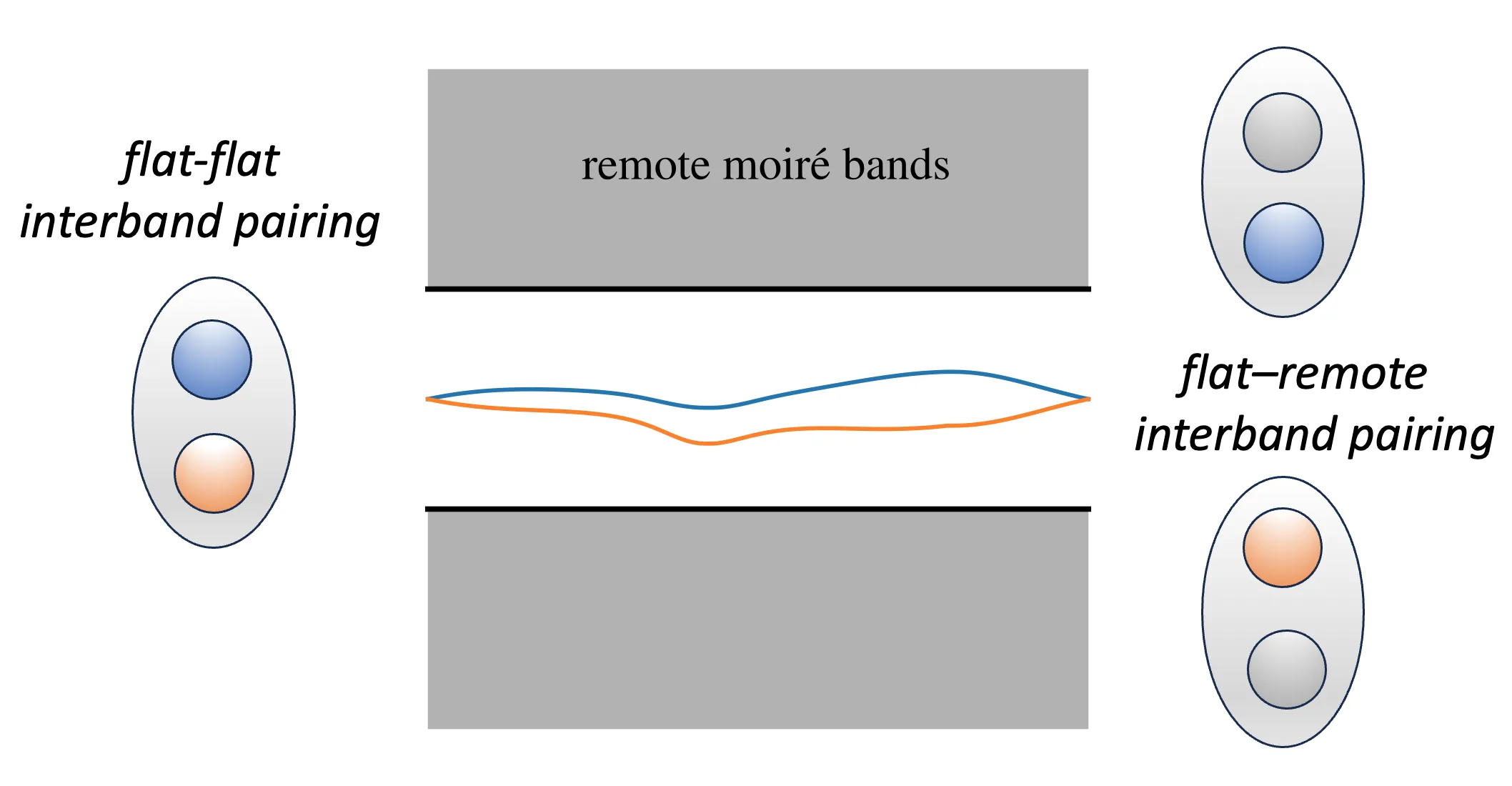
A sheet of graphene one atom thick is twisted at a small angle, and it starts behaving like a layered pie with layers slightly rotated relative to each other. At a certain twist angle, this material becomes a superconductor: electrons begin to move in pairs, like dancers in a waltz, without losing energy. But what exactly happens inside has remained a mystery.
In the new work, scientists peered into this 'dance' using two different tools: tunneling spectroscopy, which takes a 'snapshot' of electronic states, and measurements of superfluid stiffness — how strongly the superconducting state resists changes. It turned out that electron pairs do not form a simple uniform sea but a density wave with finite momentum — a so-called pair density wave state. It's as if the dancers moved not in a circle but in waves rolling onto the shore.
Moreover, these same excited electrons affect superfluid stiffness: at low temperatures, it is suppressed roughly as the square of the temperature. The scientists predict that by changing the electron density or applying an electric field, one could enhance the residual current at zero voltage while simultaneously weakening the stiffness. This provides a direct way to test the theory in future experiments.
Original abstract
as written by the authors arXiv:2603.24766
Superconductivity in twisted graphene is probed by tunneling spectroscopy and superfluid stiffness, two observables that access the same order parameter from complementary perspectives. We show that a finite-momentum pair-density-wave (PDW) state, consistent with reported Kekul\'e signatures, reconciles substantial low-energy tunneling weight with an approximately $$T^2$$ suppression of the low-temperature superfluid stiffness. The PDW order produces a Bogoliubov Fermi surface and finite zero-bias conductance. The same gapless quasiparticles also enter the geometric superfluid response, yielding a low-temperature stiffness suppression that persists in the flat-band limit. We further predict that, under density or displacement-field tuning, enhanced residual zero-bias conductance should accompany reduced low-temperature stiffness, providing a direct experimental link between tunneling spectroscopy and phase rigidity in twisted graphene.
Superconductivity in twisted graphene occurs at a twist angle of about 1.1 degrees: this is called the 'magic angle.' At such a twist, the layers form a moiré pattern, similar to what you see when looking through two sheets of mesh.
In Neal Stephenson's novel 'The Diamond Age,' materials with programmable properties are described, where electronic states can be tuned, much like in twisted graphene.