Ke Wang

6 articles · 30 co-authors · latest: 2026-08-02
895 citations · h-index 14 · 30 papersData: Semantic Scholar

We have retold 6 papers by this author. 1 of them with a full read. most often about: quantum computer, computational fluid dynamics, turbulence. 30 co-authors across our retellings.

Links in the knowledge graph
Vortices on the Quantum Stage
Two vortex rings launched one after the other pass through each other and swap places. This dance, first seen in the 19th century with smoke rings, has now been reproduced on a quantum processor. Vortices are the actors on a quantum stage where time plays the role of an extra dimension.
Mesoscale2026-02-112 minarXiv:2602.10554express
A Tiny Bridge Opens the World Inside a Crystal
Twisted layers of atoms in a material form a pattern of tiny regions, domains, each of which can be electrified in one of two directions, like a compass needle pointing north or south. Previously, such materials were studied only as a whole, measuring thousands of domains at once, and their collective behavior was like a choir where individual voices are not heard.
Stellar2026-03-042 minarXiv:2603.03732express
Stellar Passports: How a Neural Network Reads Age and Mass from Light
The light of every star is its unique passport, but the entries are written in the language of spectra and colors. For old giants, such documents are almost indistinguishable: their spectra overlap, and deciphering the details by hand was practically impossible.
Superconductivity2026-03-251 minarXiv:2603.24766express
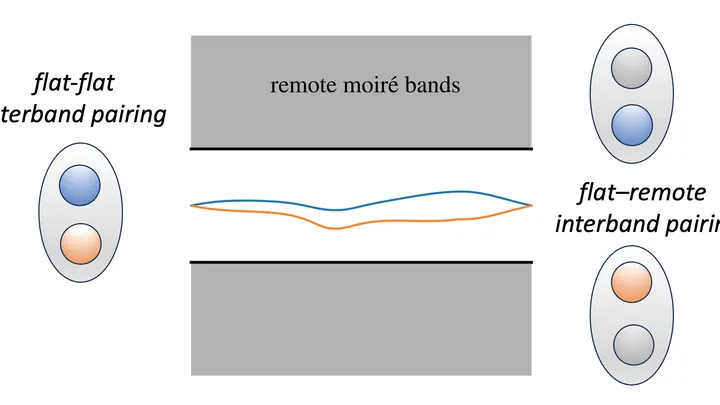
Superconductivity in Graphene: A Dance of Electrons
A sheet of graphene one atom thick is twisted at a small angle, and it starts behaving like a layered pie with layers slightly rotated relative to each other. At a certain twist angle, this material becomes a superconductor: electrons begin to move in pairs, like dancers in a waltz, without losing energy. But what exactly happens inside has remained a mystery.
The Underground Guardian of Purity
A huge pool of clear liquid is hidden deep underground. Inside, there is nothing but a pristine 'broth' that flashes with faint light when an invisible particle flies through. This is the JUNO detector—20,000 tons of liquid scintillator built to hunt for neutrinos. The main enemy of such a hunt is not darkness but its own noise.
Galaxies2026-08-022 minarXiv:2608.01052express
Bubbles in Cosmic Foam: A New Look at the Breathing of Stars
A pot of boiling porridge: bubbles burst, steam escapes, and everything gets mixed up. Massive stars in giant gas clouds behave in much the same way. Their radiation and stellar winds blow out enormous cavities, molecular bubbles, scattering material all around.