A Layered Crystal Learns to Catch Light express
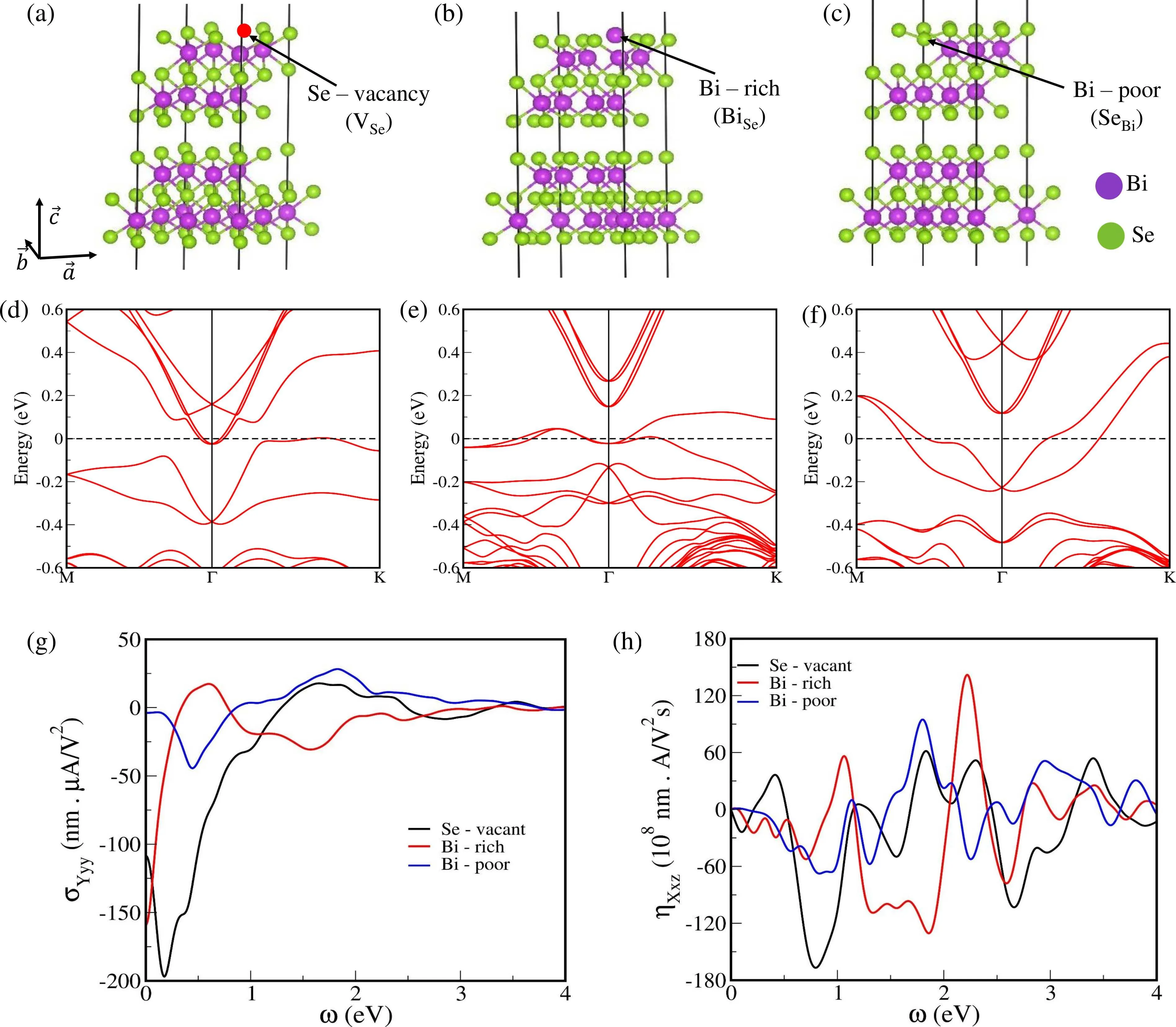
The crystal bismuth selenide (Bi₂Se₃) is symmetric by itself, like a neatly stacked sandwich: flip it over, and nothing changes. But twist one layer slightly relative to the other, and the symmetry breaks. The material begins to 'feel' which side the light comes from and responds with an electric current.
The authors tested three ways to break the symmetry: rotating the layers by an angle of 21.78°, adding a point defect (removing a selenium atom), and applying an external electric field. In all cases, a so-called shift current emerged — a direct current that flows while the light is on. Its magnitude turned out to be comparable to the best two-dimensional materials, such as GeS.
Such a current is especially interesting for the terahertz range — between microwaves and infrared light. There, simple sources and detectors are scarce, but here the material itself can act as an antenna, converting light into current. In the long run, this leads to new solar cells and fast optoelectronics.
The angle of 21.78° is not random: at this angle, the two layers first form a periodic superlattice, like two fences with different spacings that align only after several spans.