Magnetic Pattern from Vanadium Triangles express
A woven basket made of willow twigs holds its shape thanks to the interweaving. A similar pattern, triangles linked into a flat network, has been found in a new crystal with the formula Cs₃V₉Te₁₃. Here, vanadium atoms form two sets of triangles that pierce each other like threads in fabric.
This pattern is not just pretty: it forces electrons to move along special "flat" energy pathways. On such pathways, electrons lose their usual mobility and begin to strongly influence each other. As a result, the material becomes a magnet with unusual behavior: when cooled to 47 K (minus 226 °C), a spin-density wave emerges — an ordered magnetic state akin to ripples on water. Even higher, around 350 K, hints of short-range magnetic order appear, as if spins start to align but haven't yet fallen into formation.
Pressure also changes the material's character: by compressing the crystal, one can bring it to a quantum critical point — a state where the slightest perturbation switches properties. This resembles tuning a musical instrument: tighten the string a bit more, and the sound changes.
Such a crystal is a rare find. It combines flat energy bands, magnetism, and pressure sensitivity. Materials like this could be useful in future electronics, where precise control over electrons is crucial.
Original abstract
as written by the authors arXiv:2603.27682
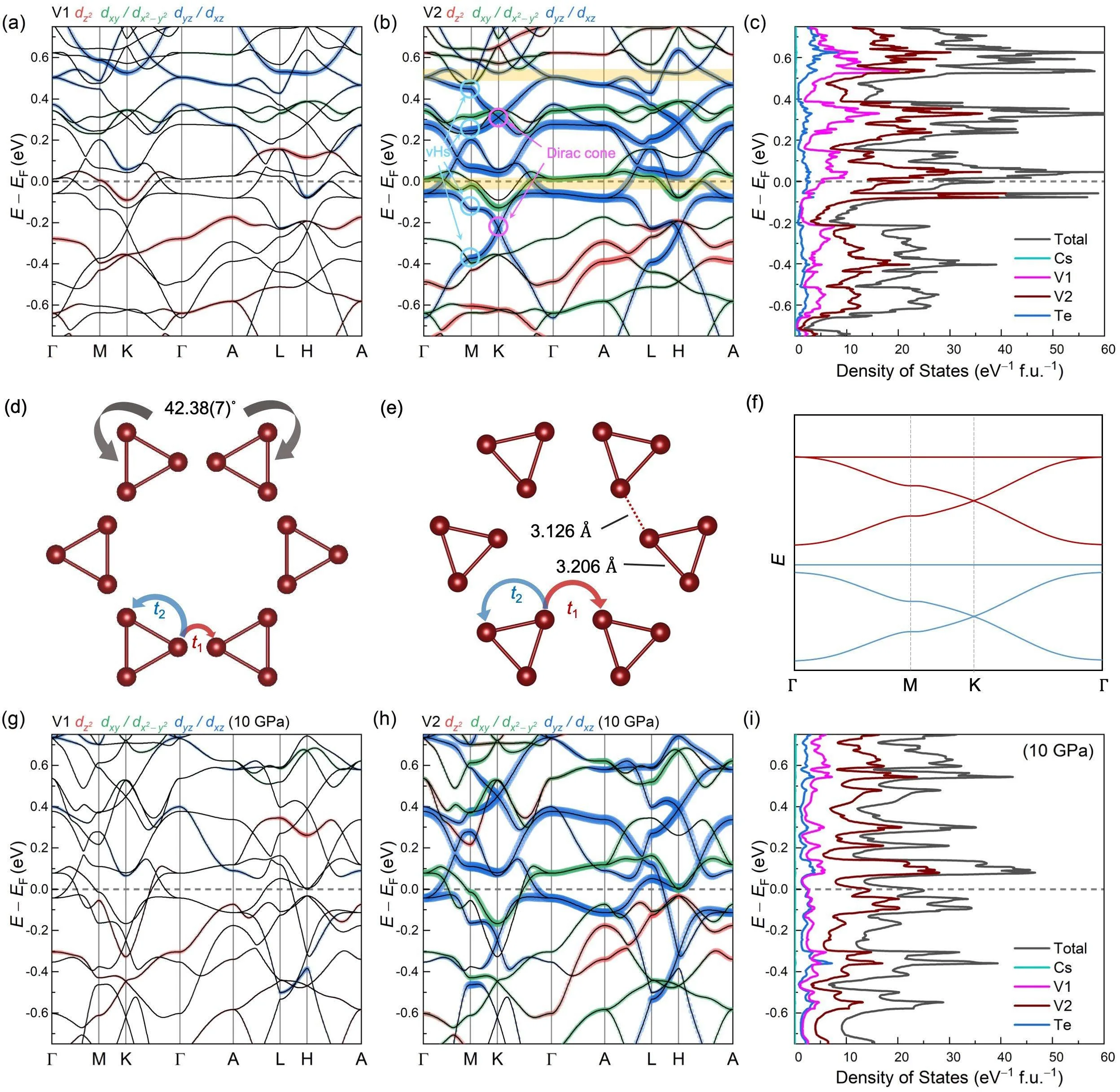
Correlated electron systems with topological flat bands show great promise in exploring exotic quantum phenomena. However, such crystalline materials remain rare. Here we report the discovery of a novel material, Cs$$_3$$V$$_9$$Te$$_{13}$$, which unexpectedly exhibits magnetism and significant electron correlations. The crystal structure features two interpenetrating sets of vanadium triangles that can be linked with an ideal kagome lattice. The physical property measurements demonstrate a cascade of correlated electron phenomena, including quasi-two-dimensional bad metal, non-Fermi-liquid behavior, antiferromagnetic spin-density-wave transition at $$T_\mathrm{N}$$ = 47 K, possible short-range spin ordering at $$\sim$$350 K, a large Sommerfeld coefficient of 246 mJ mol-fu$$^{-1}$$ K$$^{-2}$$, and pressure-induced quantum criticality. These correlated electron behaviors are associated with the topological flat bands at the Fermi level, the latter of which are generated from the V2 sublattice in terms of a bipartite kagome model. Our findings establish Cs$$_3$$V$$_9$$Te$$_{13}$$ as a brand new correlated matter that synergistically combines flat-band physics and tunable properties.
The kagome pattern formed by vanadium atoms appears in Japanese basket weaving and traditional ornaments. In physics, it is known for creating "flat" energy bands where electrons barely move but interact strongly.
In Greg Egan's novel Schild's Ladder, physicists explore exotic states of matter to build new technologies — somewhat akin to working with quantum-critical materials.