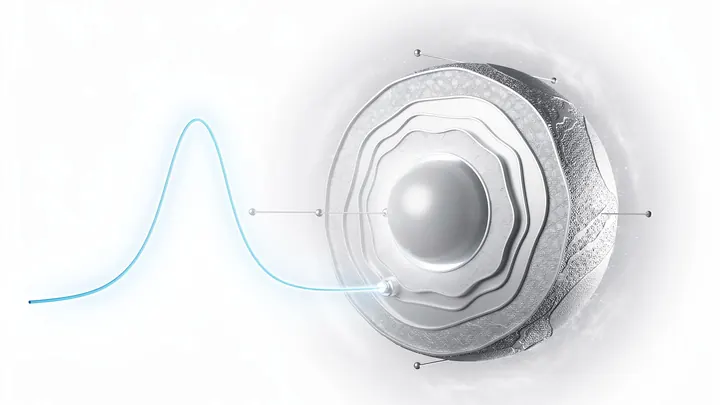
A free electron is an electron that is not bound to an atom, molecule, or crystal lattice. In solid-state physics, it serves as the ultimate reference point: the mass of a free electron (m₀) is the baseline against which the 'effective mass' of electrons moving through a crystal is measured. When an electron travels through a semiconductor or metal, its response to electric fields is altered by the periodic potential of the lattice, making it behave as if it had a different mass — sometimes lighter, sometimes heavier, and in exotic cases even negative. The free electron is the clean, unperturbed case from which all these deviations are defined.
History
The concept of effective mass was introduced in the 1920s by Rudolf Peierls and Felix Bloch as quantum mechanics was being applied to solids. The free electron itself was identified earlier, with J.J. Thomson's discovery of the electron in 1897 establishing it as a fundamental particle.
How it works
In a vacuum, an electron obeys Newton's laws with its rest mass, and its energy-momentum relation is simply E = p²/2m₀. Inside a crystal, the electron's energy-momentum relation becomes more complex, with band structures and gaps. Physicists approximate this by writing E = p²/2m*, where m* is the effective mass — a parameter that captures how the lattice modifies the electron's dynamics. The free electron mass m₀ is the constant against which m* is compared, often expressed as a ratio like m*/m₀ = 0.5 or 1.2.
In practice
The free electron mass is used as a standard in semiconductor physics, where engineers design transistors and diodes by tuning effective masses through material choice and doping. It also appears in the calculation of plasma frequencies and in the Drude model of electrical conduction in metals.
Fun fact
In graphene, electrons behave as massless particles with an effective mass of zero, moving at a constant speed of about 1/300 the speed of light — a behavior that earned its discoverers the 2010 Nobel Prize in Physics.
In a pot of water, microscopic spheres, colloidal particles, are floating. Each sphere is coated with long polymer chains that look like a brush and carries an electric charge. If you get the temperature and solution composition right, the spheres start arranging themselves into ordered patterns — crystals.
In a tight row of atoms, spaced closer than the wavelength of light, a remarkable state hides. The excitation is distributed among all particles so that their radiation cancels itself out. This quantum 'silence' is an ideal vault for a photon: it can be stored there hundreds of times longer than usual.
A flashlight beam cuts through fog. The denser the fog, the more the light scatters and the later it reaches your eye. A similar principle works with fast radio bursts — mysterious, super-powerful pulses from distant galaxies. As their radio waves travel through space, they interact with free electrons — particles stripped from atoms.
In 1998, physicists caught neutrinos doing something astonishing: the particle changes its type on the fly. That is only possible if it has mass. This became the only laboratory proof of physics beyond the Standard Model. But exactly how much a neutrino weighs remains a mystery.
The core of a neutron star can be likened to a taut string of super-nuclear density. Sound traveling along it is the oscillation of pressure, whose speed $$c_s$$ betrays the stiffness of matter. New research shows that this cosmic string does not hum monotonically.
Two thin sheets with honeycomb patterns were stacked and slightly rotated, creating a new pattern — a moiré, like the shimmer of silk. The electrons in the experiment behaved similarly: they arranged themselves into two layers, with one layer rotated exactly 30 degrees relative to the other.
A palm hovering over a hot stove feels the heat even when the surrounding air seems cool. Something similar happens to electrons in the Aharonov–Bohm effect: the particle senses an electric voltage even though it enters a region where the field has already been switched off.
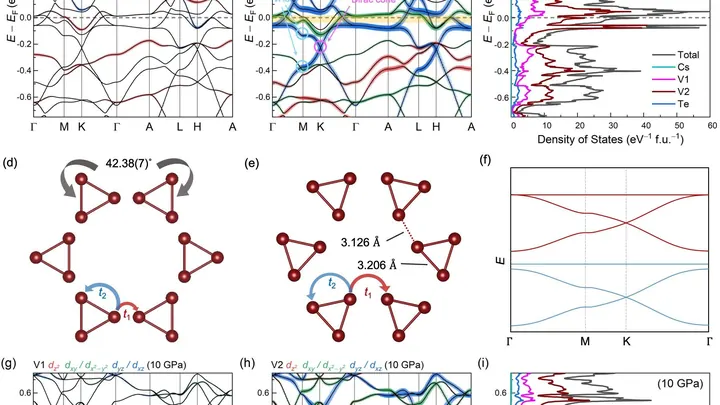
A woven basket made of willow twigs holds its shape thanks to the interweaving. A similar pattern, triangles linked into a flat network, has been found in a new crystal with the formula Cs₃V₉Te₁₃. Here, vanadium atoms form two sets of triangles that pierce each other like threads in fabric.
This pattern is not just pretty: it forces electrons to move along special "flat" energy pathways.
Neutrinos are tiny particles that zip through Earth, barely noticing it. In the MicroBooNE experiment, they are caught in a tank of liquid argon. When a neutrino strikes an argon nucleus, it produces an electron and protons, like splashes from a stone thrown into water.