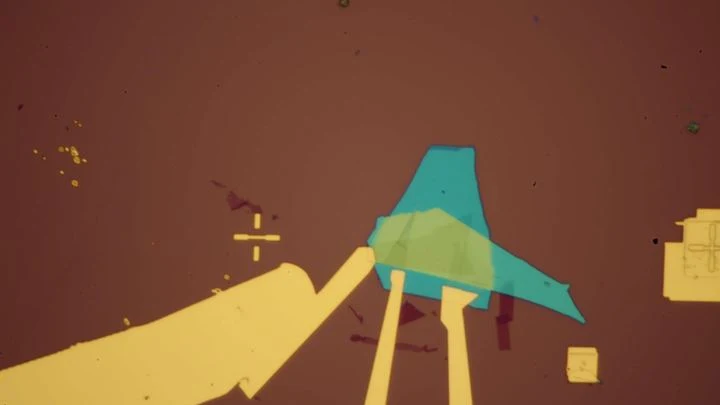
A Weyl semimetal is a crystalline material in which electrons behave as massless particles, mimicking the behavior of particles in curved spacetime. In these materials, the energy of electrons depends linearly on their momentum, just like photons, but with a much lower speed. This unusual property arises from the material's electronicband structure, where two non-degenerate bands touch at points called Weyl nodes. Near these nodes, the electrons are described by the Weyl equation, the same equation used in high-energy physics for massless fermions.
History
The concept of Weyl fermions in condensed matter was proposed by Hermann Weyl in 1929 for particle physics, but the first experimental observation of Weyl semimetals in crystals was reported in 2015, with tantalum arsenide (TaAs) being a prominent example.
How it works
In a Weyl semimetal, the conduction and valence bands cross at discrete points in momentum space, called Weyl nodes. These nodes come in pairs of opposite chirality (left-handed and right-handed). Electrons near a Weyl node behave as massless particles, with their spin locked to their momentum. The linear dispersion means that the effective mass of the electrons is zero, and they move at a constant speed. The chirality of the nodes leads to a phenomenon called the chiral anomaly, where charge can be pumped between nodes of opposite chirality in the presence of parallel electric and magnetic fields.
In practice
Weyl semimetals are studied for potential applications in spintronics and quantum computing, as their unique electronic properties could enable dissipationless current flow and novel topological devices.
Fun fact
In a Weyl semimetal, electrons can behave as if they are in a gravitational field, allowing the simulation of curved spacetime phenomena in a laboratory crystal.
The quantum world is full of surprises: swap two electrons, and their combined wavefunction just changes sign; swap two photons, and nothing happens at all. But there are particles that behave very differently when exchanged, as if they remember being swapped. These particles are called anyons, and they can only exist in a two-dimensional world.
Two electrons that leave a metal needle tip almost simultaneously start to repel each other, like two people trying to squeeze through a narrow door at the same time. The closer they are, the more they get in each other's way.
Electrons in a solid usually either run freely (metal) or are locked in place (insulator). But sometimes strong mutual repulsion locks them into a halfway state: charges stand still, while spins, tiny magnetic arrows, continue to live their own life. This is called a Mott insulator.
In the world of two-dimensional materials, states sometimes emerge that are as extraordinary as they are fragile. One of them — the fractional anomalous Hall crystal (FAHC)—is like a quantum centaur: half ordered lattice, half topological liquid.
An ocean permeates all of space, yet remains invisible to us. This ocean is dark matter, and the waves on its surface are particles called axions. They are so light and elusive that they pass through Earth without noticing it. But if these waves crash against a shore made of a special material, they might leave a trace — a tiny electric current.
Imagine a carousel with two types of seats: some spin clockwise, others counterclockwise. If you push all of them at once, the carousel jerks but stays in place. That's how a Weyl semimetal crystal works: electrons are born in pairs—'left' and 'right'—and their contributions to current cancel each other, like two identical motors running in opposite directions.
Two thin sheets with honeycomb patterns were stacked and slightly rotated, creating a new pattern — a moiré, like the shimmer of silk. The electrons in the experiment behaved similarly: they arranged themselves into two layers, with one layer rotated exactly 30 degrees relative to the other.
A single-atom-thick sheet of tungsten telluride is like thin foil: electrons can't pass through because there's a band gap between their possible states, like a moat you can't jump across. Add two more layers, and the moat disappears; the material becomes a metal, and current flows. Add more layers, and the properties change again, as if someone is flipping modes with a single button.
In the quantum world, electrons can behave like waves. If you create the right conditions for them, these waves start to feel something akin to gravity. In crystals known as Weyl semimetals, electrons move as if they were massless, and their energy depends on direction, like a tilted cone.
A mosaic floor made of many small tiles, each turned in a different direction. It seems that any pattern trying to cross such a floor would get scrambled and vanish. That's how people usually think about disorder in crystals: if atoms aren't arranged in a perfect lattice, delicate quantum effects should fall apart.
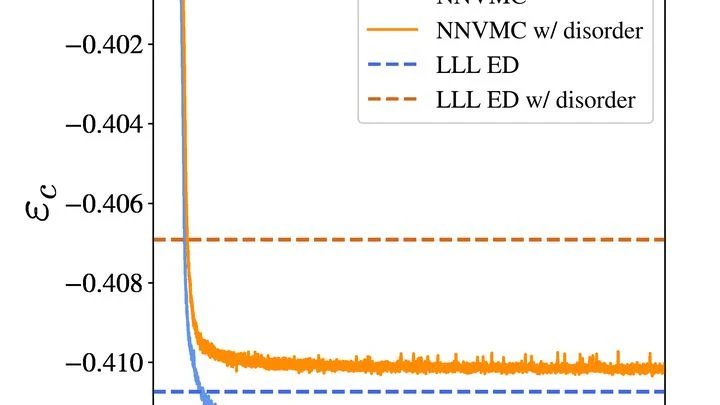
In a strong magnetic field, electrons trapped in a thin layer sometimes arrange into a regular pattern, like guests at a crowded party who find a spot where no one jostles them. This order is called a crystal, although it is not ice or salt, but the electrons themselves, frozen in place.
An ordinary flash drive stores bits in electron traps, but you can only read them through a separate wire and amplifier. In the new development, the same piece of the semimetal tellurium plays both the role of storage and the light bulb.
Heat and electricity usually go hand in hand, but making heat turn into current is no easy task. The material GdTe3, a layered crystal with a metallic sheen, when cooled to 20 kelvins (that's −253 °C) and placed in a strong 13.5-tesla magnetic field, showed something unexpected: its ability to generate electricity from heat shot up by 1075%.
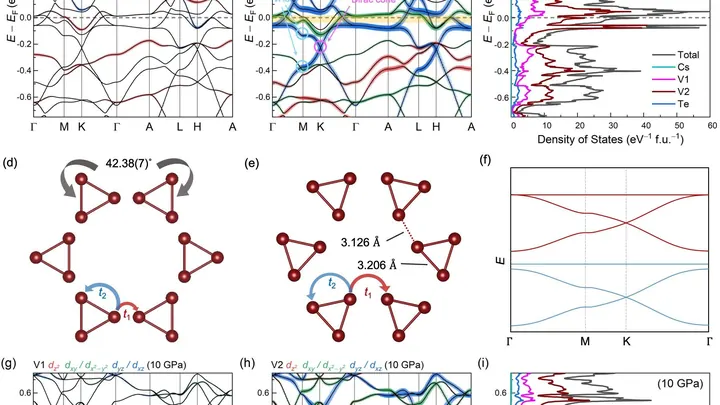
A woven basket made of willow twigs holds its shape thanks to the interweaving. A similar pattern, triangles linked into a flat network, has been found in a new crystal with the formula Cs₃V₉Te₁₃. Here, vanadium atoms form two sets of triangles that pierce each other like threads in fabric.
This pattern is not just pretty: it forces electrons to move along special "flat" energy pathways.
Drop a stone into a pond — the ripples spread evenly and then fade. Gravitational waves born from black hole mergers behave differently: even after the main wave passes, a faint 'tail' remains. It's as if, after the ripples on the water, a tremor persists for a long time, caused not by the stone itself but by how the water 'remembers' the impact.
A metal is a sea of electrons that move almost freely, colliding only occasionally. But in some materials, this sea suddenly becomes viscous and unpredictable: electrons stop behaving like independent particles. Physicists call this state 'non-Fermi liquid,' and it remains a puzzle.
In two-dimensional crystals, electrons and holes, quasiparticles corresponding to the absence of an electron and carrying positive charge, attract each other, forming bound pairs called excitons. When cooled strongly, as thermal fluctuations die down, the motions of many excitons can synchronize, like a coordinated dance.
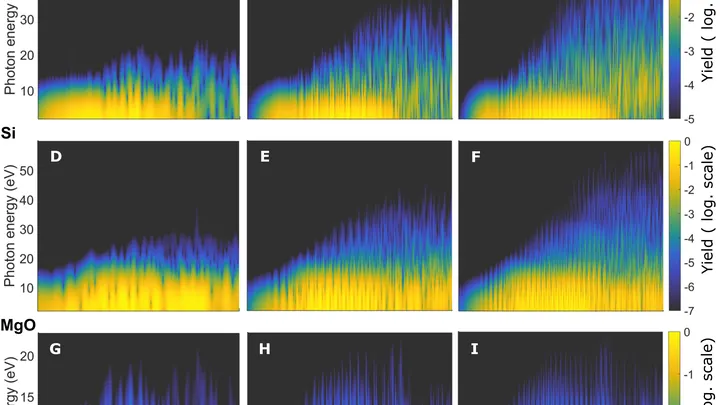
A sharp tug on a twisted cord sends a spiral wave along it. Similarly, an ultrashort laser flash in a RhSi crystal gives birth to light instantly twisted into a three-dimensional corkscrew.
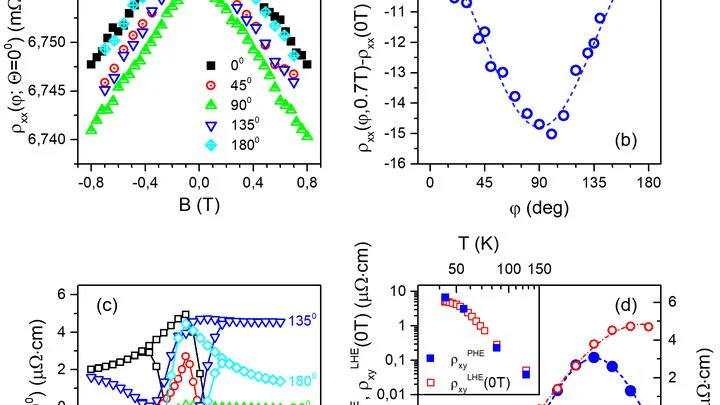
Heat one end of a conductor and keep the other cold, and electrons start flowing from hot to cold. Usually, this creates a voltage along the conductor, like water running down a tilted trough. But in some materials, electrons veer sideways, and the voltage appears across the conductor.
An atomic nucleus usually has a well-defined shape — elongated like a melon or flattened like a pumpkin. But silicon-30 behaves differently: it seems unable to make up its mind.
A flat sheet of material just one atom thick can conduct current only along its edges, like water flowing along the rims of a tray rather than across its middle. In a new study, physicists showed that such edge "channels" can be rearranged simply by rotating an invisible magnetic axis within the sheet.
A material just one atom thick and of record purity — only one foreign atom per million — becomes the setting for a remarkable phenomenon. When cooled to near absolute zero, the electrons inside, like musicians in an orchestra, freeze into a strict order, forming a crystal. This state, predicted by Eugene Wigner nearly a century ago, has now been observed in detail.
Electrons in a conductor usually behave like a gas: they dart around chaotically, collide, and don't hold formation. But if you spread them far apart and cool them down, their mutual repulsion can force them into place, like attendees in an overcrowded hall who settle into every other seat.