Möbius Strip in Space: How Magnetic Fields Heat Plasma express
Space plasma is not a calm gas but a boiling soup of charged particles threaded with magnetic fields. These fields behave like stretched rubber bands: sometimes they snap and immediately reconnect, but in a different configuration. This process, called magnetic reconnection, releases enormous energy.
Scientists built a computer model of such a break under space-like conditions: the plasma there is very rarefied, and particles rarely collide. To save computational power, they devised a clever trick: they folded the simulation domain into a Möbius strip. This allowed them to double the speed of calculations without losing accuracy.
The calculations showed that almost all the energy is released not immediately but at a late stage, once the instability has fully developed. Magnetic energy converts into two forms: fast plasma flows and heating. Moreover, heating is uneven — inside magnetic 'islands' (regions where the field loops back on itself) the plasma heats more strongly, while at break points (so-called X-points) energy splits almost equally between motion and heat.
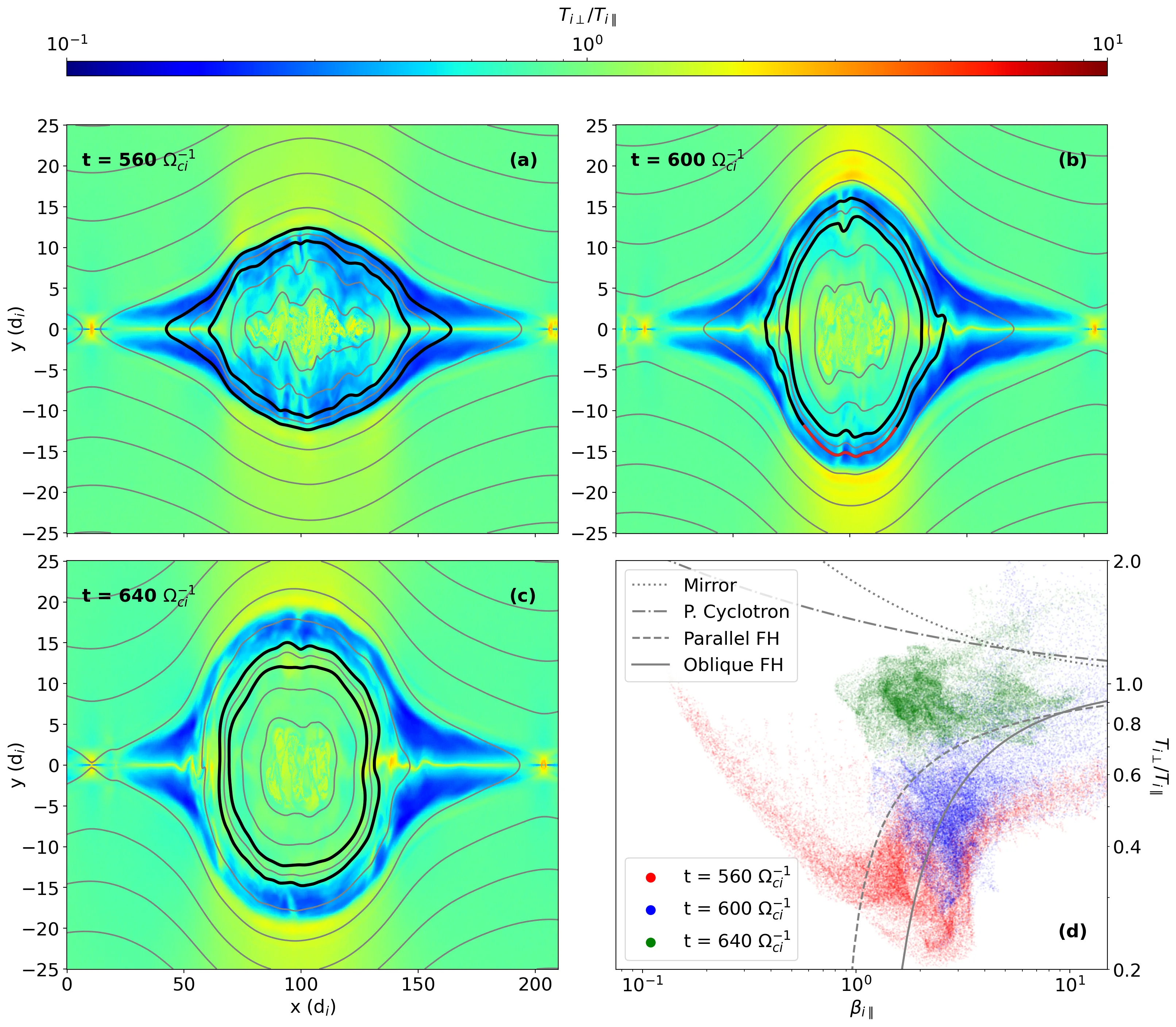
Another interesting detail: after reconnection, plasma becomes hotter along the magnetic field than across it. This temperature difference is maintained by compression of the islands, but at some point special waves (firehose instabilities) kick in, redistributing heat and equalizing temperature.
Such a mechanism helps explain why the solar corona is hotter than the Sun's surface, and how magnetic field energy turns into heat in distant astrophysical objects.
Original abstract
as written by the authors arXiv:2604.02901
This study focuses on energy conversion related to tearing-driven magnetic reconnection in the context of weakly collisional astrophysical plasmas. We present results from a two-dimensional hybrid particle-in-cell simulation employing novel periodic conditions with a topology akin to the M\"obius strip, which double the computation efficiency as compared to regular periodic conditions. Evaluation of the ion electric work rate ($$\mathbf{j}_i \cdot \mathbf{E}$$) and pressure strain interaction ($$\mathbf{P}_i : \mathbf{ abla u}_i)$$ shows that most of the energy conversion occurs during the nonlinear phase of the instability, where magnetic energy is transferred towards ion kinetic energy (bulk outflows) and internal energy (heating). These energy conversion rates are of the same order but inhomogeneous. Heating predominantly occurs within the magnetic islands, while near the X-points, nearly the same amount of magnetic energy is transferred to bulk plasma flow and heating. The reconnected plasma moreover exhibits an ion temperature higher parallel than perpendicular to the local magnetic field $$\mathbf{B}$$. This temperature anisotropy is sustained by the islands' contraction, but eventually gets regulated by kinetic firehose instabilities (parallel and oblique), and/or firehose-like processes, whose main effect is to redistribute the internal energy from the parallel to the perpendicular direction.
The Möbius strip in the calculations is not just a mathematical joke. It allowed scientists to halve computation time without losing model accuracy. There are no such strips in the real Universe, but the idea shows how unconventional geometry helps study space.