In 1920, Indian physicist Meghnad Saha combined thermodynamics and quantum mechanics to explain the solar spectrum. The essence is simple: in collisions within a hot gas, atoms can become ionized, i.e., lose electrons. The equation relates the concentrations of neutral atoms, ions, and electrons to temperature and pressure. It's like a balance between lotteries and prizes: the more expensive the prize (ionization energy), the fewer 'customers' (ions). The equation became the key to deciphering starlight.
History
Meghnad Saha, an Indian physicist and astrophysicist, derived the equation in 1920 while working on the theory of stellar atmospheres. He developed the ideas of Arthur Stanley Eddington and Karl Schwarzschild. Later, Irving Langmuir generalized the equation to multi-electron ionization, and Cecilia Payne-Gaposchkin used it to analyze the solar composition, proving the dominance of hydrogen.
How it works
It is applied in stellar spectroscopy: from the observed distribution of absorption lines of different ions, the electron temperature and density in stellar atmospheres are determined. Limitations: it assumes local thermodynamic equilibrium, which breaks down in rarefied nebulae or in the presence of strong non-thermal radiation sources.
In practice
Astrophysicists determine the temperature and chemical composition of stars from absorption lines in spectra, using ionization balance.
Fun fact
Using the Saha equation, it was first correctly determined that the Sun is mostly hydrogen, not iron, as previously thought.
14 seconds. That’s all it takes for a new code to weave the full spectrum of a star, from ultraviolet to near-infrared. This spectrum is not just a rainbow but a detailed tapestry of thousands of dark absorption lines, each left by a specific atom in the star's atmosphere.
Ten billion years ago, the universe was speckled with strange crimson sparks. The JWST spotted them in images at distant redshifts — compact sources blazing like entire galaxies yet no larger than a tiny central region. Astronomers nicknamed them “little red dots.” Their nature long defied explanation.
If you stick two identical thermometers into a pot of hot water, they'll both read the same, and we relax, thinking the temperature is measured correctly. But in a rarefied gas heated to millions of degrees, this trick stops working.
In a pot of boiling soup, tiny droplets of fat occasionally flare up — a hundred times hotter than the broth. That's roughly how future fusion plasma works: the bulk of ions heats to hundreds of millions of degrees, while a small admixture of "fast" particles (born from nuclear fusion) is accelerated even further.
A magnetic field in plasma resembles a stretched soap film: pressure from inside pushes it out, while surface tension pulls it in, giving it shape. Here too, magnetic pressure and tension forces balance each other.
Imagine a spring being compressed with tremendous force. The harder you press, the denser it gets, but at some point the compression stops being uniform — some parts give way more easily, others are stiffer. That's roughly how the matter inside a neutron star behaves — an object born in the flames of a supernova.
A balloon in your hand springs back equally in all directions. But a bottle of soda behaves differently: along the neck it is stiff, while across it is easily squeezed. This is roughly how pressure works inside some stars: it can be unequal in different directions. Such stars are called anisotropic, and their behavior has so far been described by disparate methods.
Water can be ice, liquid, or steam. Physicists call these states phases. In theory, each phase has its own measure — a way to describe how likely it is. But not every measure you can imagine occurs in nature. Some phases are real, while others are just mathematical illusions.
Scientists have found a simple criterion that separates reality from mirage.
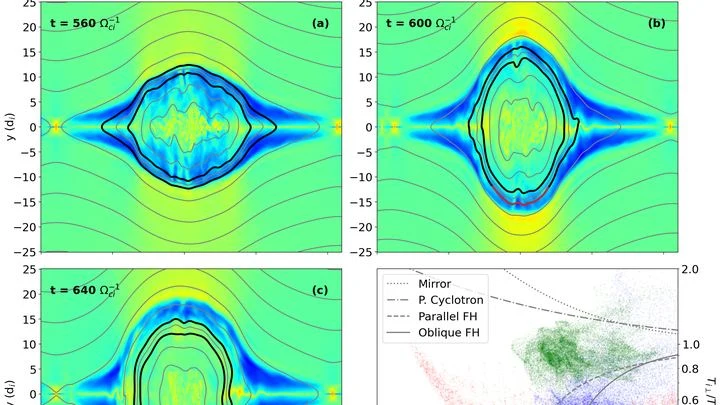
Space plasma is not a calm gas but a boiling soup of charged particles threaded with magnetic fields. These fields behave like stretched rubber bands: sometimes they snap and immediately reconnect, but in a different configuration. This process, called magnetic reconnection, releases enormous energy.
Plasma is a gas in which electrons are stripped from atoms, behaving like a soup of charged particles. To predict how such a soup flows and heats up, you need to know how particles collide and exchange energy.
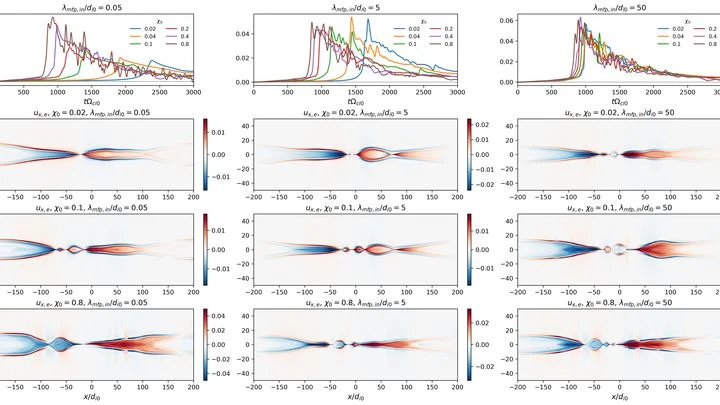
In plasma where some atoms remain neutral, magnetic field lines can rearrange at different speeds. This is like two rubber bands that are initially stuck together, then suddenly snap apart and contract, releasing energy.
The scorching gas streaming from the Sun is not a continuous flow but rather a soup of charged particles. In this soup, waves constantly boil up: electric fields flare and fade like ripples on water from a tossed stone. One such wave is the ion-ion acoustic wave.
In 1979, Su, Schrieffer, and Heeger proposed a model that explained the strange electrical properties of polyacetylene, an organic polymer that conducts electricity almost like a metal. Their chain consisted of carbon atoms connected alternately by single and double bonds.