The Pulsar's Invisible Neighbor express
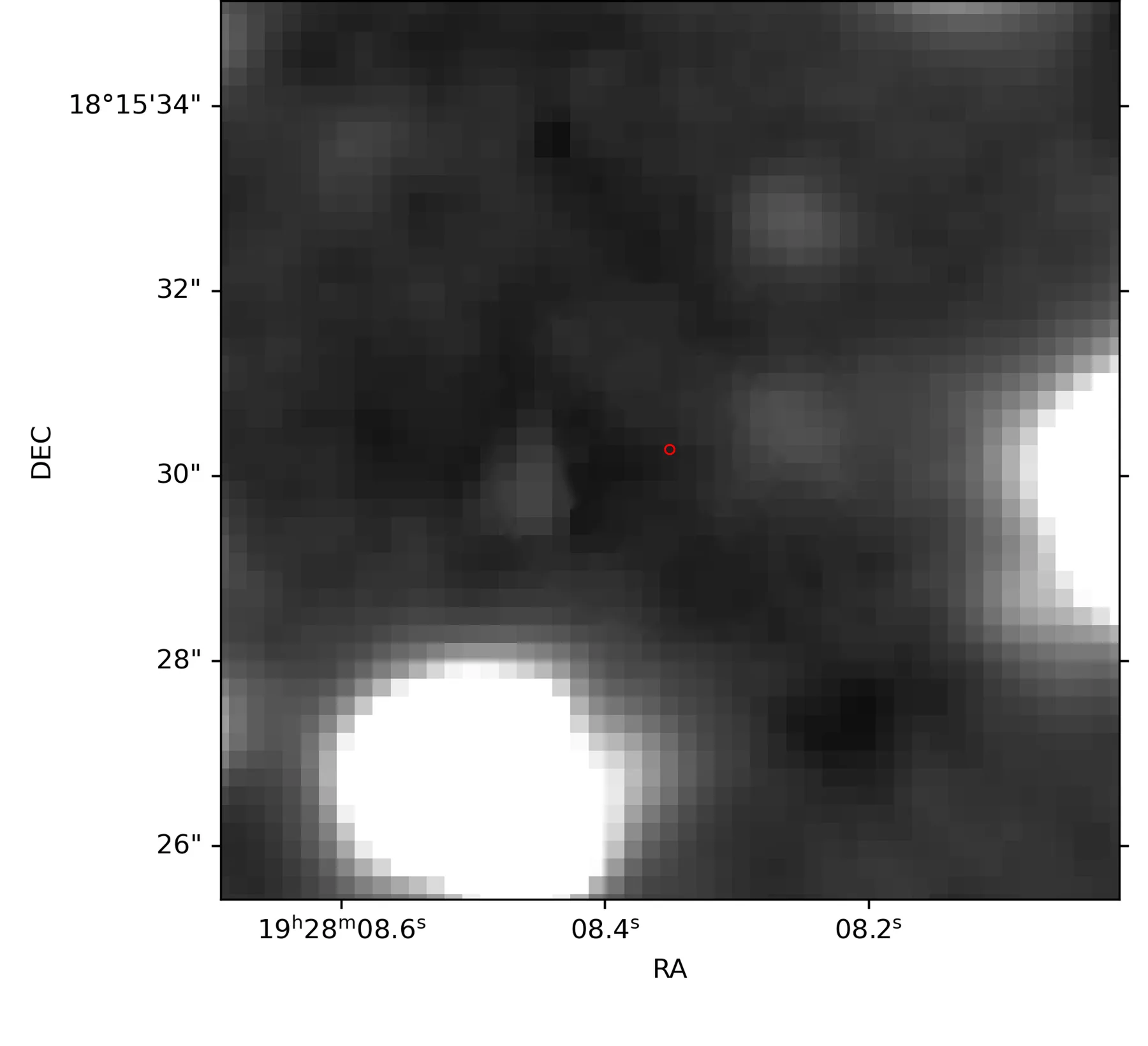
A pulsar is a dead star spinning at breakneck speed, sending out radio pulses like a lighthouse. But for PSR J1928+1815, the signal sometimes cuts out for 3.6 hours. Something is blocking the beacon. A companion star orbits the pulsar, and its shadow falls on us.
For a long time, astronomers thought the companion was a bare helium star: the core of a former star with its outer layers blown off. Such a star should shine brightly in the infrared. So they pointed the Keck Telescope at the pulsar, equipped with adaptive optics — a system that removes atmospheric blur, like a camera stabilizer. They looked deep, down to 21.3 magnitude in the Ks filter. And they saw nothing. Empty.
That leaves a white dwarf — a dense remnant of a star like our Sun. It's faint and invisible. But how does such a quiet neighbor create radio eclipses? There are two ideas. First: the white dwarf is still young and hot, blowing a wind — a stream of particles that absorbs the pulsar's radio waves. Second: the pulsar itself strips matter from the dwarf with its radiation. The first scenario is more plausible: after a certain stage in the binary's evolution, a white dwarf of about 1.2 solar masses is born, and it can blow a wind for several tens of thousands of years. That's enough to hide the pulsar.
So we've caught the system in a brief moment of its life. The wind will die down, and the pulsar will stop disappearing. That's why such pairs are rare: most are either already invisible to us or not yet born. PSR J1928+1815 is like a frame from a movie where a lighthouse flickers on and off in the fog of a foreign wind.
Original abstract
as written by the authors arXiv:2604.03385
PSR J1928+1815 is a 10.55 ms millisecond pulsar in a 3.6 hr orbit with a massive ($$1.0$$-$$1.6\,M_{\odot}$$) companion that produces extended radio eclipses. The companion, proposed to be a stripped helium star, is undetected in optical and infrared surveys. We present deep near-infrared imaging using Keck/NIRC2 with laser guide star adaptive optics. No source is detected at the pulsar position down to a $$5\sigma$$ limit of $$K_s \approx 21.3$$. Using stripped-star atmosphere models and conservative extinction estimates, we show that any plausible helium star companion would have been detected, ruling out this interpretation. A massive white dwarf (WD) companion remains consistent with the non-detection. We consider two possible origins for the eclipses: (1) absorption in a wind driven by a young, hot WD, and (2) material ablated from the WD by the pulsar. The former can naturally arise following Case BB mass transfer, which produces $$\sim 1.2\,M_\odot$$ WDs capable of sustaining winds of $$\dot{M} \gtrsim 10^{-12}$$-$$10^{-13}\,M_\odot\,{\rm yr}^{-1}$$ for $$\sim 10^4$$-$$10^5$$ yr, sufficient to obscure the pulsar at GHz frequencies. The latter requires efficient coupling of the pulsar's spin-down luminosity to the companion to drive the needed mass loss, which may be difficult to achieve. If the eclipse is powered by a WD wind, the system is likely observed in a short-lived phase; alternatively, if the companion is an older WD, the origin of the eclipsing material remains unclear. The apparent uniqueness of PSR J1928+1815 is consistent with a short detectability lifetime, though formation rate estimates remain uncertain.
Pulsar PSR J1928+1815 spins 95 times per second — faster than the blades of a kitchen blender.
In the series 'Star Trek,' pulsars were used as natural navigation beacons for starships.