The Pulsar's Invisible Neighbor express
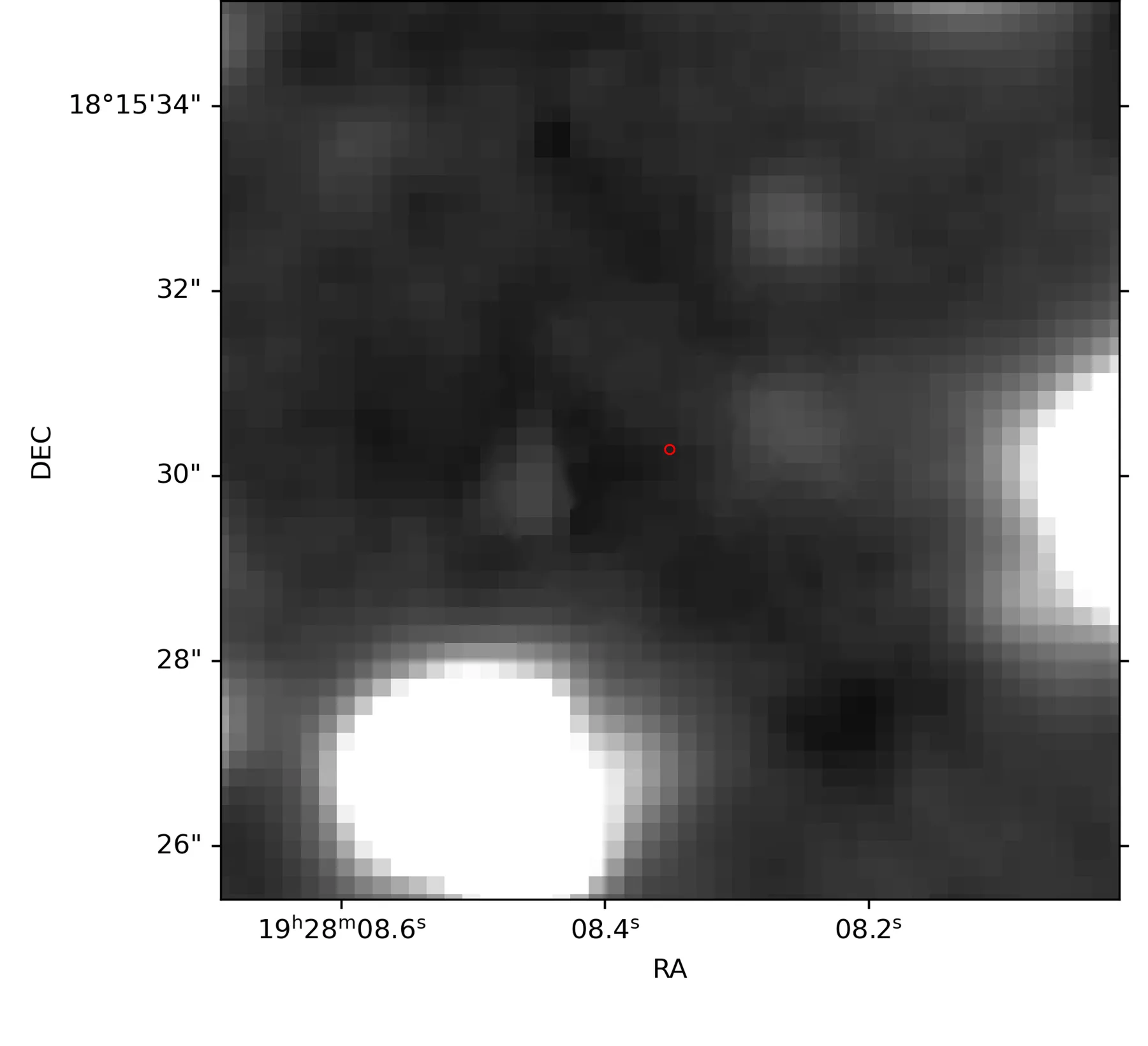
A pulsar is a dead star spinning at breakneck speed, sending out radio pulses like a lighthouse. But for PSR J1928+1815, the signal sometimes cuts out for 3.6 hours. Something is blocking the beacon. A companion star orbits the pulsar, and its shadow falls on us.
For a long time, astronomers thought the companion was a bare helium star: the core of a former star with its outer layers blown off. Such a star should shine brightly in the infrared. So they pointed the Keck Telescope at the pulsar, equipped with adaptive optics — a system that removes atmospheric blur, like a camera stabilizer. They looked deep, down to 21.3 magnitude in the Ks filter. And they saw nothing. Empty.
That leaves a white dwarf — a dense remnant of a star like our Sun. It's faint and invisible. But how does such a quiet neighbor create radio eclipses? There are two ideas. First: the white dwarf is still young and hot, blowing a wind — a stream of particles that absorbs the pulsar's radio waves. Second: the pulsar itself strips matter from the dwarf with its radiation. The first scenario is more plausible: after a certain stage in the binary's evolution, a white dwarf of about 1.2 solar masses is born, and it can blow a wind for several tens of thousands of years. That's enough to hide the pulsar.
So we've caught the system in a brief moment of its life. The wind will die down, and the pulsar will stop disappearing. That's why such pairs are rare: most are either already invisible to us or not yet born. PSR J1928+1815 is like a frame from a movie where a lighthouse flickers on and off in the fog of a foreign wind.
Pulsar PSR J1928+1815 spins 95 times per second — faster than the blades of a kitchen blender.
In the series 'Star Trek,' pulsars were used as natural navigation beacons for starships.