Heat Goes Sideways Under a Magnetic Field express
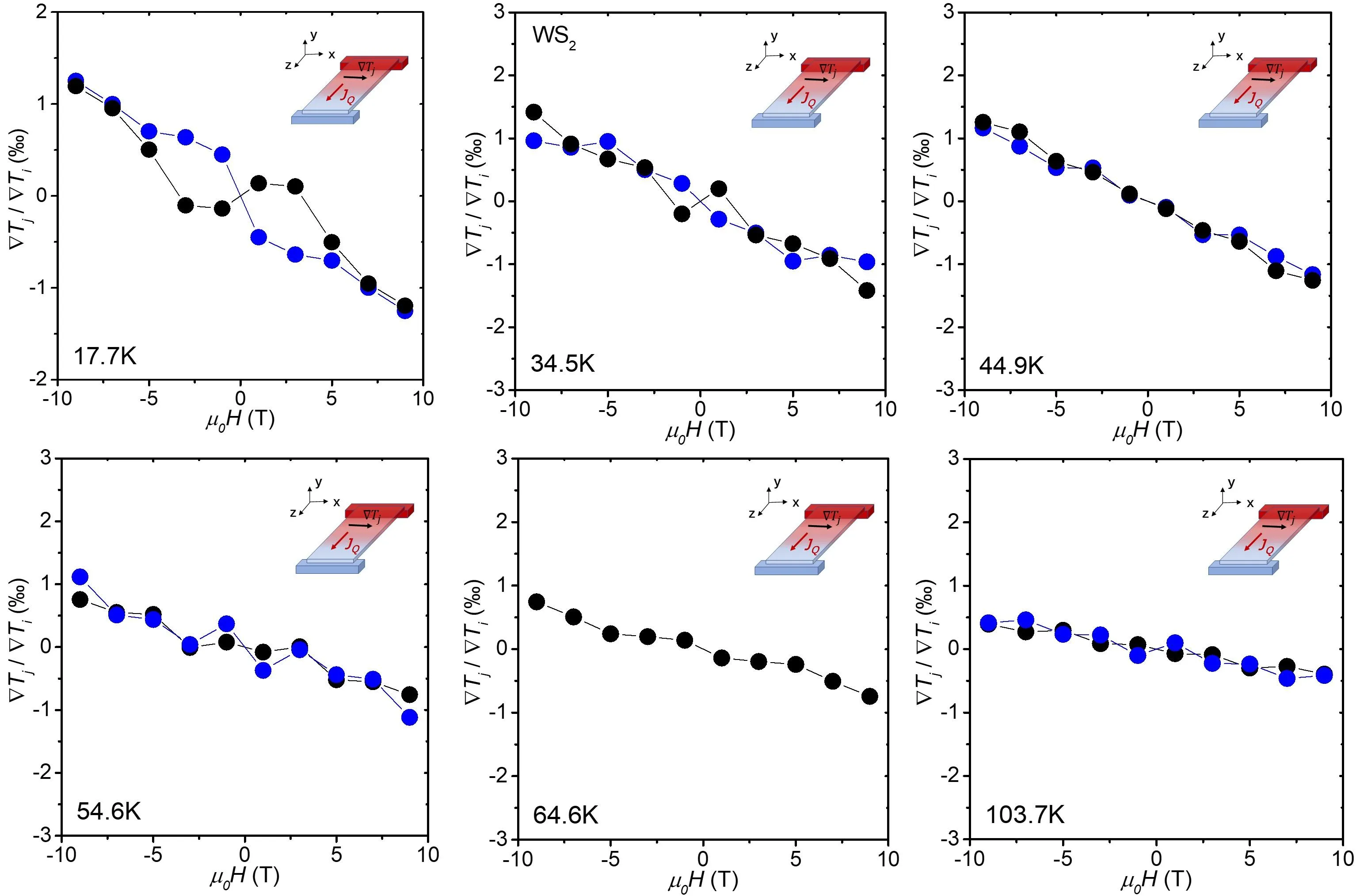
In an insulating crystal, heat usually flows from the hot end to the cold end. But when you switch on a magnetic field, part of the heat flow veers sideways, like water running down a slope that drifts to the side when the wind pushes it. This behavior is called the thermal Hall effect.
The researchers took a layered crystal of WS2 (tungsten disulfide — a material similar to graphite but made of tungsten and sulfur atoms) and measured how heat travels along and across the layers. It turned out that both flows become strongest at nearly the same temperature. And their ratio does not exceed a certain limit, just as in other insulators.
The authors compared this to the behavior of a gas of non-spherical molecules. There, a magnetic field affects molecular rotation, and collisions give rise to a transverse heat flow. By analogy, in a crystal, the field acts on phonons through their interactions with each other. A simple estimate incorporating the Berry force (an effect related to the geometry of atomic motion) describes measurements for seven different crystalline insulators well.
Original abstract
as written by the authors arXiv:2604.03644
The amplitude of the Hall response of electrons can be understood without invoking interactions. Most theories of the phonon thermal Hall effect have likewise opted for a non-interacting picture. Here, we challenge this approach. Our study of WS$$_2$$, a transition metal dichalcogenide (TMD) insulator, finds that longitudinal, $$\kappa_{xx}$$, and transverse, $$\kappa_{xy}$$, thermal conductivities peak at almost the same temperature. Their ratio obeys an upper bound, as in other insulators. We then compare transverse thermal transport in a phonon gas and in a molecular gas. In the latter, the Senftleben-Beenakker effect is driven by the competition between molecular collisions and applied magnetic field in setting the distribution of molecular angular momenta. An off-diagonal transport response arises thanks to interactions between non-spherical particles, which do not need to be chiral. By analogy, we argue that in a phonon gas, magnetic field will influence phonon-phonon interactions, and generates a transverse thermal \emph{resistivity}, whose order of magnitude can be accounted for by invoking a Berry force on the drift velocity of the nuclei in the presence of a finite heat. This simple picture gives a reasonable account of the experimentally measured transverse thermal resistivity of seven different crystalline insulators.
The thermal Hall effect in insulators was first observed in 2005 in terbium-gadolinium garnet, and since then it has been seen in many crystals.