Heat Goes Sideways Under a Magnetic Field express
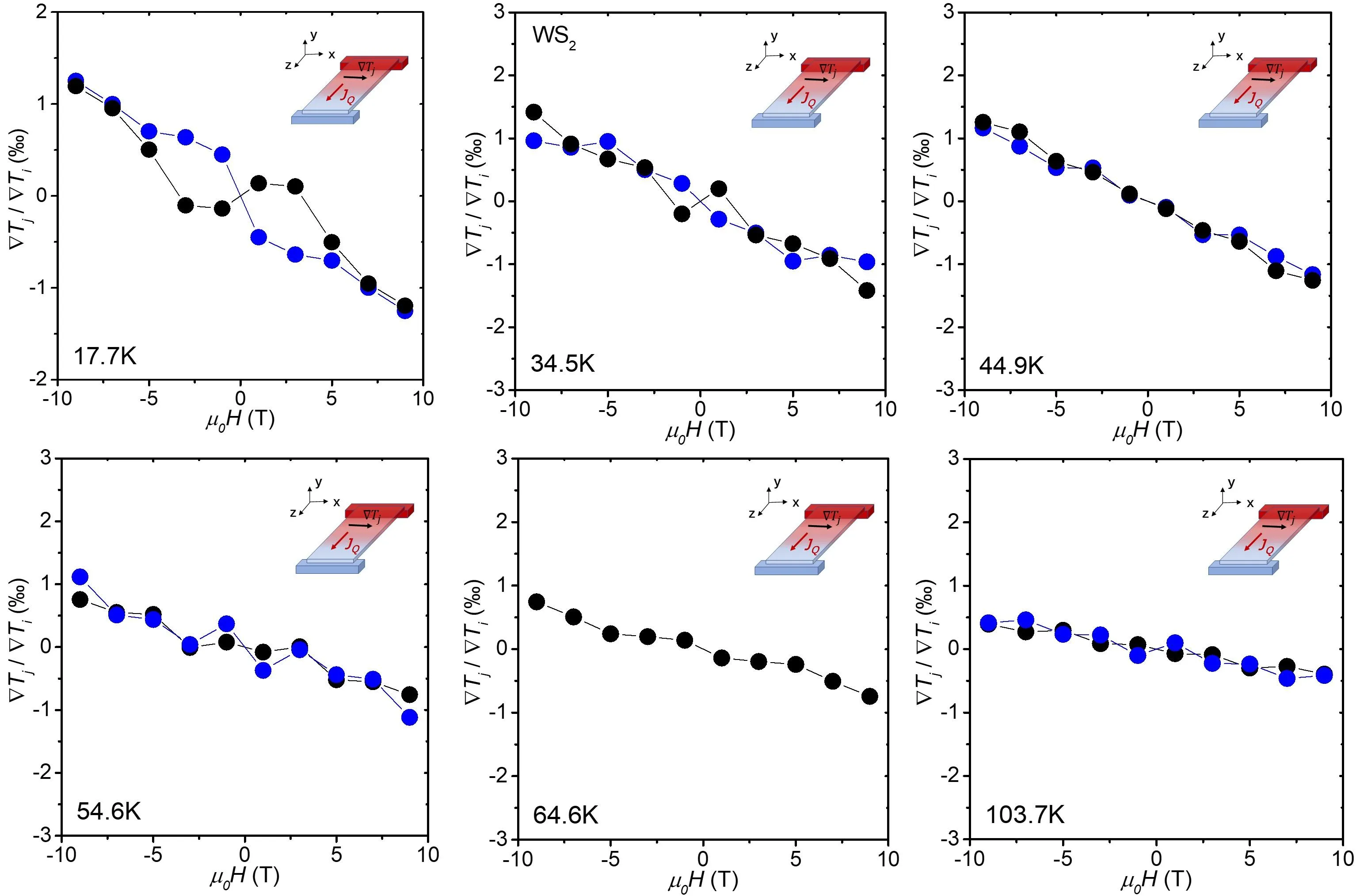
In an insulating crystal, heat usually flows from the hot end to the cold end. But when you switch on a magnetic field, part of the heat flow veers sideways, like water running down a slope that drifts to the side when the wind pushes it. This behavior is called the thermal Hall effect.
The researchers took a layered crystal of WS2 (tungsten disulfide — a material similar to graphite but made of tungsten and sulfur atoms) and measured how heat travels along and across the layers. It turned out that both flows become strongest at nearly the same temperature. And their ratio does not exceed a certain limit, just as in other insulators.
The authors compared this to the behavior of a gas of non-spherical molecules. There, a magnetic field affects molecular rotation, and collisions give rise to a transverse heat flow. By analogy, in a crystal, the field acts on phonons through their interactions with each other. A simple estimate incorporating the Berry force (an effect related to the geometry of atomic motion) describes measurements for seven different crystalline insulators well.
The thermal Hall effect in insulators was first observed in 2005 in terbium-gadolinium garnet, and since then it has been seen in many crystals.