Flexible Threads Turn Clothing into Radiation Detectors express
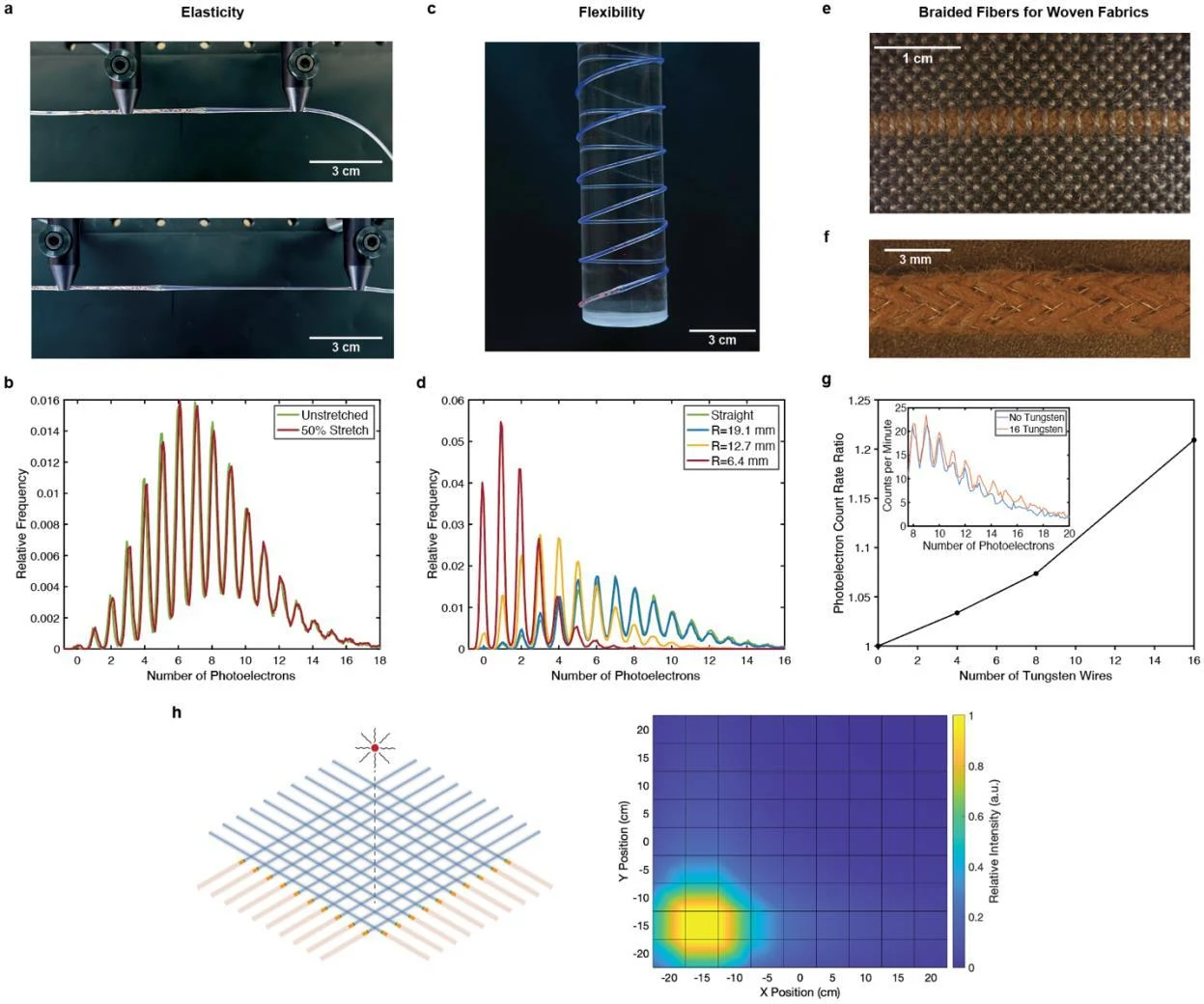
Inside an ultra-thin polymer thread are microscopic crystals — scintillators. When an invisible radioactive particle hits, they flash for a moment, like fireflies. A sensitive sensor catches each flash, turning the thread into a flexible detector.
Tests with strontium-90, cesium-137, and cobalt-60 showed that the fabric even senses natural background radiation. To boost the signal, tungsten and merino wool were added to the braid: this unexpected pairing of metal with soft wool increased sensitivity by 20%. Tungsten converts gamma rays into a shower of electrons, which the crystals catch more readily. This also helps distinguish types of radiation, paving the way for portable studies of fundamental particles and smart clothing that warns of danger at nuclear power plants and in radiation therapy.
Original abstract
as written by the authors arXiv:2604.05061
Nuclear radiation detectors play a key role in applications spanning nuclear and particle physics, nuclear engineering, security, and medicine. With the expanded global interest in nuclear power, discreet, inconspicuous, and readily deployable nuclear detection capabilities are increasingly important. However, conventional dosimeters are often rigid, bulky, or lack spatial resolution, limiting their use for mobile, conformal, or large-area distributed mapping of dynamic fields. Here, we present flexible, radiation-sensitive optoelectronic fibres with up to 50% elasticity for real-time gamma dosimetry. Silicon photomultipliers are thermally drawn into the core of fibres composed of a scintillator waveguide, enabling electronic-photonic integration and detection of scintillation light with single-photon resolution. We show that these fibres are sensitive to localized nuclear radiation exposure from collimated 0.5 {\mu}Ci Sr-90 {\beta}-sources and 10 {\mu}Ci Cs-137 and Co-60 {\gamma}-sources, with extended responsivity measured over 30 cm, and estimated lower detection limits approaching near- background radiation levels (~14-41 nSv/hr). Co-locating the scintillator and detectors in the fibre eliminates past length limitations driven by optical losses and enabling a greater collection cone through capture of transient non- guided modes. We further enhance radiation sensitivity and mechanical robustness by covering the fibres with a tungsten-merino wool composite braid, enabling us to machine-weave them into fabrics alongside common textile yarns. The tungsten wires function as a gamma-electron converter, increasing the detection efficiency of the assembly by ~20%. Distributed woven arrays of fibres formed in this way present an opportunity to create large-area, conformal fabrics capable of real- time dosimetry of gamma radiation fields with high spatial resolution.
The first radiation detectors used by Marie Curie and Ernest Rutherford required entire laboratories. Now you can wear a detector like a sweater.
Isaac Asimov's Foundation series mentions personal dosimeters, but fabric detectors are now a reality.