Baby Star Fires in Bursts express
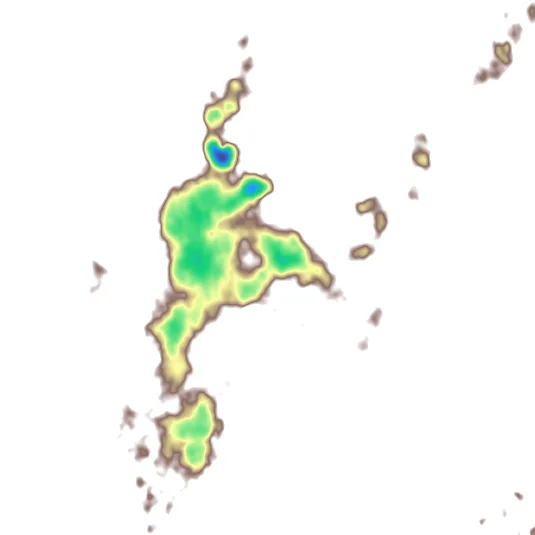
In a dense cloud of gas and dust where giant stars are born, the ALMA telescope has spotted something familiar. Four thin gas jets shoot out from the same region, each leaving behind a chain of bright knots, like a dashed line.
Two of the jets bend like the letter S. This happens when the source of the outflow wobbles slightly, like a garden hose in a hand that sways from side to side. For small, Sun-like stars, such jets are common. But here, in the W49N region, stars are born that are tens of times more massive than the Sun, and the outflows carry thousands of times more energy.
This discovery shows that the mechanism that drives jets in newborn stars does not depend on their size. Whether a small star or a giant, the heart beats the same.
Original abstract
as written by the authors arXiv:2604.13671
We present a detailed investigation of a multipolar episodic molecular outflow in the mini-starburst region W49N, which hosts the most luminous water maser in the Galaxy. Using high-resolution ($$\sim$$0.3 arcsec) Atacama Large Millimeter/submillimeter Array (ALMA) observations of the $$\mathrm{^{12}CO}$$ emission as part of the ALMA-QUARKS survey, we analyze the morphology and kinematics of the outflow. Our observations reveal four newly identified outflow lobes in addition to the previously known central bipolar jet. These lobes appear more jet-like rather than exhibiting wide opening angles. Based on the $$\mathrm{^{12}CO}$$ (2-1) and $$\mathrm{^{13}CO}$$ (2-1) emission, we provide a more reliable estimate of the outflow's physical parameters, confirming it as one of the most energetic outflows in the Galaxy. Notably, these newly discovered lobes exhibit chains of knots, a characteristic signature of episodic ejection. Furthermore, two of the lobes display prominent S-shaped wiggles, suggestive of a precessing jet. The discovery of these features -- commonly observed in outflows from low-mass protostars -- in such an extreme massive star-forming environment provides compelling evidence that some underlying physical mechanisms for launching outflows are conserved across a wide range of stellar masses.
The most powerful water maser in our Galaxy is located in W49N: it shines like several thousand Suns.