Stellar objects are the diverse bodies that populate the universe: stars in all their varieties, planets, neutron stars, brown dwarfs, black holes, and more. They are the laboratories where physics plays out on cosmic scales—from nuclear fusion in stellar cores to the extreme gravity of compact remnants. Understanding stellar objects is essential for mapping the Milky Way, tracing the Sun's path through the galaxy, and even probing dark matter, as some objects like neutron stars can act as detectors for exotic particles.
History
The classification of stellar objects has evolved since the 19th century, with key milestones like the Hertzsprung-Russell diagram (1910s) linking stellar brightness to temperature, and the discovery of neutron stars in 1967 and brown dwarfs in 1995.
How it works
Each type of stellar object is defined by its mass and evolution. Stars fuse hydrogen in their cores; when they exhaust their fuel, they become white dwarfs, neutron stars, or black holes depending on mass. Brown dwarfs are 'failed stars' too light for fusion. Planets orbit these bodies, and their formation and dynamics are governed by gravity and angular momentum. Observing stellar objects involves measuring their light, motion, and interactions—like how fast stars move reveals the galaxy's mass distribution, or how a star's wobble indicates an orbiting planet.
In practice
Stellar objects are used as cosmic probes: fast stars map the Milky Way's structure, neutron stars serve as precise cosmic clocks (pulsars), and exoplanet systems help refine models of planetary formation.
Fun fact
A teaspoon of neutron star material would weigh about 4 billion tons on Earth—roughly the mass of all humanity combined.
A white dwarf is the former core of a star like the Sun, squeezed down to the size of Earth. A teaspoon of its material would weigh several tons. A neutron star is an even denser remnant: a city the size of Manhattan, but with more mass than the Sun.
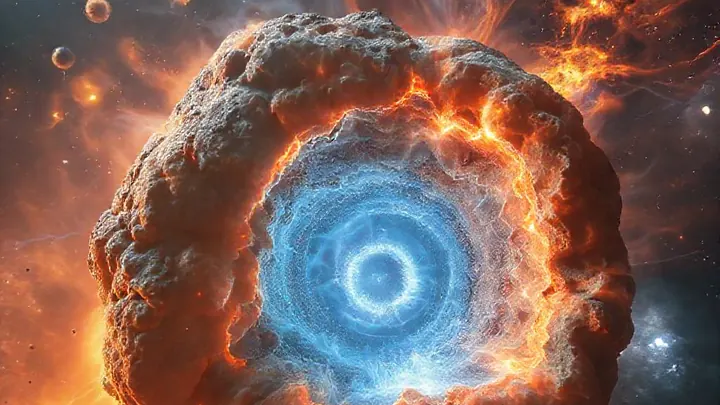
At the centers of many galaxies, not only supermassive black holes lurk, but also vast clouds of invisible matter. If this matter consists of ultralight particles, it can gather into dense clumps — a kind of 'star' made of dark matter.
The universe sounds with silence. The lion's share of matter — about 85%—remains invisible, manifesting only through gravity. Back when Vera Rubin Vera Rubin showed that galaxies spin as if wrapped in unseen mass.
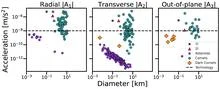
Remember the sensational comet 1I/‘Oumuamua — the first object to come to us from another star? Its hyperbolic trajectory left no doubt: it was a wanderer from the interstellar void. But astronomers wondered: could some of these visitors not be strangers at all, but our own, escaped from the Solar System millions of years ago?
Drop a stone into a pond, and ripples spread outward. Something similar happens inside compact clumps of dark matter when they encounter a special medium — a scalar field. This field, which pervades everything around us, can spontaneously intensify in the depths of such objects, much like ripples on water growing ever taller and more pronounced.
Just after the Big Bang, clumps weighing as much as a trillion Suns and with an electric charge of colossal strength, like trillions of electrified balloons, could have drifted through space.
Recently, astronomers spotted three interstellar comets coming from deep space. One of them, 3I/ATLAS, turned out to be unexpectedly large: its nucleus is several kilometers across.
An atomic nucleus is like a droplet with a thin coating — a neutron 'skin.' Inside the droplet, protons and neutrons are mixed evenly, but on the outside, like the froth on milk, a layer forms where neutrons are noticeably more abundant.
The Oort Cloud is a spherical swarm of trillions of icy bodies at the very edge of the Solar System, about a light-year from the Sun. These objects are almost motionless relative to one another until some gravitational disturbance breaks their calm.
A neutron star is the dead core of a massive star, crushed to the size of a city. A teaspoon of its material weighs as much as a mountain. Dark matter particles fly through such a dense medium almost unimpeded, but occasionally they do hit neutrons and get stuck, like bullets bogging down in deep sand.
Imagine a tiny coin hidden inside a perfect safe, but the walls are so thin that the coin sometimes slips right through, leaving a barely audible sound. Axions are like those coins — except instead of metal, they're particles, and instead of a safe, they're ordinary matter. They barely notice obstacles, making them incredibly hard to catch directly.
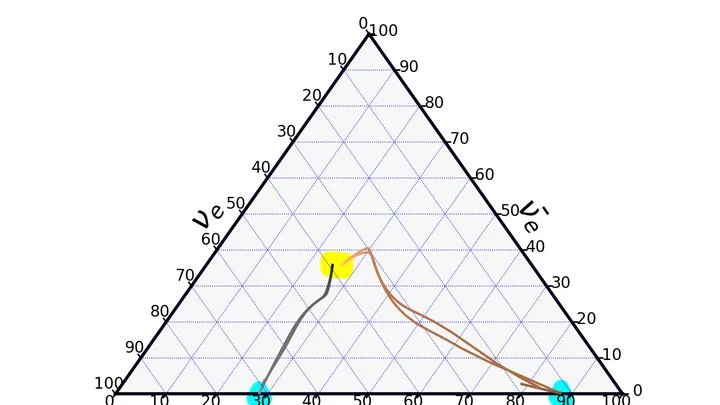
A pot of soup simmering with three ingredients. The chef adjusts the proportions on the fly, and the progress is tracked by the position of a point on a triangular scale. That's roughly how physicists tackle neutrinos from a supernova explosion.
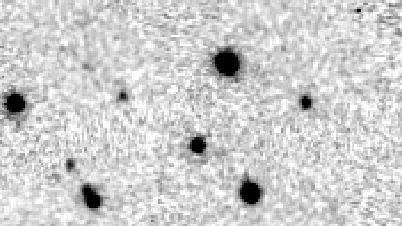
There are faint points in the sky that slowly crawl among the stars. They are cooler than embers in a fireplace and smaller than the Sun: these are brown dwarfs. There are so many of them that astronomers can't keep up with reviewing all the images. That's when volunteers stepped in: ordinary people examined pictures from the telescope and flagged moving objects.
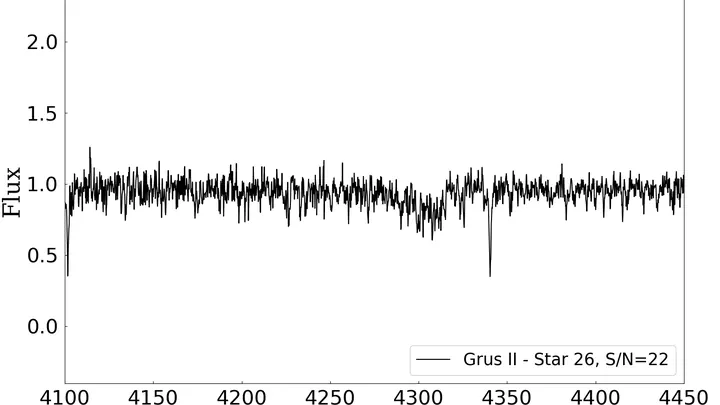
The oven that once baked the first stars has long gone cold, but crumbs from that bread remain. These crumbs are carbon atoms scattered on the surfaces of old stars in tiny satellite galaxies of the Milky Way. Such galaxies are called ultra-faint dwarfs: each contains only a few thousand stars and shines barely perceptibly.
The cosmos is full of objects that lacked the mass to become stars. These 'failed stars'—brown dwarfs — resemble campfire embers that never ignited, just slowly smoldering and cooling.
Supermassive bodies warp space, turning into a lens that bends light from distant objects. Such spacetime curvature allows astronomers to see the invisible. Recently, this method helped detect a hidden clump with the mass of a million Suns.
The Universe is filled with invisible mass, dark matter, which reveals itself only through gravity. One hypothesis suggests that dark matter consists of primordial black holes — objects formed in the extreme conditions just after the Big Bang.
In October 2017, the Pan-STARRS telescope in Hawaii spotted an object moving too fast to belong to the solar system. It was 1I/ʻOumuamua, the first interstellar visitor ever recorded by astronomers. Since then, two more have joined it: comet 2I/Borisov and object 3I/ATLAS.