Muon Collider: Peering into the Heart of Mass express
The Higgs boson is like a conductor that gives mass to all other particles. Without it, electrons would be massless and atoms would fall apart. But how does the conductor interact with itself? That is the key question a future muon collider aims to answer.
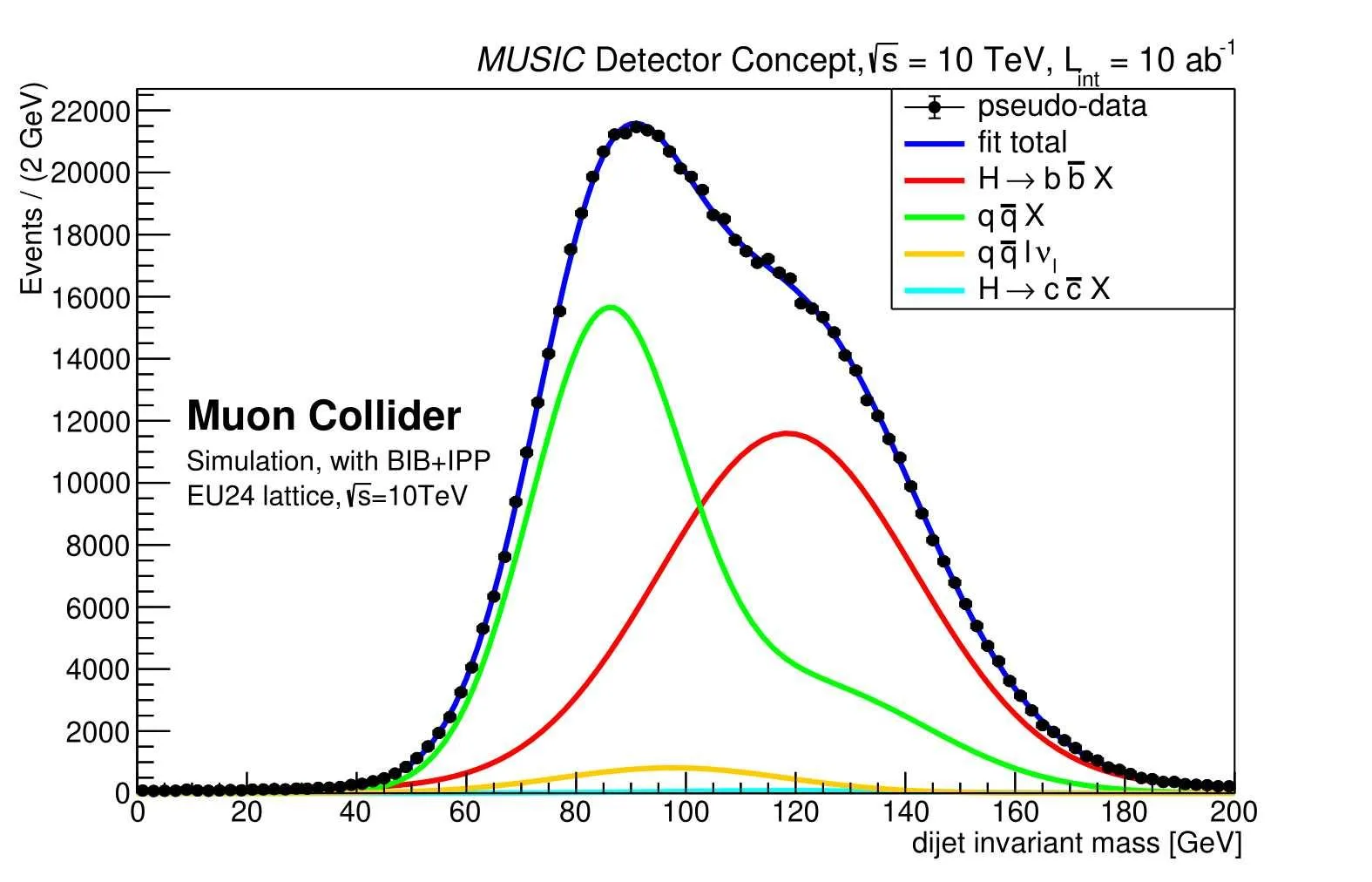
The paper examines the MUSIC facility, designed for muon collisions at 10 TeV. Muons are heavy relatives of electrons, and their collisions produce very clean events. Over five years of operation, the collider would accumulate an integrated luminosity of 10 inverse attobarns (a measure of collision count), allowing measurement of Higgs boson production rates in different channels: decay to a pair of b-quarks, decay to two W bosons, and production of two Higgs bosons simultaneously.
The precision promised by the muon collider surpasses all other proposed future accelerators. If the measured self-coupling deviates from Standard Model predictions, it would point to new physics — possibly additional fields or particles affecting the mechanism of electroweak symmetry breaking.
Muons live only 2.2 microseconds, but in a collider they are accelerated to near light speed, and thanks to relativistic time dilation, they manage to make many turns before decaying.
In Liu Cixin's novel "The Three-Body Problem," aliens use subatomic particles for ultra-precise experiments — a muon collider would similarly require exquisite control over its beams.