Magnetic Patterns on a Triangular Lattice express
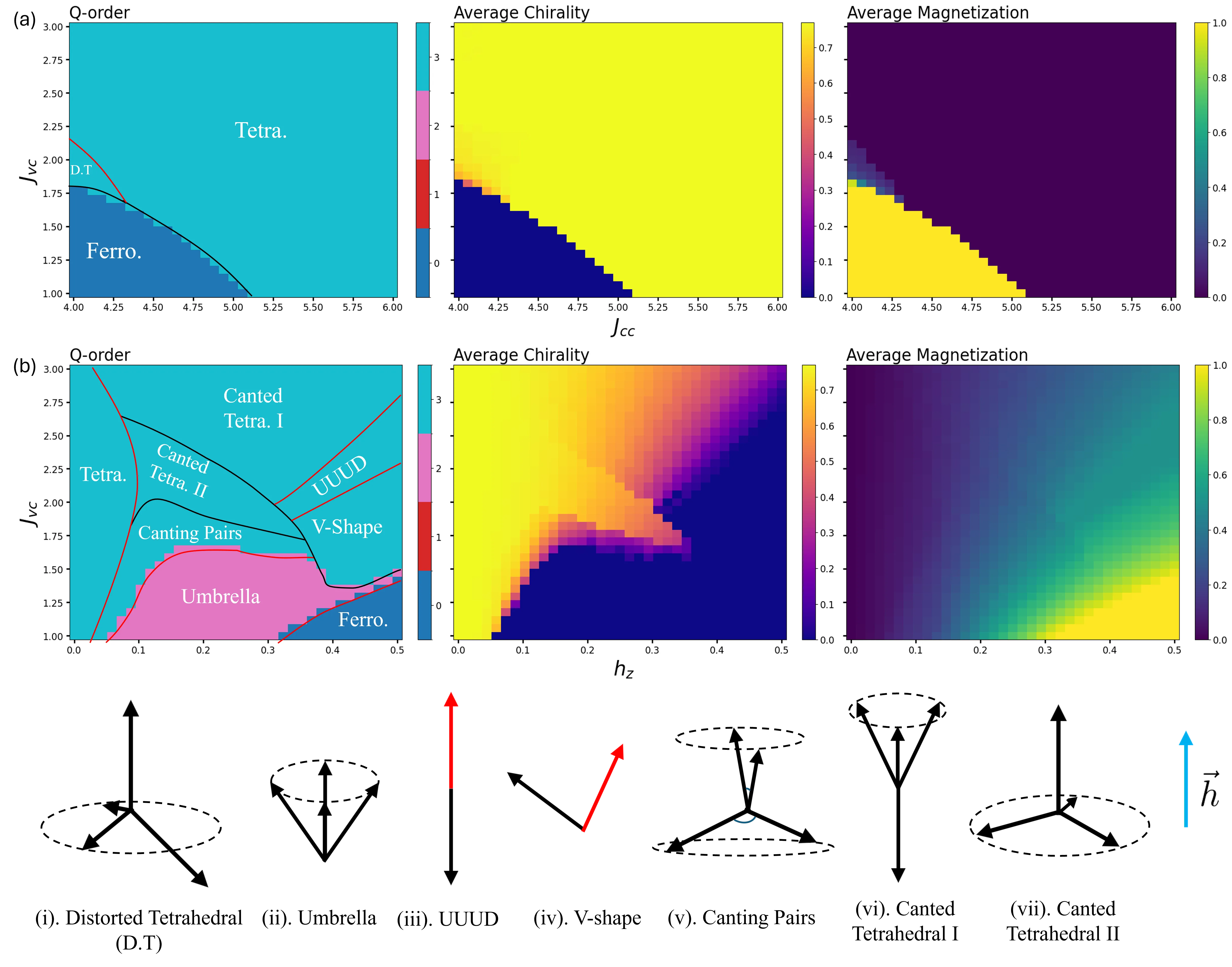
Imagine a triangular grid with tiny magnetic arrows at each node. Electrons, the charge carriers, run across this grid. Usually, the arrows align simply: all pointing the same way (ferromagnet) or alternating in the plane. But in a new study, scientists showed that on a triangular lattice, things can get far more interesting.
They considered a situation where electrons gather in special "pockets" at different points of the energy landscape — one at the center of the Brillouin zone (the Γ point) and three at the edges (the M points). This arrangement resembles four puddles connected by channels. Because of the peculiar shape of these puddles (so-called nesting, when the contours of the puddles are nearly parallel), the magnetic arrows begin to sense each other through the electrons and align into three-dimensional figures.
The most surprising part is that with this twisting, electron waves can completely stop passing through the material: it becomes an insulator inside. But along the edges of the sample, a special current arises: electrons move in only one direction, without scattering off defects. This is the quantum anomalous Hall effect, and it gives a strictly defined resistance — exactly 6.5 kilohms divided by 4. Such materials are candidates for ultrafast and energy-efficient electronics, where information is transmitted without heat generation.
Original abstract
as written by the authors arXiv:2604.17641
We study an effective low-energy Kondo model on the triangular lattice in which itinerant electrons occupy a valence pocket at $$\Gamma$$ and three conduction pockets at the $$M$$ points of the Brillouin zone. This construction has a Fermi-surface nesting structure that favors triple-$$Q$$ magnetic order while only assuming the low-energy band-structure. Treating the local moments as classical spins on a four-sublattice magnetic unit cell, we find extended regions of non-coplanar order, including tetrahedral and related canted tetrahedral states, in addition to ferromagnetic and coplanar phases. The chiral phases remain stable over a broad range of inter-pocket Kondo couplings and persist in the presence of an external magnetic field. For certain chiral orders, the electronic bands can become gapped and host a quantum anomalous Hall state with $$\sigma_{xy}=4\,e^2/h$$. These results show that chiral magnetism and a quantized anomalous Hall effect on the triangular lattice do not rely on a specific tight-binding band structure, but can arise more generally from low-energy nested pockets at $$\Gamma$$ and $$M$$.
The quantum anomalous Hall effect is like an ideal road with no traffic jams: electrons move along the edge of the material without losing energy to collisions, like cars on a dedicated lane.
In the novel "Rose and Worm" by Robert Ibatullin, a material is described that conducts electricity without resistance at room temperature — similar topological insulators could be a step toward such technology.