The Planck constant (symbol h) is a fundamental physical constant that defines the quantum of action—the smallest possible amount of change in a physical system. It sets the scale at which quantum effects become significant: for macroscopic objects, h is so small that quantum behavior is negligible, but for particles like electrons, it governs the quantization of energy, angular momentum, and other properties. It appears in the de Broglie wavelength of matter, the energy of a photon (E = hν), and the uncertainty principle.
History
Max Planck introduced the constant in 1900 to explain the spectrum of blackbody radiation, postulating that energy is emitted in discrete quanta proportional to frequency. This marked the birth of quantum theory.
How it works
The constant has the units of action (energy × time) and a value of approximately 6.626 × 10⁻³⁴ joule-seconds. In quantum mechanics, it relates the frequency of a wave to the energy of its associated particle, and it sets the minimum uncertainty in simultaneous measurements of position and momentum. It also defines the Planck scale, where quantum gravitational effects are expected to become important.
In practice
The Planck constant is used in defining the kilogram in the International System of Units (via the Kibble balance), in quantum computing, and in the calibration of semiconductor devices.
Fun fact
The Planck constant is so small that if you tried to measure the energy of a baseball pitch with quantum precision, the uncertainty in its position would be far smaller than the size of a proton.
A handful of coins drops onto a table — heads and tails land wherever they please. The same goes for an instantaneous snapshot of a quantum chain: in some places a particle is present, in others it is not. But behind the disorder lurks a precise angle.
In this work, a chain of particles closed into a ring was considered. It was divided into four arcs: two were measured, two were left untouched.
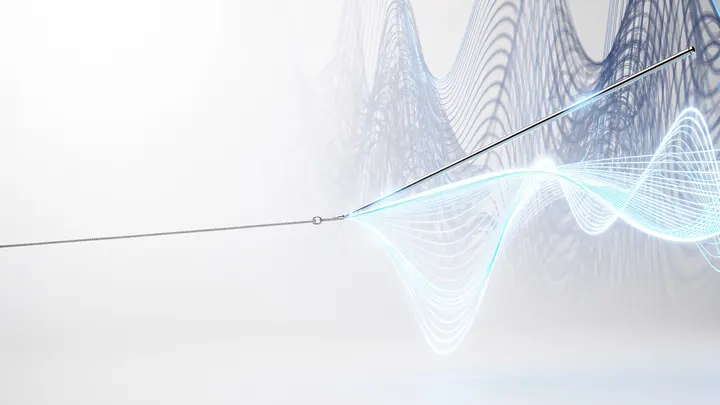
A tightrope walker steps onto the wire. Every move is a calculation: shift your weight just right, or you’ll fall. In the world of quantum particles described by the Dirac equation, there’s a different kind of abyss — the wave function’s furious oscillations.
The early universe expanded at an unimaginable rate — faster than light could cross it. In this boiling cauldron, any region of space resembled an open can of paint: its boundaries continuously captured new 'vapor' from outside, while some of its own contents irrevocably escaped.
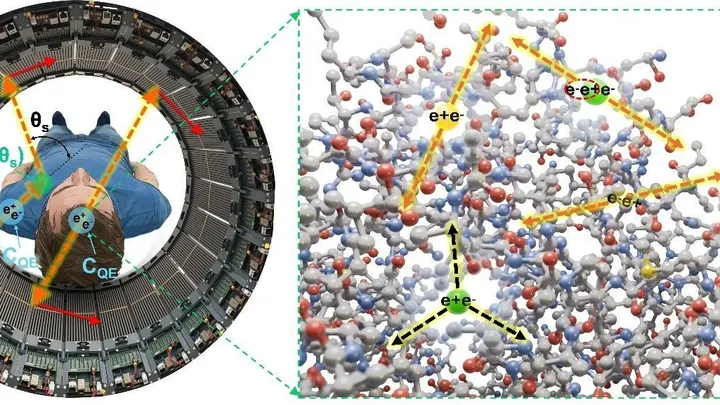
Two photons fly out from a single point in a patient's chest. They are twins: alter one, and you instantly know about the other. This connection is called quantum entanglement. In a PET scan, these pairs are born inside the body when an injected radioactive substance meets electrons in the tissues.
The degree of entanglement is not constant.
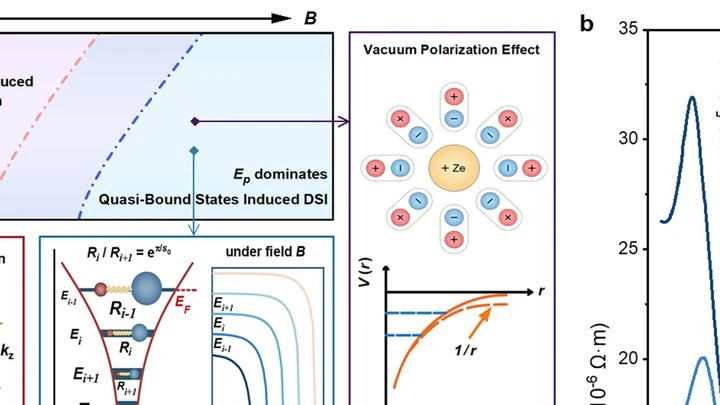
In the crystal HfTe5, electrons behave almost like light: their mass is so small that they obey the laws of relativity. If you place such a crystal in a strong magnetic field, the electrons start to circle in tiny orbits. Their energy then changes not smoothly but in steps, like floors in a building.
Spacetime at ultra-short distances resembles a digital screen: it's not smooth but made of tiny 'pixels.' This minimum length was calculated by Max Planck, and Heisenberg's uncertainty principle explains why the world cannot be continuous: precise measurement always…
Two great theories describe reality: one — how massive bodies cause curvature of space, the other — the Standard Model — governs elementary particles. Reconciling them remains elusive, like trying to describe an ocean storm in the language of a diamond lattice.