Quantum correlation detection refers to experimental techniques that identify and measure quantum correlations, most notably entanglement, between particles. These correlations defy classical explanations, linking the states of particles across distance in ways that cannot be described by local hidden variables. Detecting them is crucial for quantum computing, cryptography, and communication, as they enable secure key distribution and computational speedups. The methods range from Bell inequality tests to more advanced entanglement witnesses and quantum state tomography.
History
The theoretical foundations were laid by John Bell in 1964 with his inequalities, but experimental detection began with Alain Aspect's 1982 tests on photon pairs. Since then, techniques have evolved to detect entanglement in increasingly complex systems, including atomic nuclei and top-quark pairs.
How it works
Detection typically involves preparing a quantum system in a correlated state, then performing measurements on its parts. For example, in photon entanglement, pairs of photons are generated with correlated polarizations; detectors measure each photon's polarization, and the results are compared statistically. If the correlations violate Bell inequalities or show non-classical signatures, entanglement is confirmed. In condensed matter systems, spin correlations can be detected via neutron scattering or magnetic susceptibility measurements, revealing entanglement at room temperature in certain materials.
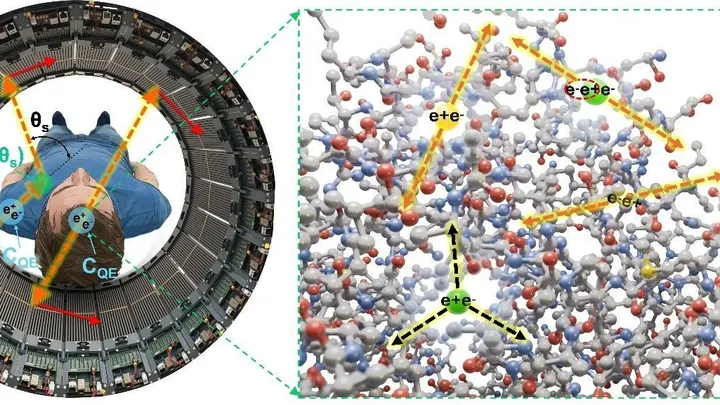
Each positron annihilation is like the birth of a pair of dancers, connected by an invisible thread of polarization. Two gamma quanta fly apart, but their states remain entangled: measuring one instantly determines the other — as if one partner senses every movement of the other, no matter the distance.
Atomic nuclei are not always like billiard balls. Some are elongated, like cigars, others are flattened. But xenon-129 resembles a potato — a bumpy triaxial ellipsoid.
Two entangled photons fly apart in opposite directions but continue to behave as a single whole: measuring one instantly determines the state of the other. That's quantum entanglement. But sometimes it resembles a seasoned spy — leaving no traces detectable by ordinary checks.
Two dice always land on the same number, no matter how far apart you toss them. In quantum physics, this behavior is called entanglement, and it's the key resource for future computers and secure communication. The trouble is, not all entanglement is easy to spot.
Two tiny spinning tops fly apart after a collision. Their rotation is not predetermined: it becomes definite only at the moment of measurement. This is quantum entanglement: the state of one top instantly responds to the state of the other, no matter how far apart they are.
Two photons fly out from a single point in a patient's chest. They are twins: alter one, and you instantly know about the other. This connection is called quantum entanglement. In a PET scan, these pairs are born inside the body when an injected radioactive substance meets electrons in the tissues.
The degree of entanglement is not constant.
Two particles flying apart in opposite directions behave as a single whole: measuring one instantly determines the state of the other. Such quantum entanglement has long been known for light particles, but now it has been observed for the first time in heavy Z bosons — the carriers of the weak force.
At the Large Hadron Collider, by accelerating particles to nearly light speeds, top quarks are created — the heaviest building blocks of the Standard Model. They live for vanishingly small fractions of a second but manage to exhibit complex quantum connections.
Inside some materials, electric current flows with zero resistance. These are superconductors, and they only work when it's very cold. Copper oxides are special: they stay superconducting at somewhat higher temperatures, but why has been a puzzle for forty years.
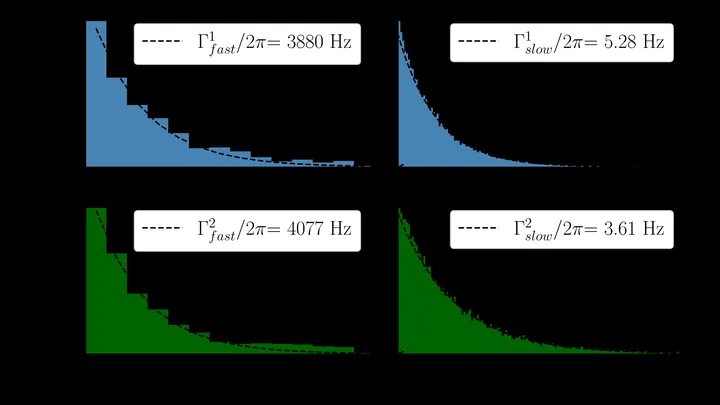
In the superconducting circuits that make up quantum computers, extra particles, quasiparticles, are born from time to time. They are like random passersby who barge into the processor's work and spoil the calculations.
The atomic nucleus is not just a bag of protons and neutrons. It is a quantum system where particles are bound by invisible threads of entanglement. When two protons or neutrons interact, their states become intertwined so that describing one without the other is impossible.
Two spinning tops are set off simultaneously in opposite directions. If one spins left, the other always spins right — no matter how far apart they fly. That's roughly how quantum entanglement works, except instead of tops, we have top quarks, the heaviest known particles.