Why There Is Exactly Five Times More Dark Matter Than Ordinary Matter express
In the kitchen, there's a bucket of water and an identical bucket of sand. Pour the sand into the water, and you get a mixture where there's exactly five times more sand than water. That's roughly how our universe is arranged: one part ordinary matter — the stuff stars, planets, and we ourselves are made of — and five parts elusive dark matter. Why the proportion is exactly this, and not a thousand to one or a million to a million, is an old puzzle known as the coincidence problem.
The authors of a new paper propose an elegant solution: both kinds of matter are linked by a shared 'mailbox' — the neutron portal. The neutron, a particle from our world, can momentarily transform into a particle from the dark sector and back. In the early universe, when everything was hot and dense, this exchange acted as a translator between two unfamiliar languages. Because of it, the amounts of dark and ordinary matter became tightly coupled — like communicating vessels, where the liquid level always equalizes.
The key point is strong supercooling. A jar of very pure honey can remain liquid at temperatures well below its usual freezing point. But let a tiny crystal appear, and the whole jar instantly solidifies. Something similar happened in the dark sector: it stayed 'liquid' for a long time, then abruptly transitioned to a new state. This transition stirred spacetime and produced gravitational waves at nanohertz frequencies — exactly the signal recently detected by radio telescope arrays monitoring pulsars. Thus, one and the same model explains two puzzles at once: the coincidence of abundances and the nature of the mysterious cosmic hum.
As a result, the mass of dark matter particles naturally comes out to be on the order of a few gigaelectronvolts — roughly that of a proton. And the main 'postman' — the neutron portal — should have a mass thousands of times larger, which opens the possibility of finding its traces at the Large Hadron Collider or in beam-dump experiments. So ordinary water and invisible sand turn out to be parts of a single recipe written in the first moments after the Big Bang.
Original abstract
as written by the authors arXiv:2604.21168
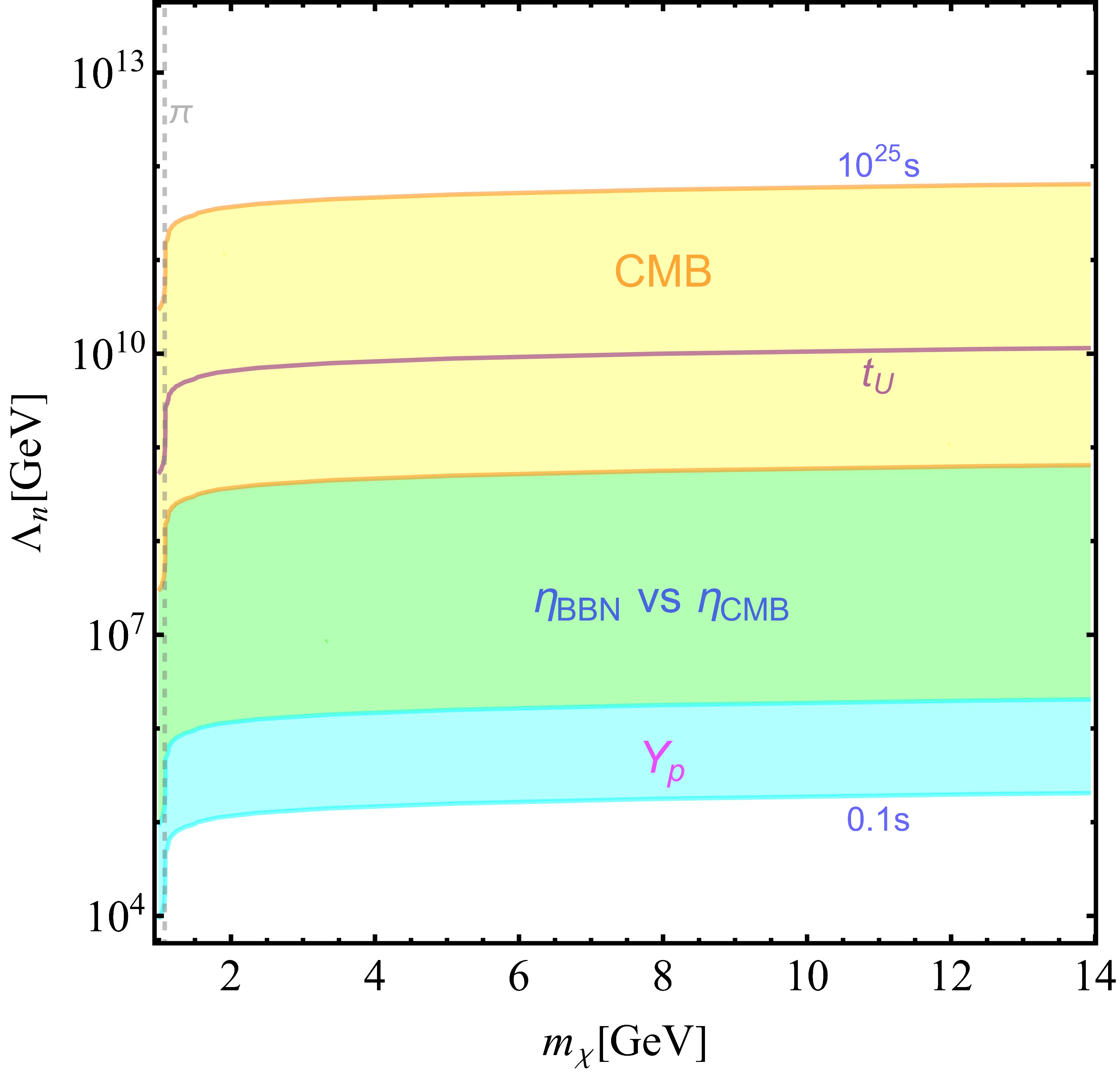
We present a dynamical solution to the dark matter-baryon coincidence problem based on the neutron portal operator connecting the visible and dark sector asymmetries. This framework is motivated by the possibility that a strongly supercooled dark confinement phase transition accounts for the nano-Hz stochastic gravitational wave signal observed by pulsar timing arrays, while also generating the dark matter and baryon asymmetry in the Universe. We show that the GeV-scale mass of asymmetric dark matter can be naturally correlated with the (multi-)TeV scale cut-off for the neutron portal through its ultraviolet completion. The dark sector is governed by an approximate fixed point and confines once the heavy portal states are integrated out, dynamically generating a scale of $$\mathcal{O} ({\rm GeV})$$. We analyze both tree and loop-level ultraviolet completions and demonstrate how the resulting confinement scale is linked to the effective neutron portal scale. We also discuss cosmological constraints and experimental prospects in beam dump searches and colliders for probing the neutron portal.
If there were slightly less dark matter, galaxies couldn't assemble into familiar spirals — the universe would remain a scattering of lonely stars without structure.
In Liu Cixin's novel 'The Dark Forest,' invisible threads of dark matter are used as a weapon — here, they become the key to understanding the very fabric of the cosmos.