Why There Is Exactly Five Times More Dark Matter Than Ordinary Matter express
In the kitchen, there's a bucket of water and an identical bucket of sand. Pour the sand into the water, and you get a mixture where there's exactly five times more sand than water. That's roughly how our universe is arranged: one part ordinary matter — the stuff stars, planets, and we ourselves are made of — and five parts elusive dark matter. Why the proportion is exactly this, and not a thousand to one or a million to a million, is an old puzzle known as the coincidence problem.
The authors of a new paper propose an elegant solution: both kinds of matter are linked by a shared 'mailbox' — the neutron portal. The neutron, a particle from our world, can momentarily transform into a particle from the dark sector and back. In the early universe, when everything was hot and dense, this exchange acted as a translator between two unfamiliar languages. Because of it, the amounts of dark and ordinary matter became tightly coupled — like communicating vessels, where the liquid level always equalizes.
The key point is strong supercooling. A jar of very pure honey can remain liquid at temperatures well below its usual freezing point. But let a tiny crystal appear, and the whole jar instantly solidifies. Something similar happened in the dark sector: it stayed 'liquid' for a long time, then abruptly transitioned to a new state. This transition stirred spacetime and produced gravitational waves at nanohertz frequencies — exactly the signal recently detected by radio telescope arrays monitoring pulsars. Thus, one and the same model explains two puzzles at once: the coincidence of abundances and the nature of the mysterious cosmic hum.
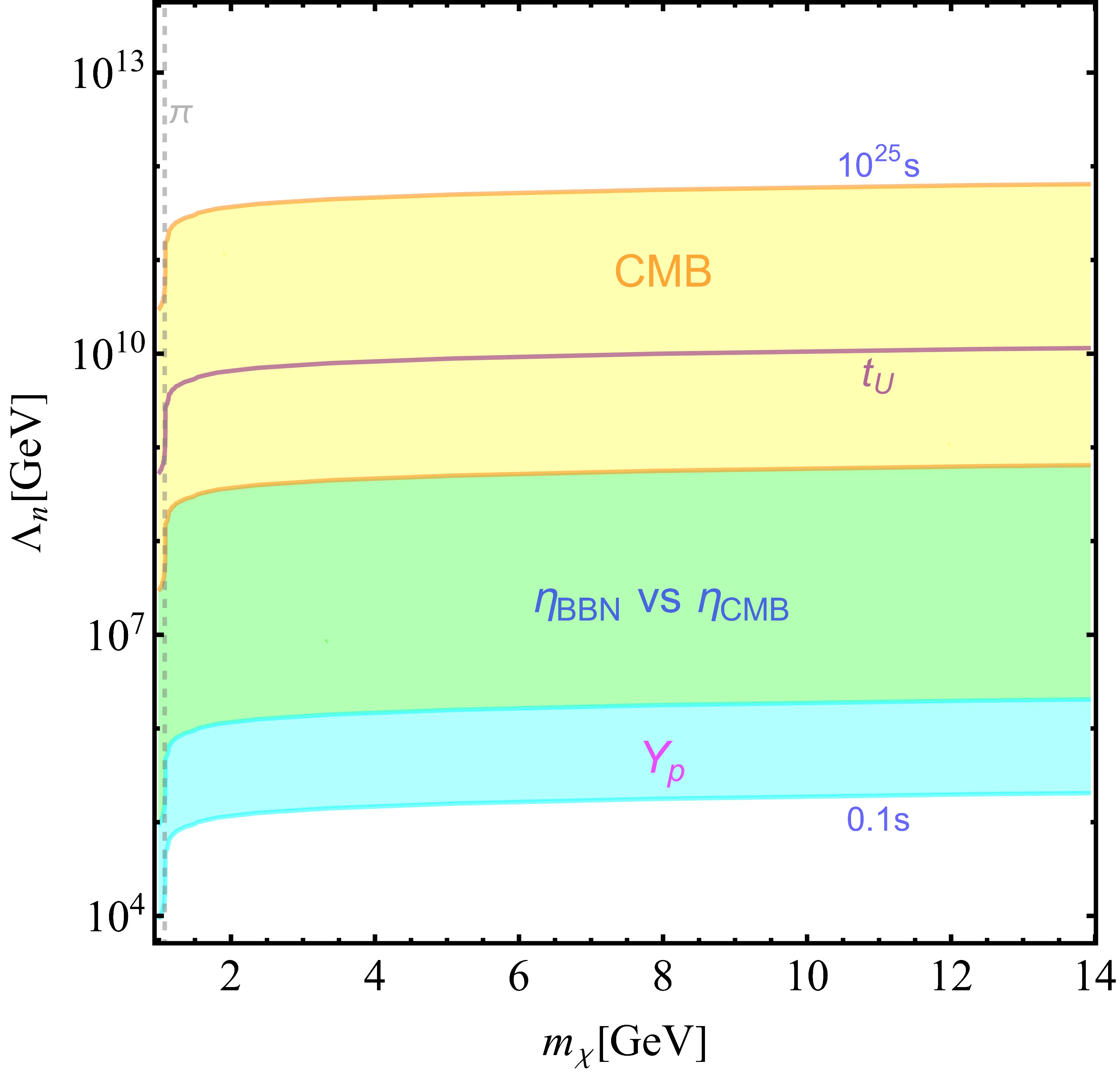
As a result, the mass of dark matter particles naturally comes out to be on the order of a few gigaelectronvolts — roughly that of a proton. And the main 'postman' — the neutron portal — should have a mass thousands of times larger, which opens the possibility of finding its traces at the Large Hadron Collider or in beam-dump experiments. So ordinary water and invisible sand turn out to be parts of a single recipe written in the first moments after the Big Bang.
If there were slightly less dark matter, galaxies couldn't assemble into familiar spirals — the universe would remain a scattering of lonely stars without structure.
In Liu Cixin's novel 'The Dark Forest,' invisible threads of dark matter are used as a weapon — here, they become the key to understanding the very fabric of the cosmos.