A Film That Catches Invisible Light express
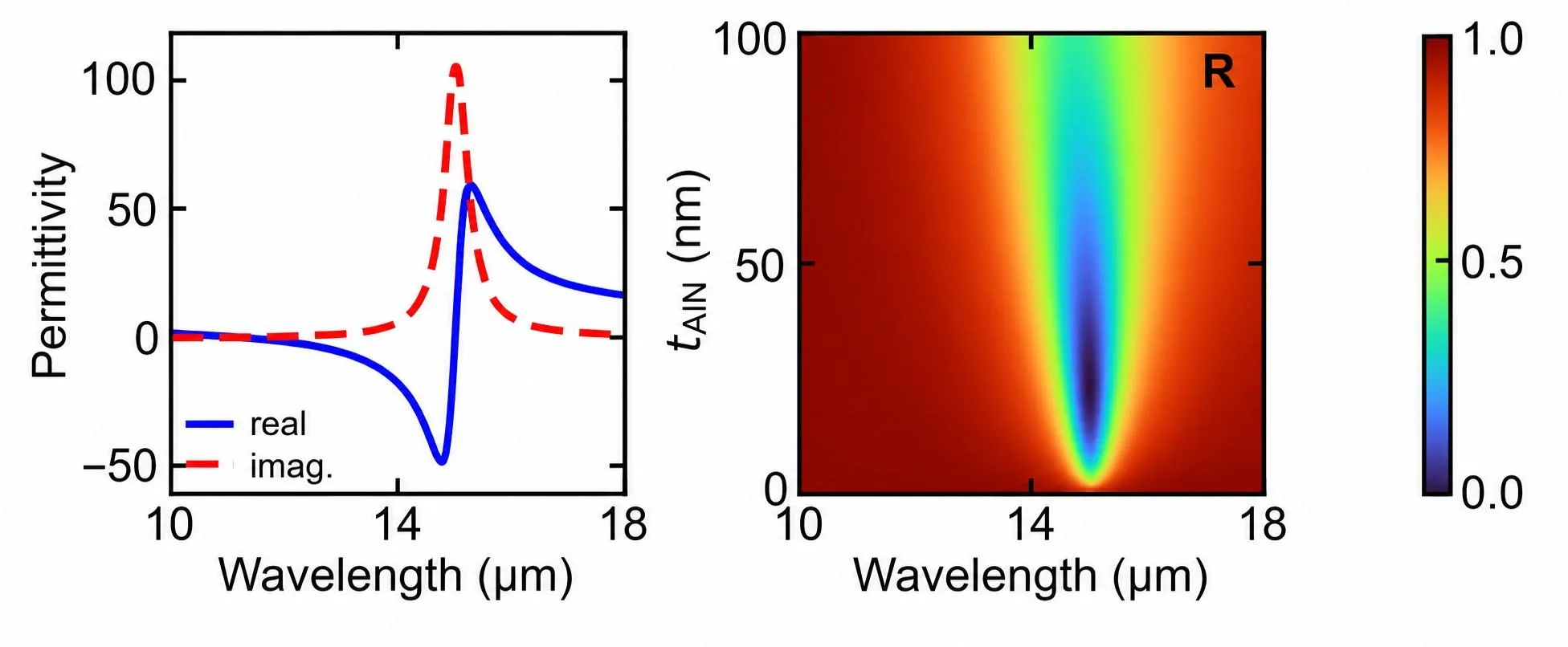
A film of aluminum nitride, as thin as a soap bubble, hangs above a mirror with a micrometer-sized air gap between them. When invisible infrared light with a wavelength of about 15 micrometers hits it, the film starts to vibrate in sync with the light, like a string that responds only to its own note. The vibration warms it slightly, and its electrical resistance changes. That's how the signal is born.
The secret to its narrow tuning lies in the material itself. Atoms in aluminum nitride oscillate at a specific frequency, and light of that frequency is absorbed most strongly. By suspending the film over a mirror, physicists made the light reflect and pass through it multiple times, enhancing absorption. To help the film heat up and cool down faster, they punched neat holes in it, like a colander, which heats up more easily than a solid pot.
The sensor was tested by shining infrared light of different wavelengths on it. It responded only to a narrow band from 14 to 18 micrometers, with the strongest response at 15.48 micrometers — exactly where theory predicted. Its sensitivity was high: a resistance change of 920 parts per million for each milliwatt of incoming light.
Why does this matter? Many gases and substances leave their "fingerprint" in infrared light at just such wavelengths. A compact sensor tuned to the right "note" could determine in seconds whether carbon monoxide or another pollutant is in the air, without interference from everything else. And if you array several such films with different tunings, you get a miniature spectrometer — a device that splits heat into colors, just as a prism splits sunlight.
A wavelength of 15.48 micrometers is about 30 times thinner than a human hair, and it's the wavelength at which the bond between aluminum and nitrogen atoms in the crystal "sings."
In the series "The Expanse," ships use spectrometers to detect gas leaks, such sensors could become their miniature version.