More Than a Hundred Distant Stars in a Single Galaxy express
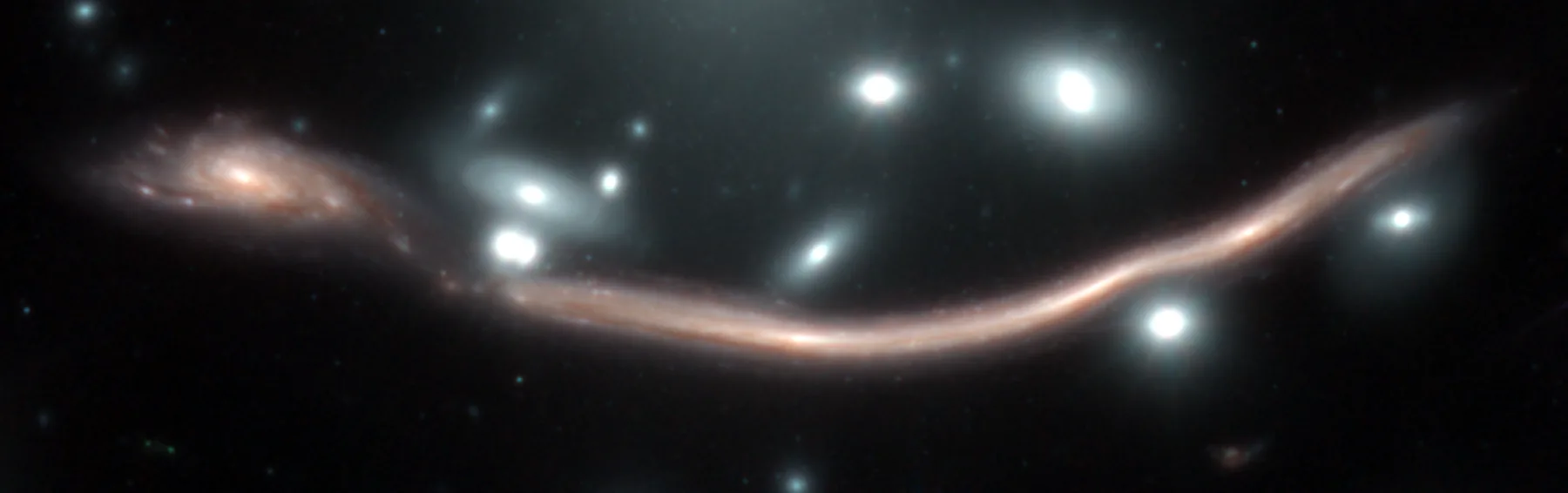
Light from the distant Dragon Galaxy has been traveling toward us for more than seven billion years. On its way, it passes by a huge galaxy cluster whose gravity bends the path of light like a lens. As a result, the galaxy appears brighter and larger than it really is, just as a magnifying glass enlarges fine print. Inside this cosmic lens, there are also individual stars. When one of these stars passes directly in front of a star in the Dragon, the latter's light is briefly amplified even more, and we see a flare.
Astronomers imaged this region with the James Webb Space Telescope for three consecutive years, searching for such flares — stars that appeared and disappeared in the images. They found more than a hundred such events. This is a record: previously, only a few dozen could be spotted in a single galaxy. Now it's possible to count how many bright and faint stars the Dragon contains. It turns out there are more bright stars than old models predicted.
The positions of the flares also reveal how the invisible dark matter is distributed in the cluster. Flares occur more often where the gravitational lens is strongest. This helps refine the cluster map and test hypotheses about the nature of dark matter. Astronomers also noticed that the flares are not perfectly symmetric: there are more on one side of the center than the other. This asymmetry could be a trace of the wave-like properties of dark matter — if it consists of ultralight particles that behave like waves.
Such a large-scale census of distant stars is a new tool. Previously, knowledge about stars in distant galaxies came from their total light, but now individual stars can literally be counted. It's like going from viewing a crowd from afar to suddenly seeing faces.
The Dragon Galaxy got its name from its elongated shape: the gravitational lens stretched its image into an arc resembling the curved body of a dragon.
In the series 'Star Trek', gravitational lenses were used to peer into the distant past of the universe — though there it was technology, while here it's nature itself.