Light travel time is the interval a photon spends journeying from a distant astronomical source to an observer. Because light moves at a finite speed, looking out into space is equivalent to looking back in time: the farther away an object is, the older the light we receive from it. This simple relation between distance and look-back time is the backbone of observational cosmology, letting astronomers reconstruct the history of the universe by studying galaxies, quasars, and supernovae at different distances.
History
The concept became concrete after Ole Rømer's 1676 measurement of the speed of light using Jupiter's moons, and was later formalized in the 19th century with the development of stellar astronomy. The cosmological implications were fully realized after Edwin Hubble's 1929 discovery of cosmic expansion.
How it works
The mechanism is straightforward: light in a vacuum travels at about 300,000 kilometers per second. For an object at a distance d, the light travel time is simply d divided by the speed of light. In an expanding universe, the relation becomes more complex because space itself stretches while the photon is en route, but the core principle remains — every observation is a delayed snapshot of the past.
In practice
Astronomers use light travel time to calibrate distance scales, study the early universe via high-redshift objects, and plan observations of transient events like supernovae or gravitational wave counterparts.
Fun fact
The light we see from the Sun left its surface about 8 minutes and 20 seconds ago, so we always see the Sun as it was in the recent past.
At the heart of a dying star, as its core collapses into a neutron sphere, an invisible storm is born. Trillions of neutrinos, particles that barely interact with matter, race through the scorching plasma. There are so many of them that they begin to influence each other, changing their 'flavors' (electron, muon, tau) like chameleons.
General relativity, which describes the structure of the universe, does not forbid closed timelike curves. But Stephen Hawking put forward the 'chronology protection' conjecture: quantum effects should destroy such curves, making time travel to the past impossible.
A ball on a slope with two pits usually rolls into the nearest one and comes to rest. But if the slope is slightly deformed and 'remembers' recent nudges, the ball can hang around halfway for a long time — in a narrow spot it doesn't want to leave. That's exactly the trick physicists played with light.
Photographing the vicinity of a black hole is like shooting a fountain: a short exposure freezes the droplets, a long one blends everything into blurry streaks. Light from the superheated gas swirling around the hole reaches us along different paths. Some rays curve around it in an arc, others make multiple loops due to spacetime curvature.
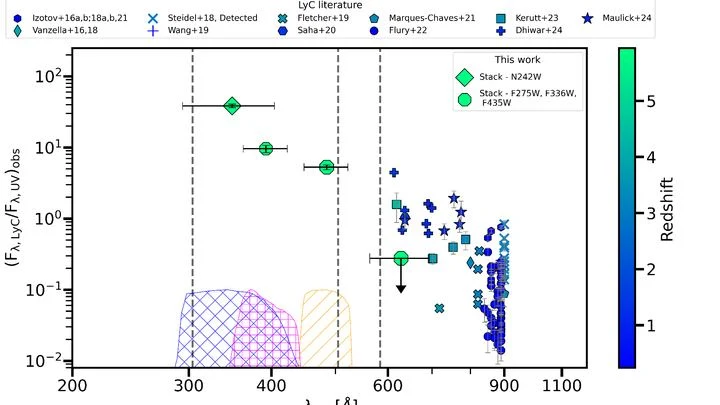
After the Big Bang, the Universe was filled with cold gas — mostly neutral hydrogen and helium. It enveloped the cosmos like a morning fog, impenetrable to light. The Dark Ages began.
When the first galaxies ignited, their radiation, like a searchlight beam, started knocking electrons out of atoms.
The Comet Interceptor mission launches without a target. The spacecraft freezes at a point of space equilibrium, like a fighter jet on combat standby: engine warmed up, but takeoff only on alert.