Magnetic Patterns Under the Microscope express
A magnetic film just tens of atoms thick stores information in tiny magnetic vortices. But you can't look inside and see these vortices directly: the instrument only senses the weak magnetic field around the film. Reconstructing the magnetization pattern from such a field is like guessing the shape of an invisible relief from its shadow on a wall. The same shadow can be cast by many different shapes, and the problem splits into an infinite number of answers.
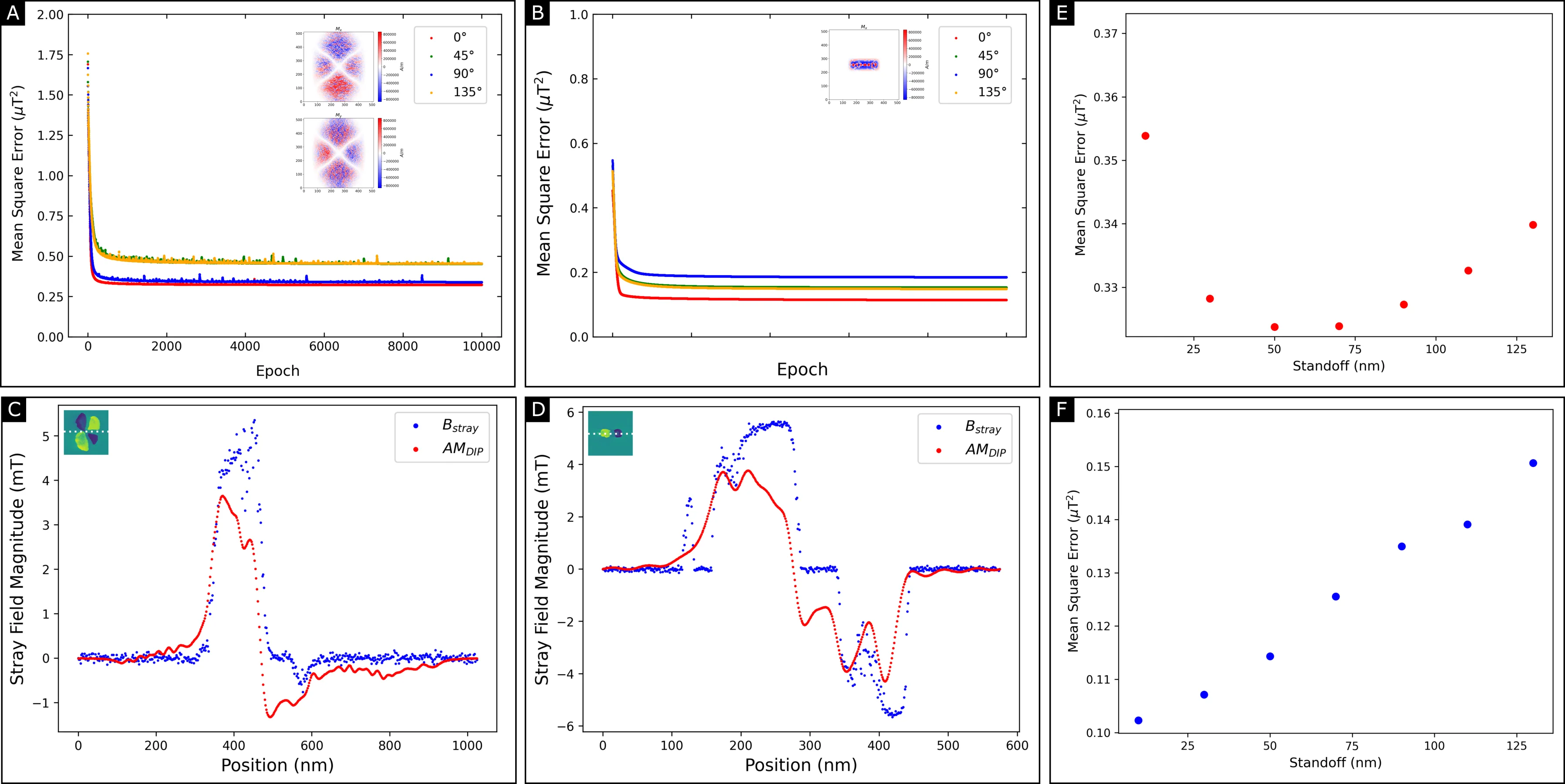
The authors proposed a method that doesn't require ready-made examples for training. Instead, they run a simple neural network that itself selects an image explaining the measured field. The network starts from random noise and gradually, step by step, draws the magnetic pattern while checking against the laws of physics. This approach is called deep image prior: the network 'knows' before training that natural images are usually smooth and connected, not random pixel garbage.
The experiments were carried out on permalloy patterns, a nickel-iron alloy, deposited on tiny pads on a silicon substrate. Comparison with an independent method, magnetic force microscopy, confirmed that the reconstructed images match the real magnetic domains — regions where all atomic magnets point in the same direction. Such a tool will be useful for developing memory that stores information in magnetic vortices and sensors that detect ultra-weak fields.
Original abstract
as written by the authors arXiv:2604.23431
Reconstructing magnetization in nanoscale magnetic thin films is essential for developing next-generation memory, sensors, and various spintronic technologies. However, this remains challenging due to the ill-posed nature of the stray field inverse problem, i.e., there are infinitely many magnetization solutions to a given stray field distribution. Here, we demonstrate that a physics-informed deep image prior (DIP) framework, using a simple convolutional autoencoder conditionally achieves a reasonable qualitative and quantitative reconstruction of complex in-plane magnetization patterns from scanning NV magnetometry. We find that the orientation of user-defined masks implemented to restrict the reconstruction solution space dramatically affects convergence. The optimal alignment of the mask improves the reconstruction signal-to-noise ratio by up to $$\SI{3}{\decibel}$$, thereby also serving as a diagnostic tool. The DIP approach requires no pre-trained datasets and is considered computationally less intensive as compared to supervised learning approaches. We analyze both Landau and dipole domain structures in lithographically patterned Permalloy nanostructures by incorporating experimentally-guided spatial constraints. Complementary magnetic force microscopy measurements were carried out to support the Scanning NV measurements.
Permalloy, used in this work, magnetizes even in the Earth's weak field, which is why it's used for transformer cores and shields that protect instruments from magnetic interference.
In Greg Egan's story 'Wang's Carpets', magnetization patterns in thin films become carriers of consciousness — what a distant future for spintronics!