Breathing Contact and the Memory of Decay express
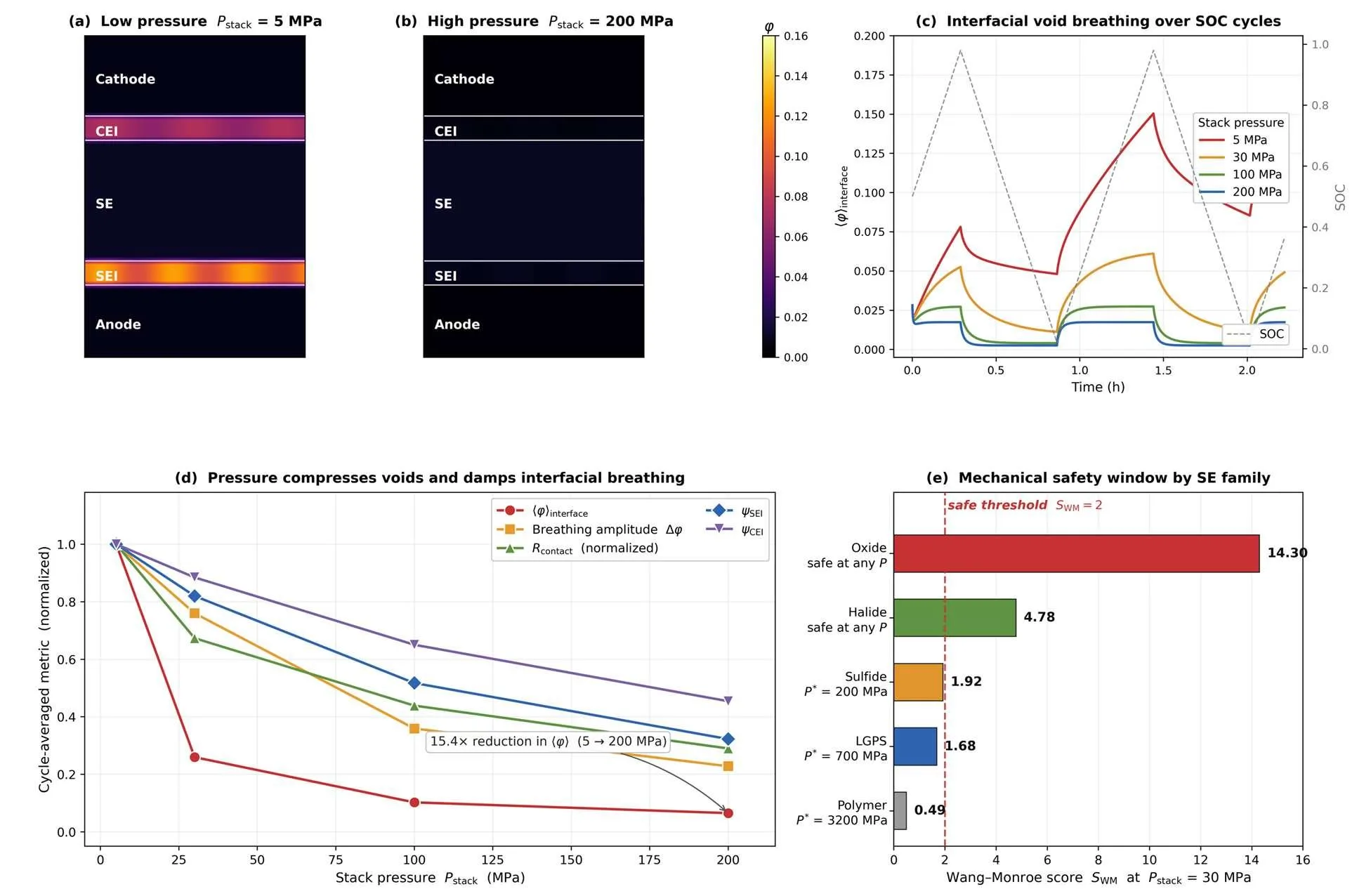
An ordinary phone battery breathes — not with air, but with contact. Inside a solid body, where there are no liquids, lithium presses against the electrolyte (the ion-conducting substance) during charging and pulls away during discharging, like a lung on inhale and exhale. This 'breathing' is not poetry but physics: each cycle creates and destroys the contact points through which current flows.
But there is a second, quieter enemy. At the interface where lithium meets the electrolyte, a 'reactive memory' slowly accumulates — a layer of decomposed electrolyte residue. Like limescale in a kettle, but only fractions of a micron thick. This layer grows with each cycle and does not disappear, even if the battery is squeezed harder. The authors derived four numbers that describe the breathing and one more for the thickness of the memory layer. It turns out that external pressure (as if a weight were placed on the battery) almost completely suppresses the contact oscillations but is powerless against the chemical memory. The decomposition film grows independently.
The practical conclusion is stark: it is not enough to simply improve conductivity or reduce resistance. You must simultaneously tame the breathing (via pressure or design) and control the interfacial chemistry so that memory does not accumulate debris. Only then will a solid-state battery stop being a finicky lab champion and make it into a real electric vehicle.
The decomposition layer at the lithium-electrolyte interface can be hundreds of times thinner than a human hair, yet it determines whether a battery survives a thousand cycles or dies after a hundred.