How Water Turns into Alkali and Back express
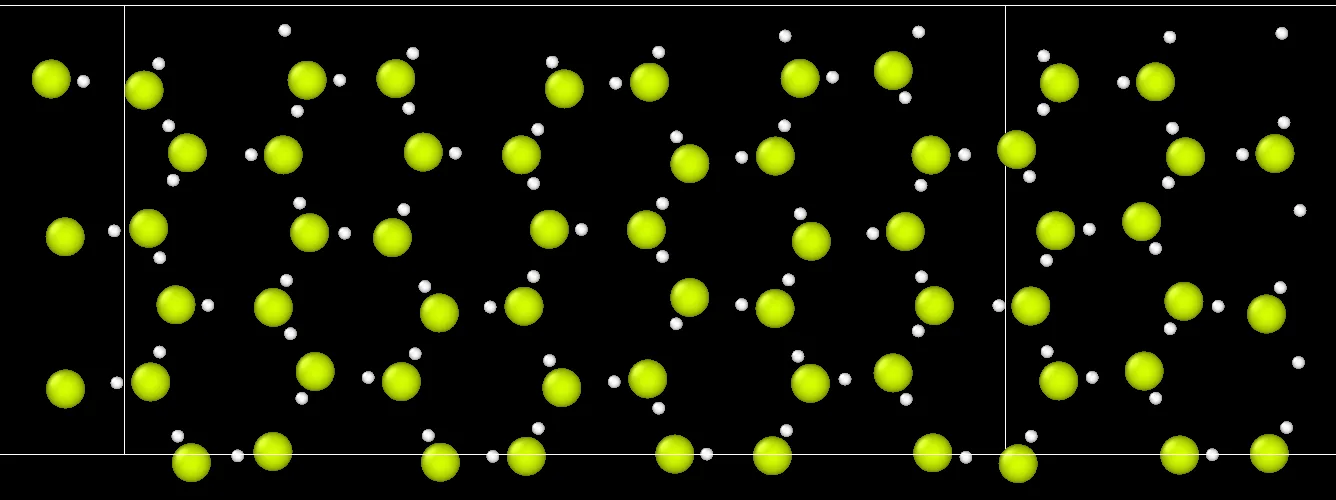
In a crystal of water and caustic cesium, oxygen and cesium atoms sit in place like beads in a rigid lattice. Hydrogen atoms behave differently: they are like passengers constantly changing seats. In this layered material, each oxygen is linked to three neighbors via hydrogen bridges, forming a honeycomb-like pattern.
The most interesting part happens upon heating: a hydrogen atom can jump out of the honeycomb, leaving a vacancy behind. This vacancy, like an empty seat in a crowded bus, moves quickly because a neighboring molecule rotates to fill it. This dance of individual molecules creates a net flow of charge, and the crystal starts conducting electricity while remaining solid.
When hydrogen jumps from water to hydroxide, an unusual Raman signal emerges. Instead of two separate notes (from water and from the OH group), the instrument hears a single broad hum, and at high temperatures a low hum appears as well — a sign that proton exchange is in full swing. The authors derived a formula linking this hum to the hopping frequency, so now the speed of the chemical reaction can be measured directly from the spectrum in the crystal.
Original abstract
as written by the authors arXiv:2605.01045
We describe the atomic-level motions in caesium hydroxide monohydrate (CsOH$$\cdot$$H$$_2$$O), which is a chemical compound containing layers of water and hydroxide ions. At this composition, each oxygen is involved in three hydrogen bonds which, in the hexagonal structure, form a quasi-2D honeycomb lattice. While oxygen and caesium atoms form a typical crystal lattice, the dynamics of the hydrogen atoms are more complex. Here we show that the covalent and hydrogen bonds are continually interconverting, meaning that the water and hydroxyl are interconverting by proton exchange. The order-disorder transition of the water and hydroxyl proceeds by chemical reaction rather than rotation or diffusion of the molecules. A hydrogen can rotate out of the layer, leaving a vacant site in the 2D layer. Such a hydrogen vacancy can diffuse rapidly by single molecule rotation, leading to fast-ionic conduction. The proton exchange leads to a novel type of Raman activity combining stretch and exchange processes, for which we develop a theoretical model. This would manifest in a broad single peak associated with both H$$_2$$O and OH stretches and a low frequency peak appearing at elevated temperature.
The hydrogen vacancy in this crystal moves a hundred times faster than water molecules themselves could squeeze through the lattice, as if an empty spot in a queue ran to the checkout while people barely moved.
In Peter Watts's novel Blindsight, an alien ship uses a solid proton conductor — possibly similar to this crystal, where current is carried by proton hops rather than electron flow.