Simple

Ripples from a Black Hole Falling into a Space Tunnel

Original: "Gravitational Waves from a Black Hole Falling Radially into a Thin-Shell Traversable Wormhole"
arXiv:2605.01216v1 · 2026-05-02 · CC BY · ⏱ 1 min · General Relativity HEP Phenomenology
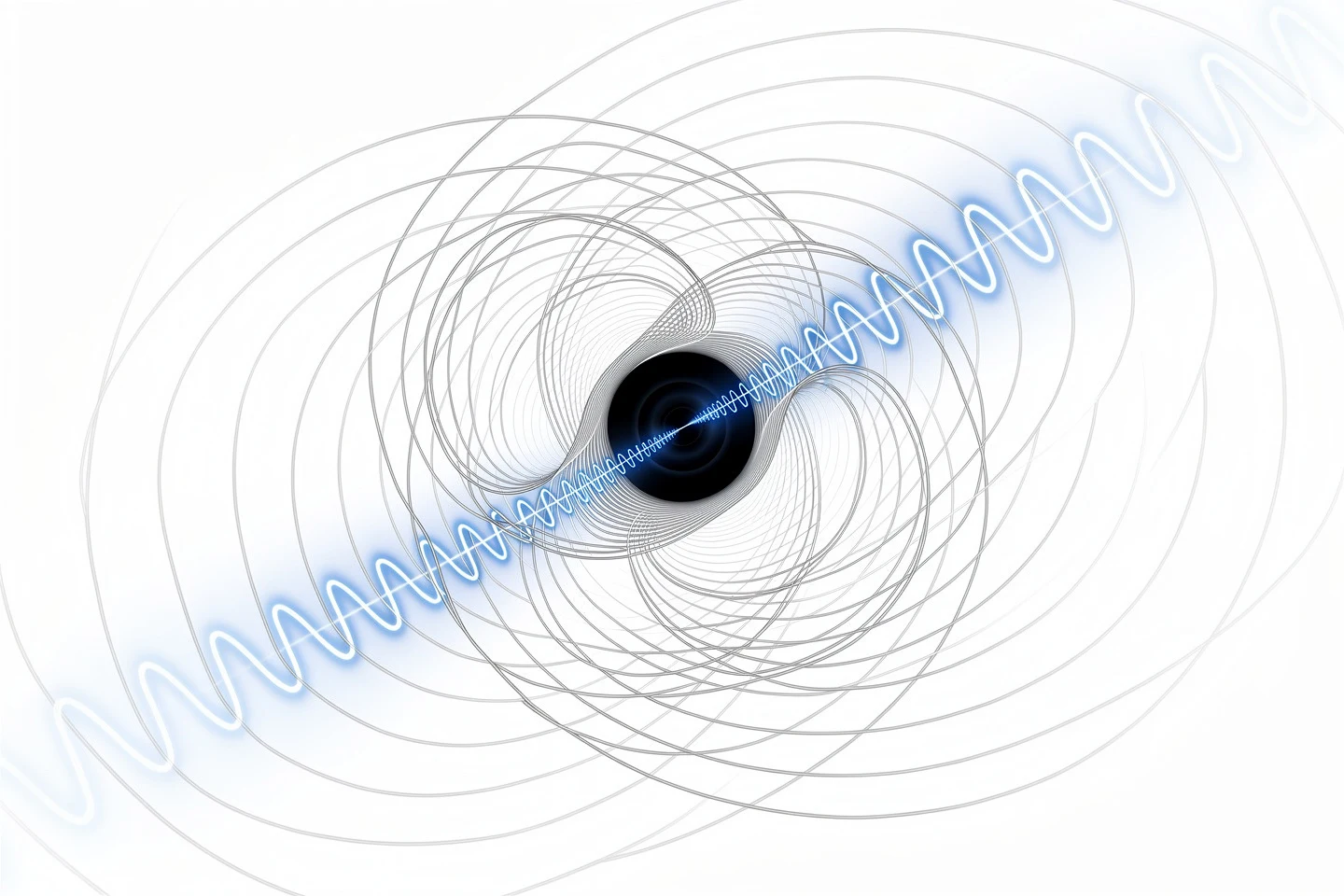
When a black hole dives into a space tunnel, it creates a unique ripple detectable by Earth-based detectors.
Abstract

Like a pebble dropped into water, a black hole falling into a wormhole creates gravitational waves with a distinctive rhythm: pulse, pause, pulse again. Such bursts could be picked up by ground-based detectors even from very distant galaxies.

Links in the knowledge graph 1

Spacetime trembles like a taut membrane: a black hole falling into a wormhole disturbs its fabric most forcefully. Ripples—gravitational waves—race across it, reaching Earth's LIGO detectors at the ultimate speed.

Near the throat, warped by the wormhole's gravity, the ripples grow in amplitude and frequency. But the moment the hole crosses the boundary, the waves cut off abruptly—just like a stone dropping into a funnel.

Near the throat, time almost freezes: to an outside observer, the fall lasts forever, yet the detector hears instant silence. This time dilation effect was predicted by Einstein.

Such a signal is impossible to confuse with a typical black hole merger. Researchers hunt for it by sifting through old data with computer models. The discovery would be proof of wormholes—for now, hypothetical tunnels.

The wormhole doesn't collapse thanks to matter with negative pressure: it pushes the walls apart instead of pulling them together.

🎯 The throat of a hypothetical wormhole is so wide that a black hole flies into it like a pea into a bucket—barely touching the sides.

🎬 The idea that a wormhole can be not only imagined but also 'heard' echoes the film Interstellar, where [scientist:Kip Thorne]Kip Thorne[/scientist] consulted on the scene of flying through the tunnel.

h_{ij}^{\text{TT}} = \frac{2G}{c^4 D} \frac{d^2 I_{ij}}{dt^2}
Here h_{ij}^{TT} is the deformation of spacetime in the transverse-traceless gauge, G is Newton's constant, c is the speed of light, D is the distance to the source, I_{ij} is the mass quadrupole moment.
\text{ASD}(f) = \sqrt{S_h(f)}
ASD(f) is the amplitude spectral density at frequency f, S_h(f) is the one-sided power spectral density of the detector noise.
Scientists
Christian DopplerD. B. McLaughlinDidier QuelozMichel MayorR. A. RossiterStephen Hawking
Tags
Wormhole black hole gravitational waves LIGO spacetime curvature Time dilation speed of light gravity numerical simulation
Laws
Doppler effectHawking radiationgravitational lensingprinciple of constancy of the speed of lightBekenstein-Hawking entropymass–energy equivalence
Original: arXiv:2605.01216v1 · CC BY · bridge42worlds