Black holeecho is a hypothetical delayed electromagnetic or gravitational signal that follows the main burst of radiation from a black hole event, such as a merger or accretion flare. In general relativity, a black hole's event horizon absorbs everything, so no echo is expected. However, if quantum gravity effects replace the horizon with a highly reflective surface or a firewall, some radiation could bounce back after a delay, producing a series of repeating pulses. This effect is a key observational test for the existence of exotic structures like fuzzballs or wormholes.
History
The idea of black holeechoes was proposed in 2016 by Vitor Cardoso and Paulo Pani, who suggested that Planck-scale modifications to the horizon could produce observable gravitational wave echoes. The concept gained attention after the first LIGO detections, though no confirmed echoes have been observed.
How it works
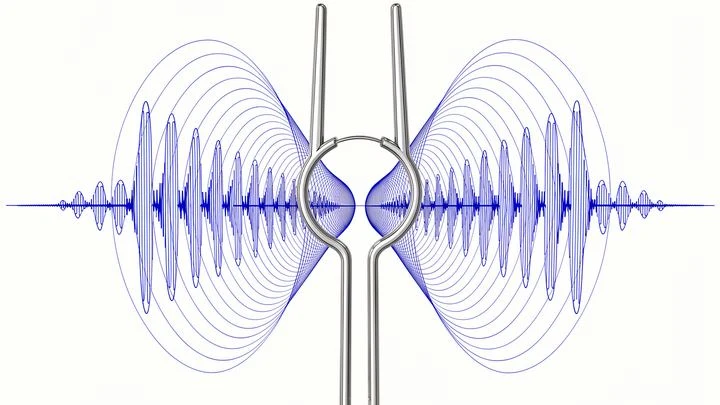
When matter falls into a black hole or two black holes merge, the intense gravitational field produces a burst of gravitational waves and electromagnetic radiation. If the black hole has no true horizon but a compact object with a reflective surface, part of the radiation is reflected and escapes after a time delay proportional to the object's size. This creates a repeating 'echo' signal with decreasing amplitude, similar to sound echoes in a cave. The delay and spacing of these echoes encode the structure of the quantum-gravity region near the would-be horizon.
In practice
Researchers search for echo patterns in gravitational wave data from LIGO and Virgo, and in X-ray flares from black hole accretion disks, to test quantum gravity models.
Fun fact
If black holeechoes are real, they could also be produced by wormholes, and the echo pattern might reveal the presence of a traversable wormhole—a concept that has been explored in the context of the ER=EPR conjecture.
A vortex in a magnetic material is like a whirlpool, but instead of water, the directions of magnetization twist. An electron flying through such a vortex feels not just a magnetic field, but a curvature of space: its path bends as if it were rolling down a funnel with a narrow neck.
When two black holes merge, ripples spread across the fabric of spacetime — gravitational waves. But what if one of them isn't a run-of-the-mill black hole but something else — an exotic compact object?
Space is full of invisible waves — ripples in the fabric of spacetime left behind by cataclysms like black hole mergers. An ordinary black hole swallows everything without a trace. But there are hypothetical exotic objects — ultradense clumps of matter without an event horizon (a surface from which not even light can escape).
The LIGO detectors caught the signal GW250114—a gravitational wave from the merger of two black holes. After the main burst, a decaying 'tail' remained — direct waves from the newborn hole's horizon. It was expected that their damping would reveal the gravitational strength at the horizon's surface. But the measured value came out smaller.
In the first moments after the Big Bang, matter and antimatter were almost perfectly balanced. But something tipped the scales — otherwise everything would have annihilated into radiation, leaving the universe empty. One candidate for the role of "tipper" is the ultraheavy right-handed neutrino.
In the early Universe, primordial black holes emerged — objects no larger than an atom but with the mass of a mountain. They gradually evaporate and, before disappearing, should produce gravitational waves — ripples in spacetime. If they were all identical, they would pop simultaneously, like popcorn kernels: the roar would be deafening.
Einstein and Rosen imagined a bridge connecting two sheets of reality. Wheeler gave it a name — wormhole, and Thorne with Morris proved: the tunnel is traversable if you fill it with exotic matter.
A black hole is usually depicted as an abyss with a point of no return. To save information, which quantum laws forbid from disappearing, physicists replaced that boundary with a fluffy tangle of microscopic strings. Infalling data gets permanently imprinted into its intertwined threads.
The term 'wormhole'—coined for physics by John Archibald Wheeler in 1957—still teases the imagination. It's a hypothetical tunnel through curved spacetime, connecting distant regions of the Universe or even different universes.
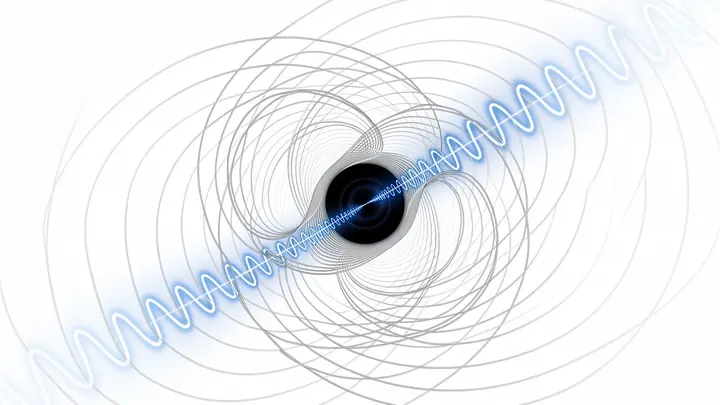
When two supermassive black holes circle each other before merging, they shake spacetime itself, like a speedboat racing across a lake leaves waves in its wake. These waves are called gravitational waves. They travel through the Universe and pass through everything, even the Earth.
A wormhole is a hypothetical tunnel that shortens the path between distant corners of the universe, like a soap bubble stretched between two points. To keep the bubble's walls from closing, a special film is needed — matter with negative pressure, akin to dark energy. But this support isn't eternal: remove half the film, and the bubble bursts.
The Big Bang was like a cosmic thunderclap that set the fabric of space vibrating. These vibrations — gravitational waves — still echo through the Universe like a fading rumble from that ancient event. The louder the initial 'bang,' the more primordial black holes should have formed.
A black hole is a place from which even light cannot escape. But quantum theory says it still glows faintly. This glow is called Hawking radiation. In space, it's impossible to spot: it's too faint. So physicists build models of black holes from ordinary materials.
If you briefly flash light near a black hole, it will respond with a long echo, like a bell that keeps ringing after being struck. The light gets trapped near the hole, bouncing repeatedly off an invisible boundary: the photon sphere, where rays circle around like sound in a metal.
A wormhole is a tunnel that pierces through curved space and connects distant regions of the Universe. Recently, Juan Maldacena and his colleagues proposed a working model of such a hole based on a special combination of spatial curvature and quantum particles.