Cosmic Gong: How a Black Hole Rings a Wormhole ✛ ✎ ✦
The term 'wormhole'—coined for physics by John Archibald Wheeler in 1957—still teases the imagination. It's a hypothetical tunnel through curved spacetime, connecting distant regions of the Universe or even different universes. The idea itself dates back to the Einstein-Rosen bridge, but it was Kip Thorne and colleagues in the late 1980s who showed that a traversable wormhole could exist if its throat is lined with exotic matter having negative pressure — defying conventional notions of gravity.
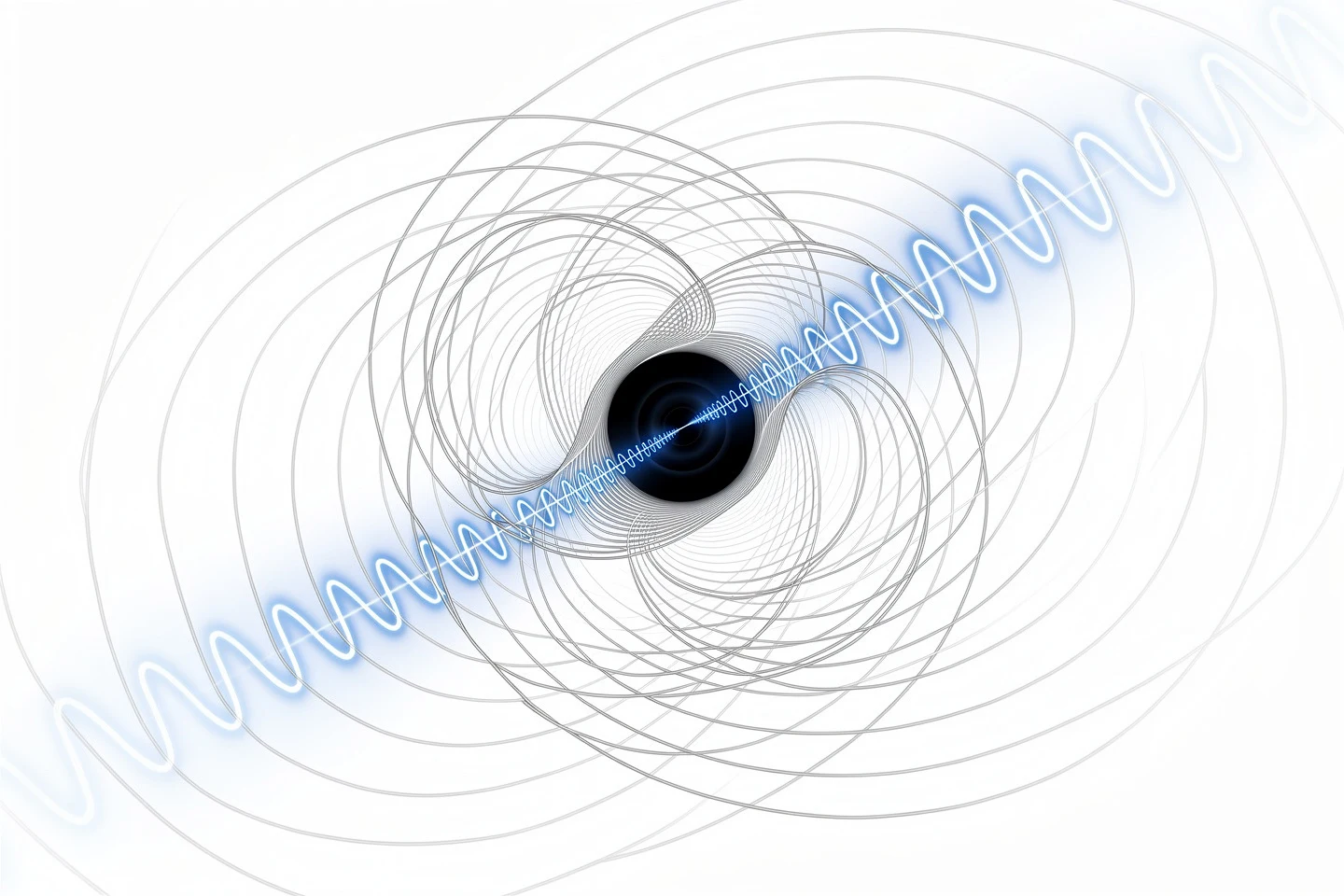
Imagine the wormhole as a colossal cosmic gong, and the black hole falling into it as a mallet. As the mallet approaches the throat from our side, it strikes an invisible membrane and produces a burst of gravitational waves. But once it crosses the boundary and reaches the other side, the sound disappears for us — the signal cuts off, like a note flying off into a parallel reality. This creates a distinctive pattern: a pulse, silence, another pulse — a rhythmic echo of strikes racing at the speed of light across the fabric of space. Each such jab is a gravitational whisper from another universe, one we will never see but may overhear.
To decode this cosmic chiming, physicists constructed an analytical signal model in the quadrupole approximation. As the black hole approaches the throat, time dilation effects sharply amplify the deformation amplitude of spacetime. Bright peaks flare up in the spectrum at frequencies of 10–100 Hz — right within LIGO's operating band. At a distance of 500 Mpc, the amplitude spectral density reaches 10⁻²² Hz⁻¹/², breaking through the sensitivity threshold. In other words, if such a pair comes within range, ground-based interferometers will pick up the wormhole's 'ringing' by its characteristic pattern of bursts and silences, as if we were eavesdropping on the breath of a neighboring universe.
Detecting such a signal would be an observational revolution. It would directly confirm the existence of wormholes — objects that require a quantum description of gravity and violate classical energy conditions. This would open a new window into quantum gravity theory and, perhaps, connect black holes to the information paradox. The next steps are to adapt matched-filtering algorithms in LIGO data to search for pulsed signals with characteristic modulation. In the future — incorporating wormhole rotation and numerical simulations of nonlinear effects to create precise templates for future observatories like the Einstein Telescope.
The throat area of the wormhole exceeds the black hole's horizon area by a factor of 3600: it flies in there like a billiard ball into a giant pipe, and the repulsive exotic matter keeps the wormhole from collapsing.
The idea of a traversable wormhole was featured in the movie 'Interstellar' (with Kip Thorne as scientific consultant)—a journey through such a tunnel. The proposed signatures turn science fiction into observational science: now we can 'hear' a black hole plunging into a wormhole.