Cosmic Strings That Melt express
When hot soup cools, clumps form on the surface — similarly, as the early universe cooled, it gave birth to threadlike clumps of energy: cosmic strings. Some of them are like a stretched rubber band: as long as it's intact, it's stable. But if you nick the band, it snaps. Strings can also be "cut," producing a particle-antiparticle pair of a special type — monopole and antimonopole (magnetic charges that haven't been found in nature yet). Such decay proceeds via quantum tunneling — roughly like a ball rolling over a bump on its own, even though by all rules it shouldn't.
The authors considered a common scenario: symmetry breaks in two steps, like water first turning into ice with one structure, then into ice with another. At each step, strings can be born. Until now, it was thought their fate was only quantum decay. But it turns out strings can also lose stability in another way — simply because their "shape" is energetically unfavorable. This is classical instability: like a pencil balanced on its tip falls without any quantum help.
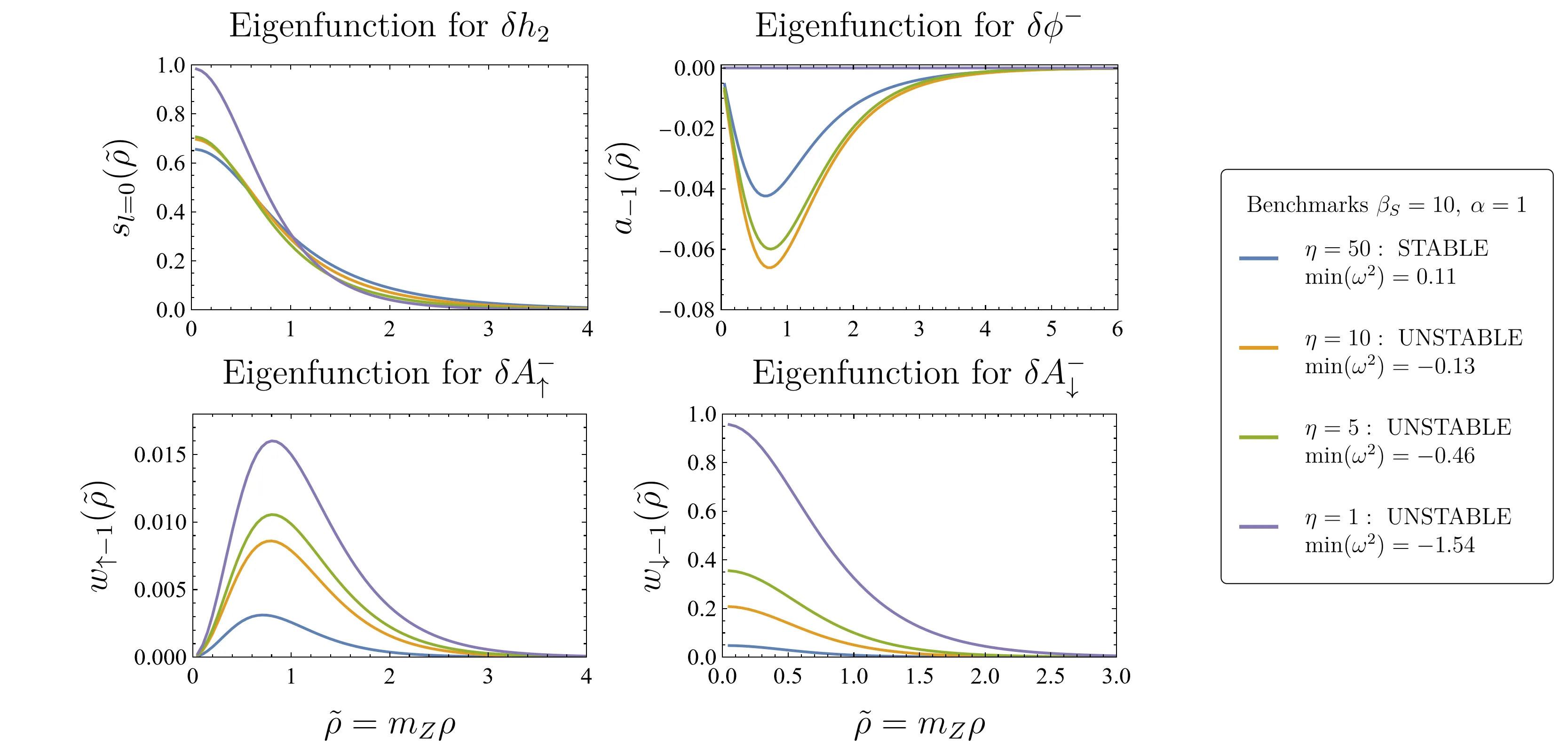
The researchers mapped out regions on the parameter map where strings are stable and where they are not. It turned out that classical instability intrudes into the zone important for explaining gravitational waves detected by pulsar timing arrays (PTAs)—networks of radio telescopes monitoring the "ticking" of dead stars. If a string loses stability classically, its decay proceeds differently, and the spacetime ripple from it will be different. It's like hearing not just the crack of branches but also the rustle of falling leaves in the forest noise — the picture changes.
Original abstract
as written by the authors arXiv:2605.03003
Metastable strings can arise from a two-step symmetry breaking chain of the type $$SU(2) \to U(1) \to 1$$.They can decay through quantum tunneling by nucleating a monopole-antimonopole pair, and are prominent candidates for explaining the gravitational wave background detected at Pulsar Timing Arrays (PTAs).We investigate the classical stability of the strings arising in this commonly-considered setup, which serves as a fundamental input for discussing their possible decay channels. We identify the regions of parameter space in which the strings are either classically stable or unstable. Our results show that classical instabilities can impact the parameter space relevant for PTAs. We also discuss the possible fate of the string network in the regions of classical instability.
A cosmic string as thick as an atomic nucleus could weigh as much as a mountain on every meter of its length.
In Arthur C. Clarke's novel "The Fountains of Paradise," engineers build a space elevator — a cable capable of withstanding tremendous tension. Cosmic strings, if they were stable and accessible, could be the ideal material for such a structure.