How to Paint a Magnet with Light express
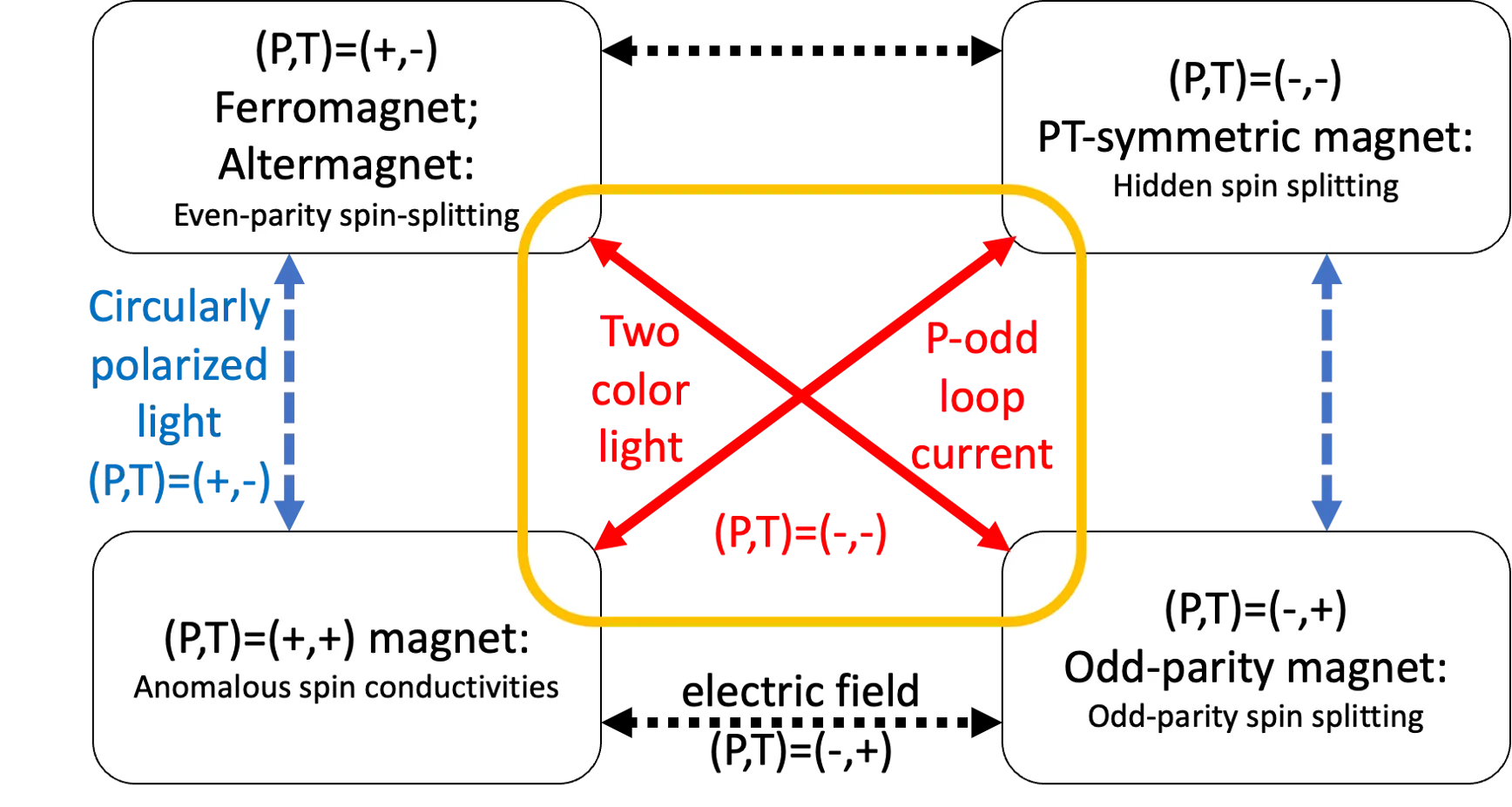
In a piece of ordinary magnet, all electron spins, tiny magnetic arrows, point in the same direction. It's a formation of soldiers facing their commander. This order is called a collinear altermagnet. But physicists have found a way to make the formation 'dance': using two laser beams of different colors, beating in perfect sync, they can create a new type of magnetic pattern in the material.
Two laser beams with synchronized phases (colors in a 1:2 ratio) generate a hidden order in the material that breaks the symmetry of spatial reflection. Simply put, the electron arrows start pointing differently depending on their position in the crystal — a 'spin texture' emerges. This effect is like two waves of commands hitting a line of soldiers: one makes everyone turn their heads right, the other makes those in even positions tilt forward. The result is a complex but controllable relief.
The practical value lies in the ability to control spin currents without magnetic fields or heavy metals. Usually, this requires bulky electromagnets or rare materials. Here, all you need is two light beams and an ordinary altermagnet, which are abundant in nature. The authors also showed that applying the same technique to a symmetric magnet produces an anomalous spin current — a flow of spins without dissipation, i.e., without excess heat. This is exactly what developers of spintronic chips dream of.
Original abstract
as written by the authors arXiv:2605.03026
Momentum-dependent spin splitting and its relation to inversion ($$P$$) and time-reversal ($$T$$) symmetries are central to nonrelativistic spintronics. Representative examples include collinear altermagnets with $$(P,T)=(+,-)$$ and non-collinear odd-parity magnets with $$(P,T)=(-,+)$$. In this work, we develop a theoretical framework to induce odd-parity spin splittings in the more abundant collinear altermagnets through two mechanisms: driving by a two-color linearly polarized light field or coupling to a $$P$$-odd loop-current order. Properly phase-locked two-color driving induces a static $$(P,T)=(-,-)$$ order, symmetry-equivalent to a translationally invariant $$P$$-odd loop-current order. Coupling this order to an altermagnet produces a controllable mixed-parity spin texture, opening new avenues for the electrical and optical manipulation of spin-polarized currents in spintronics applications. The same mechanism applied to a collinear $$PT$$-symmetric magnet induces a distinct $$(P,T)=(+,+)$$ state with a nonrelativistic dissipationless anomalous spin Hall conductivity. We present group-theory and microscopic Floquet theory to highlight the emergent responses.
A two-color laser field with a frequency ratio of 1:2 resembles the musical interval of an octave, but in the world of photons. This 'optical octave' makes electrons oscillate anharmonically, which gives rise to the unusual magnetic order.
In Arthur C. Clarke's novel 'Childhood's End', aliens controlled matter with fields. It seems we are learning to do the same — using light to restructure the internal architecture of magnets.