quantity

renyi entropy

A family of entropy measures generalizing von Neumann entropy, parameterized by a positive order α.
9 related articles

Description

Rényi entropy is a family of information-theoretic measures that generalize the von Neumann entropy, parameterized by a positive real order α. For α approaching 1, it reduces to the standard Shannon or von Neumann entropy, while other α values emphasize different aspects of a probability distribution, such as rare or common events. In physics, it quantifies entanglement and complexity in quantum systems, from spin chains to black holes.

History

Introduced by Alfréd Rényi in 1961 as a generalization of Shannon entropy. Its application to quantum systems grew in the 2000s with advances in entanglement theory.

How it works

For a quantum state with density matrix ρ, the Rényi entropy is defined as S_α(ρ) = (1/(1-α)) log Tr(ρ^α). By varying α, one can probe the spectrum of eigenvalues of ρ: lower α highlights larger probabilities, higher α highlights smaller ones. In many-body systems, the scaling of Rényi entropy with subsystem size reveals universal properties like central charge in conformal field theories.

In practice

It is used to measure the complexity of turbulent flows and to detect hidden order in phase transitions, as in the article 'Танцующий хаос: как измерить сложность турбулентности'.

Fun fact

In quantum field theory, the Rényi entropy for α=2 is often easier to compute than the von Neumann entropy, and it can be measured in experiments via 'entanglement spectroscopy'.

Concept graph →

Related articles · 9

Measuring Chaos Without Burning Extra Copies
A quantum state is like mountain weather: it changes with every glance. To estimate its uncertainty, physicists make copies and take measurements. Each copy is a thermometer that breaks after use.
Strongly Correlated2026-08-042 minarXiv:2608.04098express
Strange Metal: When Pollen and Wind Get Tangled Together
The wind carries pollen, and each grain moves as if on its own. But once the air swirls into a vortex, the pollen trajectories can no longer be separated: they are tangled. This is roughly how electrons behave in a strange metal: their motion is so strongly coupled to soft fluctuations of the medium that the usual particle carriers disappear.
Statistical Mech2026-07-281 minarXiv:2607.25625express
How symmetry hides in a spin chain
A quantum chain is like a string of lights, where the bulbs are the spins of particles. Ideally, all bulbs glow in sync, following a common rhythm: that's symmetry. But if you cut off a piece of the string, the rhythm can get out of step: within that segment, symmetry is broken. Physicists study a chain of strongly interacting particles (the XYZ model).
Mesoscale2026-07-023 minarXiv:2607.02188
Quantum Fingerprint: Anyon Entropy Reveals Their Topological Nature
The hunt for non-Abelian anyons is a quest for a quantum ghost that leaves only one clue: entropy. These particles live in two-dimensional systems at ultralow temperatures. Their exchange doesn't just flip the sign of the wavefunction — it entangles states, creating topological order.
Materials2026-06-071 minarXiv:2606.08686express
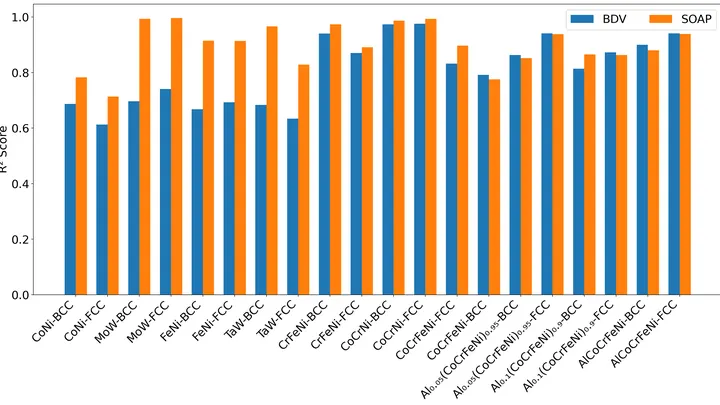
How Entropy Predicts Alloy Structures
Creating an alloy from several metals is like cooking a soup from mysterious ingredients: guessing the final texture without trial and error is nearly impossible. Conventional models often get it wrong when there are more than three different kinds of atoms.
HEP Theory2026-05-272 minarXiv:2605.28958express
How a Patch of Space Gives Birth to a Quantum Whole
A soap bubble hangs in the air, and its shape already contains everything needed to calculate the internal tension. A similar principle worked in a new study on quantum gravity. Physicists took a closed surface, an analog of such a bubble, and specified a few numbers on it: for example, the electric field strength and the curvature.
Statistical Mech2026-04-212 minarXiv:2604.19244express
How a Leaderless Rearrangement Points to Hidden Order
An orchestra without a conductor is playing, and suddenly, without any visible cue, the violins grow louder and the woodwinds shift slightly in time. From the outside, nothing seems to have changed, but inside the ensemble, a regrouping has occurred. This is roughly how small physical systems behave during so-called third-order pseudotransitions.
Plasma Physics2026-01-311 minarXiv:2602.00600express
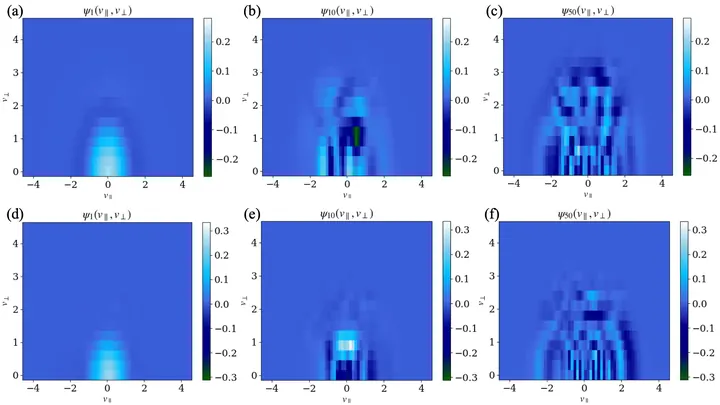
Dancing Chaos: How to Measure the Complexity of Turbulence
Hot plasma in a future fusion reactor is like a packed dance floor: billions of particles whirl in a complex rhythm, colliding and changing speed. Figuring out how tangled this dance is — no easy task. Scientists have found a way to measure its complexity without watching every move.
Nuclear Theory2026-01-101 minarXiv:2601.06544express
Quantum Entanglement in the Atomic Nucleus
The atomic nucleus is not just a bag of protons and neutrons. It is a quantum system where particles are bound by invisible threads of entanglement. When two protons or neutrons interact, their states become intertwined so that describing one without the other is impossible.