The Singularity That Never Was: How Quantum Tango Erases the Beginning of the Universe ✛ ✦
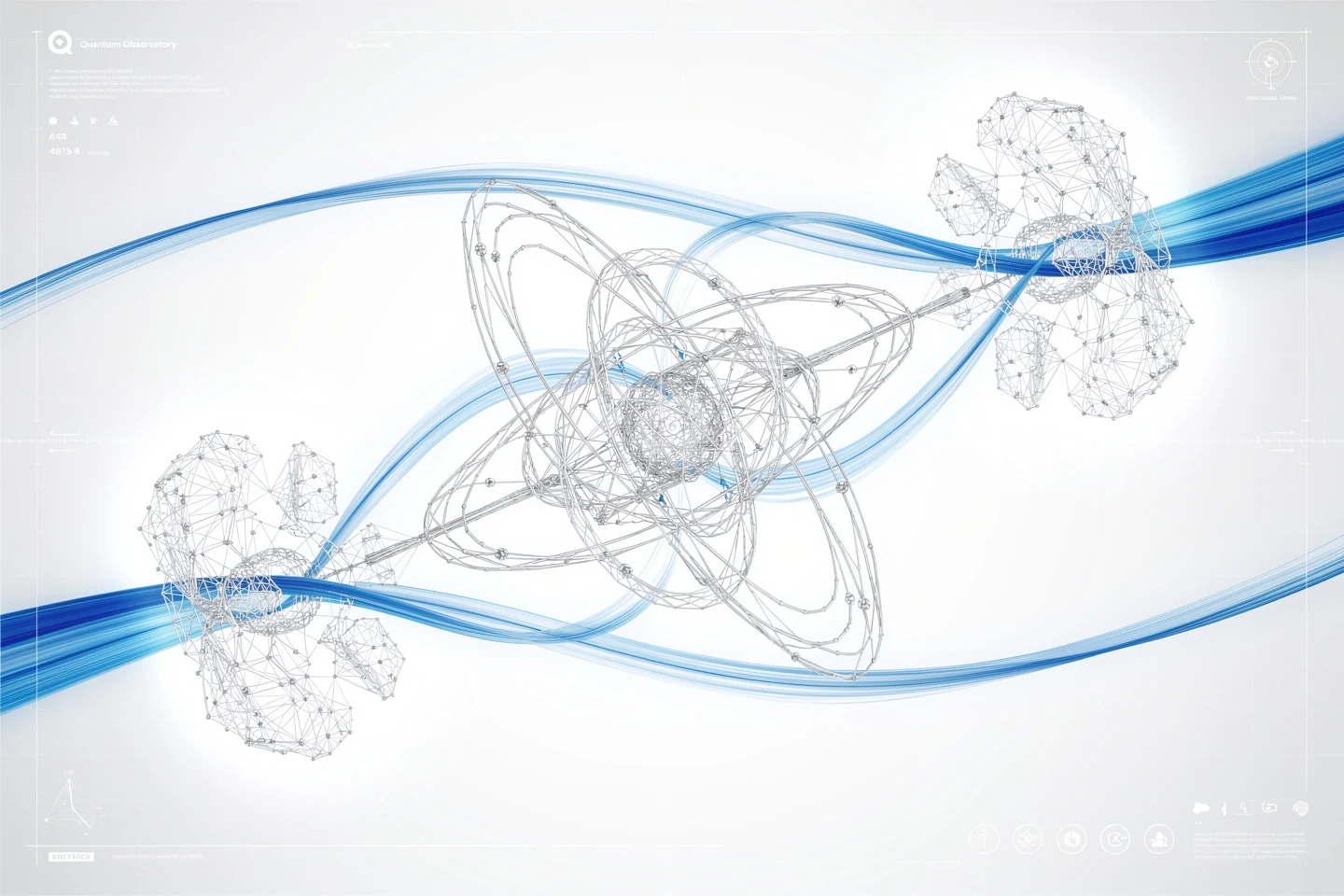
In physics, there's an old ache. General relativity paints the beginning of the universe as a point — a singularity where equations break down and volume shrinks to zero. Quantum mechanics hints that at the most critical moment, something goes differently than classical physics predicts. Canonical quantum gravity turns time into a ghost. The Wheeler–DeWitt equation — Ĥ|Ψ⟩=0 — seems to photograph the entire universe at once: no past, no future, just a frozen wave function.
However, in 1983, William Wootters and his colleague proposed a radical view: time is born not from the outside, but from quantum correlation between parts of the system. The universe is its own clock. Moreover, the choice of internal clocks is not unique: any entangled subsystems can become clocks for each other, generating a polyphonic time. Imagine a pair of tango dancers on an infinite stage without an orchestra. Their movements are not governed by an external rhythm — the rhythm emerges from their embrace, from constant mutual adjustment. So in the Big Bang model: the volume of space α and its degree of anisotropy β intertwine in an entangled dance, and it is their mutual play that sets the pace of internal time.
Calculating the conditional probability of volume given fixed clock readings showed: zero volume — a dead point, a pause — has zero probability. Expansion never starts from a point; the universe is always already in motion, like dancers who cannot freeze without breaking their embrace.
This relational approach flips our understanding of the origin of everything. If time and space are merely shadows of quantum information, the cosmos becomes a holographic stage where matter, gravity, and superposition are woven together. Future numerical simulations may show how inflation and quantum measurements emerge from this dance — their imprints we see in the cosmic microwave background.
This work is not just a mathematical exercise. It builds a bridge between quantum mechanics and cosmology, where the classical Big Bang melts into a quantum fog. A full theory of quantum gravity is still far off, but its outlines are emerging: the 'beginning of the universe' ceases to be a paradox. Perhaps our world is just one of the patterns on the canvas of eternal quantum correlations.
The Page-Wootters paradox (1983): without external clocks, any change is an illusion born of entanglement. The universe resembles a film reel: it's still until you run your finger along the frames.
This concept echoes the bootstrap paradox from Robert Heinlein's story 'By His Bootstraps': there, time also creates itself without an external reference point, looping causes and effects.