Dark Excitons: A Quantum Trickle in a Chip express
In a thin sandwich of semiconductors, light creates pairs, an electron and a positive hole, that stick together like a ball on a rubber band. Normally, such pairs, called excitons, quickly emit light and vanish. But there are others, dark ones, that live hundreds of times longer because their internal structure forbids them from easily giving off energy. These long-lived particles, the authors found, can align into a single rhythm and flow as a coherent quantum wave.
The transition to a common rhythm, condensation, here is not like water freezing into ice. The system is constantly pumped with light and loses particles, and the balance of gain and loss becomes crucial. Thanks to their long life, dark excitons "outshout" their faster bright counterparts and take the lead voice. When they become numerous, they begin to influence the spins of atomic nuclei in the crystal, like a conductor whose baton makes the entire nuclear orchestra turn in one direction. This effect, called nuclear polarization, spreads far beyond the illuminated spot and manifests as system memory: its state depends on history.
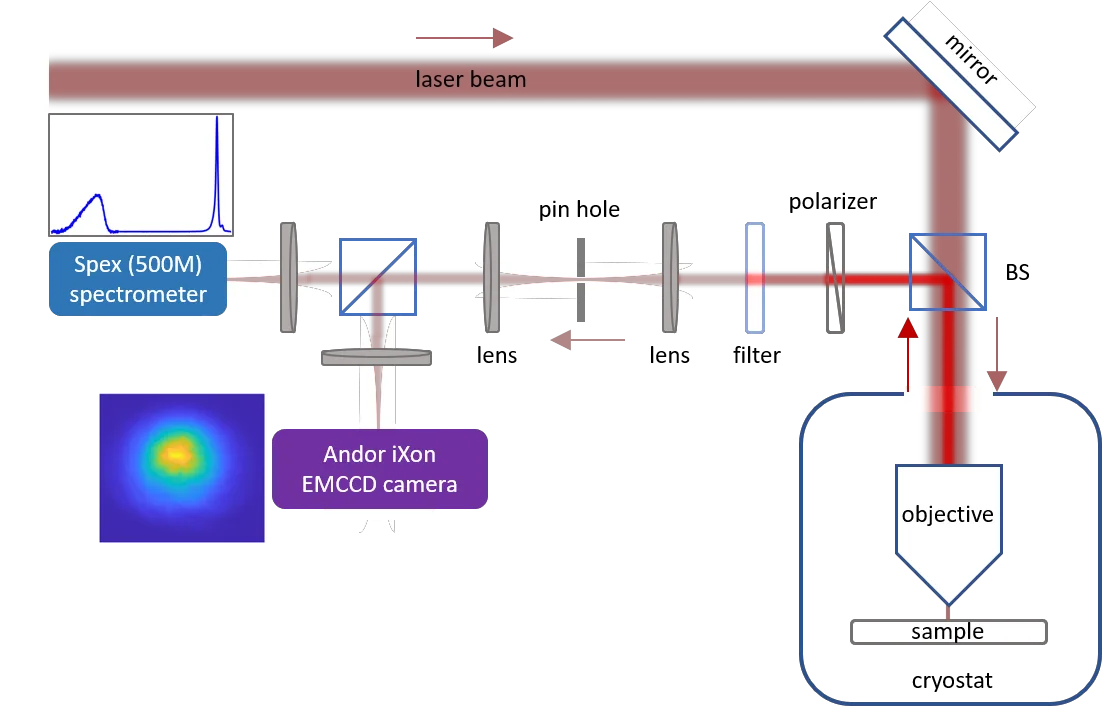
The brightest sign of coherence is interference. The exciton flow reaches the sample edge, reflects, and overlaps with the wave coming from the center. Ripples appear, alternating bright and dark fringes in the emission, from which one can measure the coherence length, that is, the distance over which particles "remember" a common phase. In the experiment, these ripples are visible on millimeter scales — a huge distance for the quantum world.
Thus, dark excitons become a bridge between two worlds: on one hand, they resemble polariton condensates, where light and matter are mixed, and on the other, denser excitonic systems. And unlike polaritons, they can be controlled by an electric field, simply by applying a voltage to the chip. This promises compact devices for quantum signal processing, where information is carried not by individual electrons but by an entire coherent wave.
The lifetime of a dark exciton in this experiment reached microseconds — an eternity for quantum particles. In that time, light travels 300 meters in vacuum, yet the exciton has not decayed.
The idea of a quantum liquid controlled by voltage evokes the "liquid light" from Greg Bear's novel "The City at the End of Time," where information flows through crystalline lattices like water through pipes.