Dark matter core formation refers to the hypothesized process by which dark matter particles clump together into dense, compact structures, potentially forming 'dark nuclei' or dense cores within larger halos. This idea arises from models where dark matter has self-interactions or forms quantum condensates, leading to gravitational collapse on small scales. Such cores could influence the dynamics of galaxies, black hole formation, and the distribution of dark matter in the universe.
History
The concept gained traction in the 2000s, particularly with the development of self-interacting dark matter models by David Spergel and Paul Steinhardt (2000) and later studies of axion-like condensates.
How it works
In these models, dark matter particles interact with each other (beyond gravity) or behave as a quantum fluid, allowing them to lose energy and collapse into dense regions. For example, in self-interacting dark matter scenarios, collisions can cool the particles, causing them to sink toward the center of a halo and form a core. Alternatively, ultralight bosonic dark matter could form a Bose-Einstein condensate, producing a solitonic core with a characteristic density profile.
In practice
This research informs astrophysical observations of galaxy rotation curves and black hole mass distributions, helping to constrain the nature of dark matter.
Fun fact
Some models predict that dark matter cores could be so dense that they collapse into small black holes, potentially explaining the origin of intermediate-mass black holes.
Under an electron microscope, a protein looks like a series of blurry shadows — hundreds of thousands of images of the same molecule, but from different angles and with heavy noise. Previously, from these shadows, one first assembled a volumetric 'haze'—a map of how electric charge is distributed inside the protein.
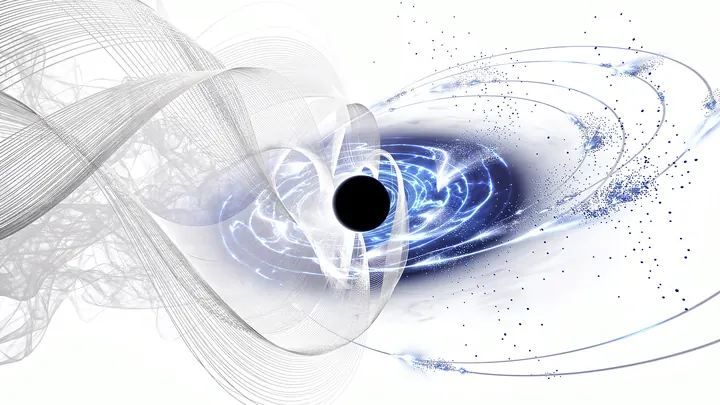
A black hole isn't just a cosmic vacuum cleaner. If it rotates, it can amplify waves around it, much like a mountain echo repeats sound. For ultralight dark matter (particles billions of times lighter than an electron), this effect, called superradiance, can create a huge cloud.
A globular cluster, a dense swarm of hundreds of thousands of stars, plows through a galaxy like a bullet through water. In ordinary dark matter (the invisible mass that holds galaxies together), it should quickly lose speed due to dynamical friction.
Three invisible strings oscillate in the intergalactic void. This is not poetry, but a hypothesis about the nature of dark matter — an ultralight quantum field with spin 1, carrying three polarizations.
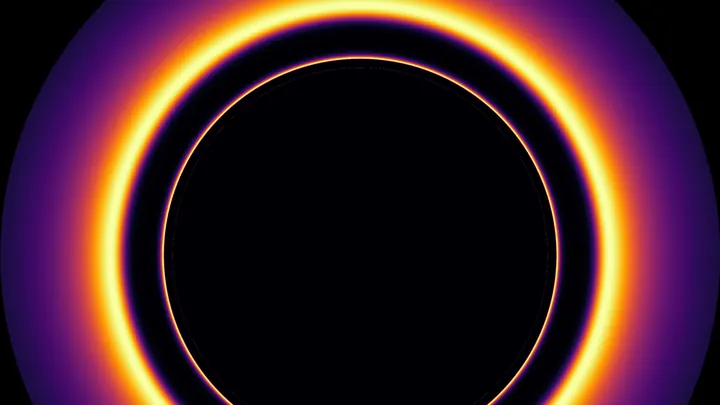
A star runs out of fuel and rapidly collapses under its own gravity. According to classical ideas, it collapses into a point of infinite density — a singularity. But what if nature abhors infinities? In models of regular black holes, instead of a singularity, a dense core of unknown matter forms at the center.
An ordinary black hole hides a singularity at its center — a point where density and curvature become infinite and the laws of physics break down. The authors of the new work built a model of a rotating black hole that, instead of a singularity, contains a calm "core" resembling ordinary flat space.
At the center of many galaxies lurks an invisible cloud — a halo of dark matter. If this matter is cold and light enough, it behaves like a superfluid: it flows without friction, and any rotation in it twists into tiny quantum vortices — threads the size of an atomic nucleus.
In the heart of a dense star cluster, a true forge reigns: here stars, like glowing blanks, collide and merge under gravity, and these mergers are not a catastrophe but an opportunity. Each strike of the stellar hammer transfers spin to the future black hole.
The early universe at redshift z>7 was an arena of rampant growth: black holes with masses up to a billion solar masses already blazed as quasars, devouring gas at monstrous rates. How these giants managed to grow in such a short time is one of astrophysics' sharpest puzzles.
In the search for the nature of dark matter, one of the most intriguing hypotheses traces back to the first moments after the Big Bang. Back then, quantum fluctuations of the inflation field gave rise to clumps of matter that could collapse into primordial black holes.
At the center of a galaxy, gravity condenses dark matter into a dense 'spike.' Such a dark spike resembles a funnel of invisible particles around a massive body. But if both the center and the particles are primordial black holes, the picture breaks down.
At the center of many galaxies lurks an invisible halo of dark matter: it holds the stars at the edges, keeping them from flying apart. For a long time, it was described as a dilute gas of particles, but new work offers a different view: dark matter might gather into a quantum droplet.
Just a few hundred million years after the Big Bang, in the ocean of invisible dark matter, giant black holes were already taking shape. They were born from the matter itself — without any help from stars. This mechanism, based on the equations of Lemaître, explains their early appearance.
If you squeeze a handful of sand, it gets denser, but at some point the grains press against each other: there's no more room to compress. Some theorists think space behaves similarly at ultra-small distances: it has a limit to divisibility, a kind of 'grain.' In this new study, that principle was applied to the birth of black holes in the early universe — the very ones that…
Imagine a spinning top the size of a city, weighing more than the Sun and making hundreds of revolutions per second. That's a neutron star — the remnant of an exploded star. Occasionally, its rotation suddenly speeds up, as if something inside has switched. Astronomers call these jumps glitches and suspect that invisible vortices in the star's superfluid interior are to blame.
In the quantum world, dark matter particles can merge into a single superfluid droplet — a state where matter flows without friction, like an ideal fluid. When near a black hole, this droplet doesn’t just disappear into it but twists into stable vortices, like water swirling around a rock in a stream.
Black holes come in two types: tiny ones — the remnants of supernova explosions, and giants in the cores of galaxies. But where are the intermediate ones, with hundreds and thousands of solar masses? The answer may lie in star swarms, where black holes collide like balls on a billiard table and, merging, bulk up.
Two black holes fly toward each other and collide head-on. In the familiar picture, their horizons (the surfaces from which not even light can escape) stretch toward each other like water droplets and merge into one smooth shape. But calculations show otherwise: before merging, a sharp beak, a cusp, extends from each horizon.
In the seething cauldron of the early universe, the vacuum, like a supercooled liquid, could boil with bubbles of a new phase. For a long time, physicists pinned their hopes on these bubbles as a source of primordial black holes (PBHs)—ideal candidates for dark matter.
In a thin sandwich of semiconductors, light creates pairs, an electron and a positive hole, that stick together like a ball on a rubber band. Normally, such pairs, called excitons, quickly emit light and vanish. But there are others, dark ones, that live hundreds of times longer because their internal structure forbids them from easily giving off energy.
In a large gas cloud where stars are born, the magnetic field lines are roughly aligned in one direction, like the fibers in a piece of felt. But look inside, into the dense clumps that will eventually become stars, and the picture changes: there the lines are twisted every which way, like a ball of yarn after a kitten has played with it.
The cosmic web resembles a giant three-dimensional network: galaxies and clusters are connected by filaments of dark matter. These filaments act as invisible bridges along which matter flows toward major nodes. For a long time, scientists struggled to understand the density structure of these filaments, but results were contradictory.
The brain is like a sprawling city: districts-regions communicate via streets-neural pathways. If traffic lights at an intersection fail, traffic grinds to a halt. Similarly, in the brain, when bundles of nerve fibers (white matter) malfunction, distant regions stop working in concert, and thought stalls.
The James Webb Space Telescope peered into the galaxy cluster AS1063 and spotted tens of thousands of globular clusters — dense stellar "knots" scattered throughout the cluster. Their positions matched the map of invisible mass, which is constructed from the bending of light from distant galaxies.
Dark matter is the invisible framework of the Universe. It doesn't emit light, but its gravity keeps galaxies from flying apart. A new hypothesis: dark matter consists of dark photons — ghostly particles that are invisible under ordinary conditions.
At the centers of many galaxies lurk supermassive black holes, surrounded by disks of gas, cosmic dust, and stars. Their collisions can spawn gravitational waves — ripples in spacetime.
The James Webb telescope spotted “red dots” in the early Universe — dense objects tens of light-years across. Spectroscopic analysis of their light revealed the hue of hydrogen. Yet in X-rays they are nearly invisible, like a powerful spotlight wrapped in layers of gas curtains.
In laboratories on Earth, Bose-Einstein condensates are created by cooling a cloud of atoms to billionths of a kelvin. The atoms lose their individuality and merge into a single quantum wave that behaves as one entity. But in space, such conditions are not needed: gravity itself creates deep wells where matter compresses and cools into a state of quantum fog.