How to Make Quantum and Molecular Worlds Get Along express
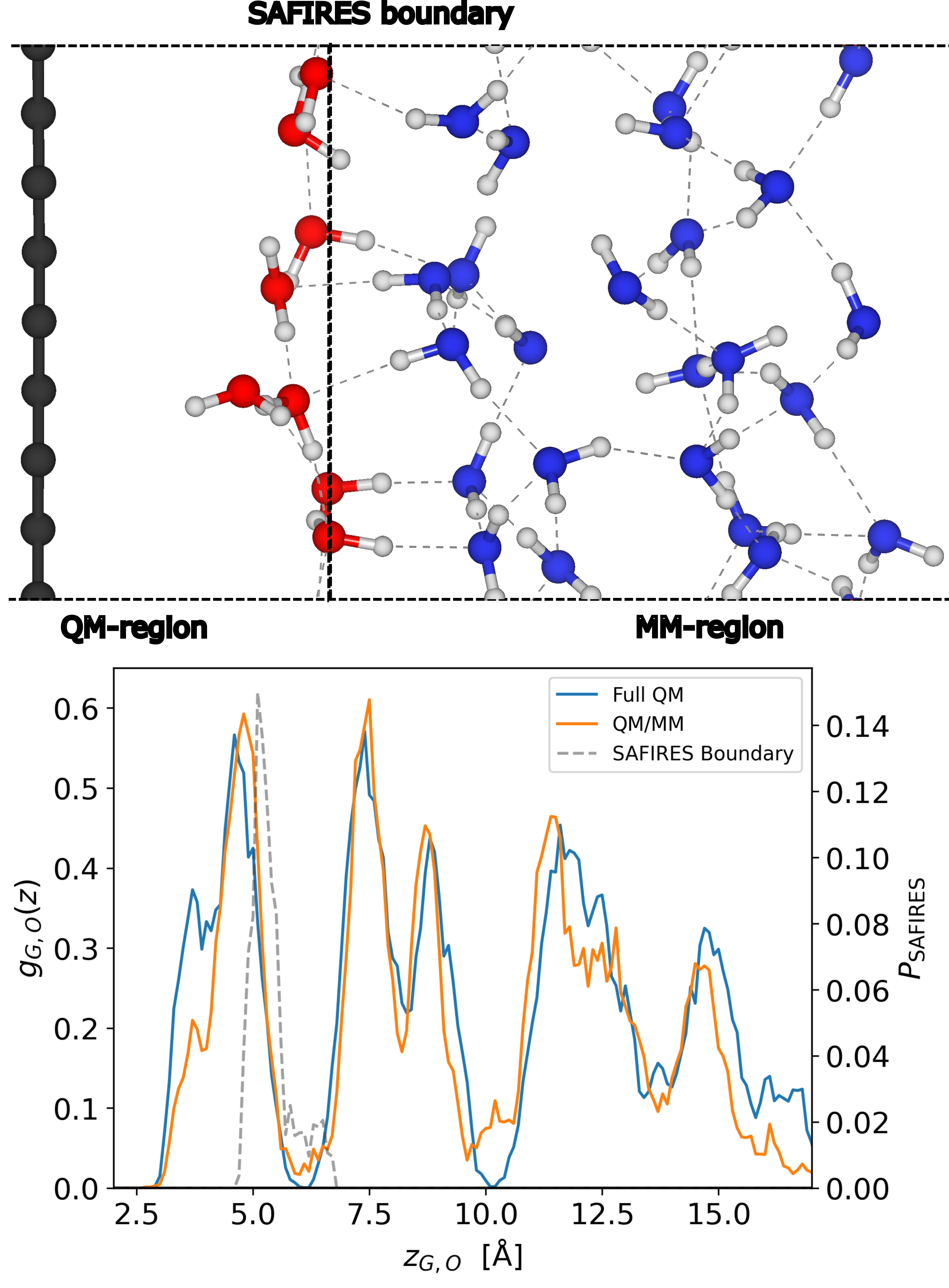
Imagine a huge swimming pool. In one corner, a chemical reaction is underway that needs to be calculated with jeweler-like precision. But the surrounding water is not just decoration: its molecules jostle, attract, and influence the reaction. How do you account for this endless dance of particles without drowning in calculations? The authors of the paper offer a solution — a flexible bridge between two worlds: exact quantum mechanics and fast molecular mechanics.
Quantum mechanics is like a watchmaker working with a magnifying glass: every electron counts, and forces between atoms are computed down to the last detail. But this approach quickly runs out of breath if there are hundreds of molecules around. Molecular mechanics, on the other hand, is like a bird's-eye view: molecules are simplified balls connected by springs, easy to compute, but subtleties get lost. The new method merges these approaches. The spotlight is on a small region where the reaction occurs. That region is treated quantum-mechanically. Around it lies a "sea" of water molecules, described in a simplified but clever way: each molecule is given not just a charge but a whole set of electrical "fingerprints"—from a simple charge shift to complex patterns. Thanks to this, the water senses the reaction, and the reaction senses the water.
The main trick is how to handle infinity. In a crystal or liquid, molecules repeat to the horizon, and computing every pair is pointless. The authors divide space into two zones. In the near zone, everything is honest: each molecule interacts directly with the quantum center and its neighbors. In the far zone, molecules are grouped together and replaced by a whole "bouquet" of electrical characteristics at a single point. This is like looking at a crowd from a distance: you can't make out faces, but the overall movement and murmur convey what's happening well. The transition between zones is smoothed with a special "softening" function, so there are no sharp jumps at the boundary, like on poorly pasted wallpaper.
The result is not just another formula but a carefully calibrated recipe where the accuracy of quantum calculations is preserved, and speed remains acceptable for large systems. Tests show that results match pure quantum calculations where they can be checked, but cover a much larger volume. This approach lets you examine each leaf on a tree without getting close, just by looking out the window. It will be useful for modeling catalysis, drug dissolution, or water behavior in living cells — anywhere where every water molecule matters, but computing them all "head-on" is impossible.
Original abstract
as written by the authors arXiv:2605.09752
A general polarizable embedded (PE) quantum mechanics/molecular mechanics scheme for periodic systems is presented, describing mutual polarization of the two subsystems. The QM system, described with density functional theory (DFT), is coupled to a single center multipole expansion (SCME) model, characterising H$$_2$$O molecules in the MM region. In SCME the H$$_2$$O molecules are ascribed anisotropic dipole and quadrupole polarizabilities and permanent multipoles up to and including the hexadecapole. Our embedding scheme illustrates a smooth and efficient convergence pattern of the periodic interaction potential by introducing a single and clustered multipole expansion points in the far-field. By choosing the near- and far-field expansion of the potential carefully the PE-QM/MM calculation matches the level of accuracy of a the QM calculation. In the short range, the electrostatic interaction between the QM and MM subsystems is damped with a real-space and pair-wise isotropic damping functions - resulting in a screened interaction and preventing over-polarization. In molecular dynamics simulations the two subsystems are separated with the elastic scattering assisted flexible inner region [Kirchhoff et. al. JCTC, 2021, 17, 9, 5863] - ensuring a smooth transition in the radial distribution at the boundary between the two subsystems.
A water molecule can have up to 16 electrical "fingerprints" of different shapes — from a simple charge shift to a complex pattern resembling a flower with six petals.