Simple

Two Atomic Beams and the Invisible Tremor of Space

Original: "Quantum gravitational deflection of parallel matter wave beams"
· Soham Sen, Vlatko Vedral
arXiv:2605.11035v1 · 2026-05-11 · CC BY 4.0 · ⏱ 1 min · General Relativity HEP Theory
Scientists have found a way to capture the quantum tremor of the void by monitoring the distance between two atomic beams.
Abstract

Light rays traveling parallel do not bend each other. Scientists proposed replacing light with atomic beams from Bose-Einstein condensates. It turns out that due to quantum properties of gravity, the distance between them starts to tremble—like two boats on choppy water. Could this trembling be the key to unlocking the quantum nature of gravity?

Links in the knowledge graph 1

Space trembles. Richard Feynman was the first to suggest that even in a vacuum, quantum laws make it constantly jitter. These aren't waves from massive bodies, but the built-in tremor of the vacuum—like ripples on the wind that never die down.

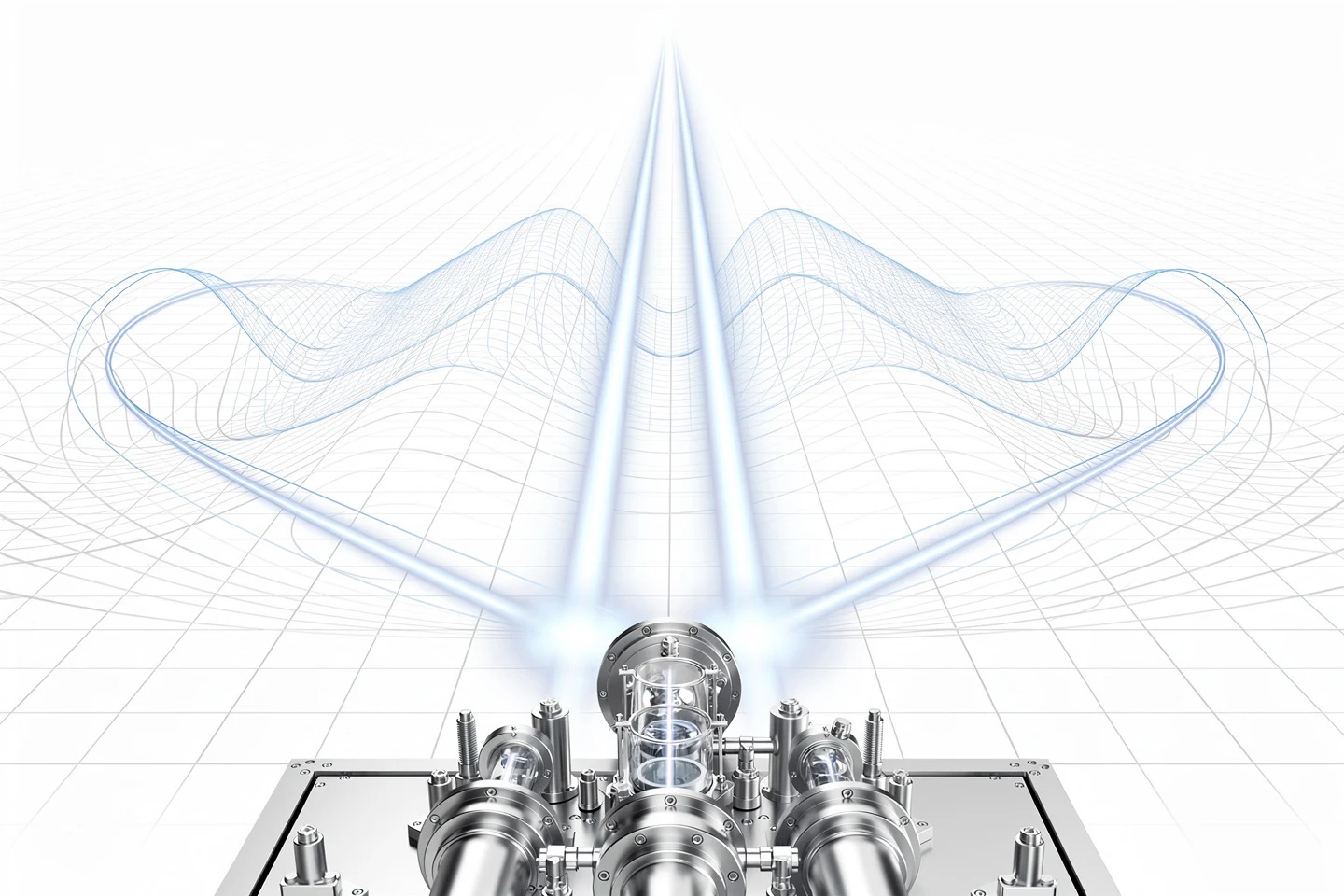
The experiment relies on a super-cold atomic cloud, where atoms merge into a single wave. From it, two parallel beams are released. According to Einstein's theory of gravity, the distance between them is constant. But quantum corrections make themselves known: space curves slightly and pulls the beams, making them wander. Bryce DeWitt back in the 1960s showed that any massive bodies experience this jitter due to the exchange of virtual gravitational waves.

The key is that this effect doesn't require studying entangled states or superpositions of geometries—just a precise measurement of distance. Modern instruments, using the wave properties of atoms, are already close to the necessary sensitivity. The amplitude of the fluctuations is a hundred billion times thinner than a hair, but by capturing it, we would prove the quantum nature of gravity and create sensors that can hear the tremor of the cosmos.

🎯 The amplitude of these fluctuations is a hundred billion times thinner than a human hair—smaller than a proton. Detecting them requires the most sensitive atomic 'rulers' in the world.

\Delta x(\tau) \sim \frac{4\sqrt{2} N_0 G m \tau^2}{d^2} \left(\frac{m \omega d^2}{2\hbar}\right)^{3/2} e^{-\frac{m\omega d^2}{4\hbar}}
Quantum-gravitational uncertainty in geodesic beam separation grows quadratically with free-fall time and depends exponentially on the distance between condensates.
Scientists
Erwin SchrödingerHugh Everett IIINiels BohrPascual JordanWerner HeisenbergStephen Hawking
Tags
Bose-Einstein condensate gravitational waves spacetime curvature quantum entanglement Quantum Field quantum measurement superposition wave-particle duality gravity
Laws
Schrödinger equationHeisenberg uncertainty principleHawking radiationNoether's theoremEinstein field equationsPlanck–Einstein relation
Original: arXiv:2605.11035v1 · CC BY 4.0 · bridge42worlds