Quantum Tremor of Parallel Worlds: Gravity on a Laboratory Table ✛ ✦
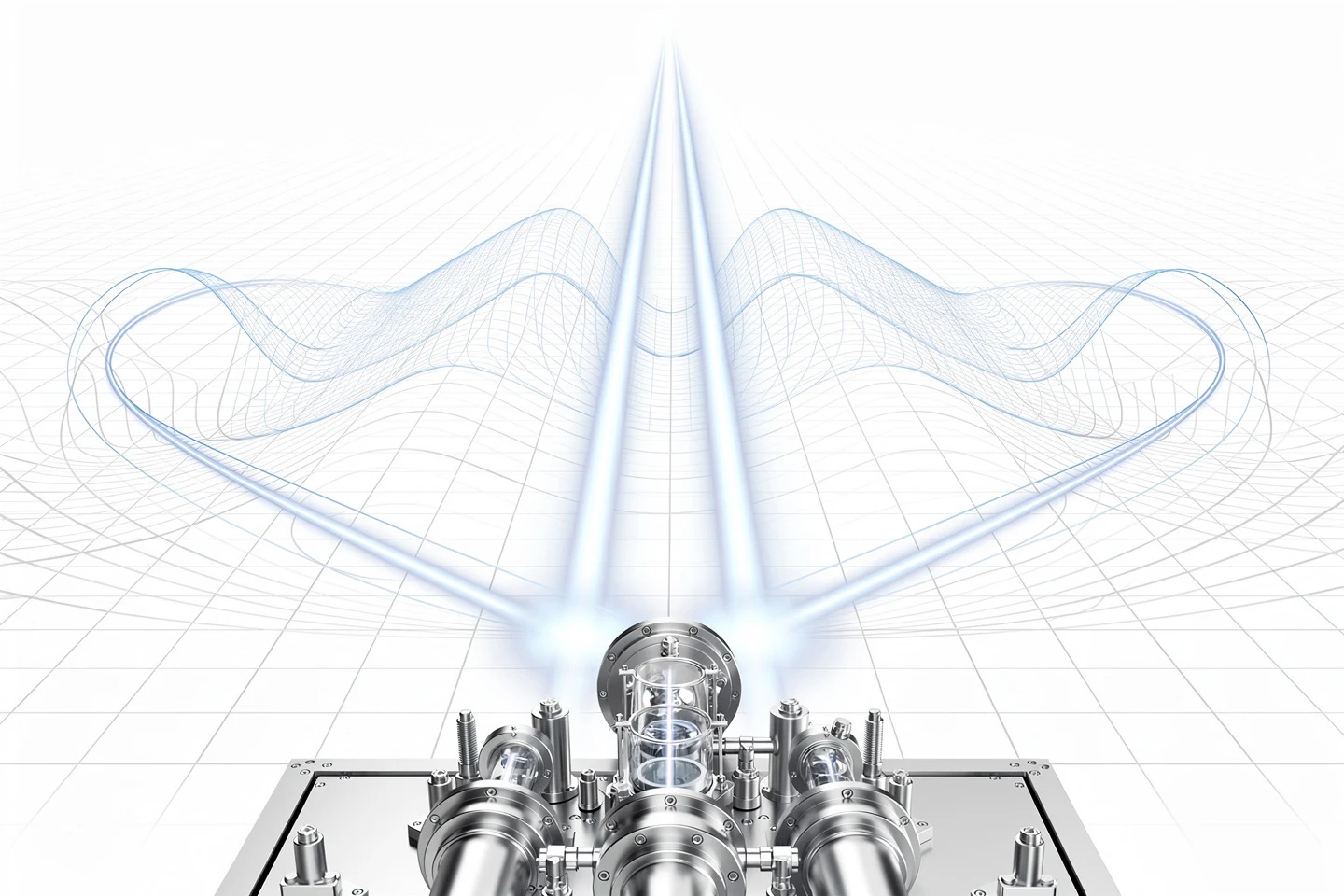
Two parallel streams of atoms, released from Bose condensates, begin their journey in free fall. In the classical picture, their separation remains unchanged — like two skiers gliding down a perfectly smooth slope. But if spacetime is not frozen snow, but a living, rippling membrane, then every tremble of it is transmitted to matter. Atoms feel microscopic jolts from quantum fluctuations, and the trajectories begin to diverge, ever so slightly. This is not instrument error, but a direct manifestation of the quantum-field nature of gravity.
The idea goes back to a long-standing question by Richard Feynman: can gravity exist in a superposition? Today we are approaching the answer using Bose–Einstein condensates — ultracold clouds of atoms behaving as a single quantum wave. In the proposed experiment, two such condensates, separated by a microscopic gap, simultaneously emit atomic lasers. Unlike photon interferometry, where trajectories are null, massive atoms follow timelike geodesics sensitive to spacetime curvature. But the most astonishing thing is that even in the absence of classical sources of gravity, a quantum jitter emerges.
Calculations by a group of theorists show that the standard deviation Δx of the beam separation grows with time τ as τ² and depends on the number of particles N₀ in the condensate. The key equation combines the quantum uncertainty of geometry with macroscopic system parameters. For realistic N₀ ≈ 10⁶, atom mass around 10⁻²⁵ kg, and flight time of 0.1–1 second, the deviation is 10⁻²⁰–10⁻¹⁸ meters — a thousand times smaller than a proton, but no longer beyond the measurable. Remarkably, the signal is robust to theory details: it arises even in the simplest linearized quantum gravity, making it a reliable candidate for first contact with quantum spacetime. The gravitational interaction here exhibits a 'tidal' character: at small gaps, the effect sharply intensifies, as if two clouds of atoms were tossing invisible gravitons back and forth, creating a quantum-entangled dance of trajectories.
Confirmation of this prediction would be revolutionary. It would mean that vacuum fluctuations of the gravitational field are real and leave a trace in the motion of quantum objects. Unlike experiments that generate entanglement via gravity, here it's not spin state that's measured, but coordinate trembling — an independent and direct test of the quantum nature of spacetime. Such an experiment weaves quantum mechanics and general relativity together not on a speculative level, but in a real setup, continuing the line started by the pioneering work of Bryce DeWitt on quantum field theory in curved space. The prospect is the creation of quantum gravity sensors capable of picking up not only waves from neutron stars, but also the whisper of quantum foam that our Universe is woven from.
Photon lasers are indifferent to each other: their light trajectories in spacetime are rigid, like taut strings. Meanwhile, atomic lasers, crawling at a snail's pace, have time to feel the quantum tremor of geometry. Where light passes fleetingly, massive atoms linger — and spacetime manages to whisper a few words to them via virtual gravitons, causing trajectories to swerve ever so slightly.