Quantum-Gravitational Deflection of Parallel Atomic Matter Beams ✛ ✦
Context
Quantum gravity remains one of the toughest challenges in physics. Direct unification leads to non-renormalizable divergences, and experimental data at Planck scales is out of reach. Hence, a key strategy has become the search for low-energy signatures of the quantum nature of gravity—for instance, through generating quantum entanglement between massive objects, as in the famous QGEM protocol. Back in the mid-20th century, Richard Feynman posed a fundamental question: are superposition and gravity compatible? Today's experiments with Bose–Einstein condensates allow us to approach an answer from a new angle—by using coherent atomic beams and sensitive interferometry.
Methods
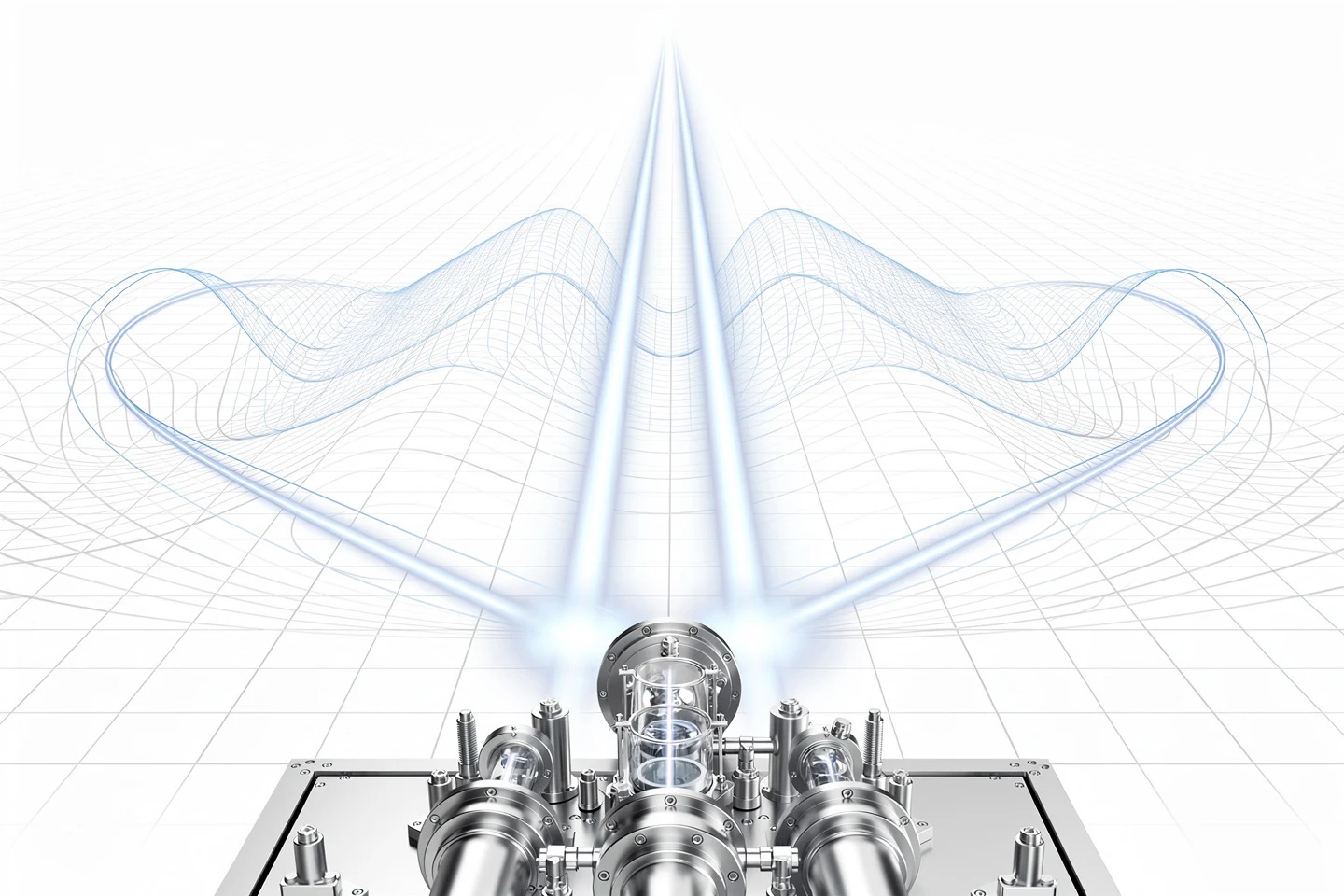
The authors proposed a model where two Bose–Einstein condensates with non-interacting bosons are held in harmonic traps at a distance d. The atoms are then released by a radio-frequency outcoupler and form two parallel atomic laser beams, freely falling in Earth's gravity. Unlike photons, whose trajectories are described by null geodesics, atoms move slower than light and follow timelike trajectories—this key difference makes deflection possible. To compute the spacetime background, linearized gravity is used, but an operator addition is introduced into the stress-energy tensor via quasiparticles (phonons), as in the pioneering works of Bryce DeWitt on quantum field theory in curved space. Thus, spacetime curvature becomes an operator, and the geodesic equation for beam separation acquires quantum corrections.
Results
Classical calculation shows no mutual deflection of two parallel photon beams. For massive atomic beams, the classical solution also yields no noticeable effect. However, under quantum-mechanical treatment, when the metric fluctuation becomes operator-valued, an irreducible noise appears in the geodesic separation. The standard deviation Δx of the coordinate difference between the beams turned out to be proportional to the number of particles N₀ in the condensate and the square of the flight time τ. For realistic parameters—N₀ = 10⁶, atomic mass m ~ 10⁻²⁵ kg, trap frequency ω ~ 10³ Hz, distance d on the order of two characteristic wave function sizes—the theoretical Δx is approximately 10⁻¹⁸ τ² m. For a lab free-fall time of τ ~ 0.1–1 s, this gives a deviation from 10⁻²⁰ to 10⁻¹⁸ m. In the regime of very small gaps (d < quantum length), a 'tidal' character emerges with a dependence Δx ∝ 1/d³. The effect is interpreted as resulting from the exchange of virtual gravitational waves—gravitons—between the condensates, giving rise to quantum fluctuations of their trajectories.
Implications
Detecting such a prediction would be direct evidence of the quantum-field nature of gravity. Unlike protocols based on generating quantum entanglement, here one measures not the state of internal degrees of freedom but the spread in coordinates—this is an alternative and independent test. Confirmation of the effect would mean that vacuum fluctuations of spacetime genuinely influence the motion of quantum objects, opening a new window into Planck-scale physics through a relatively low-energy experiment. Moreover, such studies lay the groundwork for quantum measurements of the gravitational field using atomic interferometry.
Future development
A natural next step is to increase sensitivity by using condensates with up to 10⁹ particles (e.g., magnon condensates) and extending free-fall time to tens of seconds in special towers or on satellites. Enhancement techniques like large momentum transfer (LMT) can boost the phase shift by another three orders of magnitude, pushing the expected fringe shifts to values accessible to precision interferometry. In the longer term, combining with ideas of quantum superposition of geometries could lead to a unified picture of quantum spacetime.
Impact
The work will impact several cutting-edge areas: experimental quantum gravity, atomic matter-wave interferometry, and quantum sensing. The results can be used to build next-generation quantum sensors of gravity.
Next steps
The immediate task is a detailed analysis of all technical noise sources in real atom-interferometric setups and a search for optimal parameters to isolate the irreducible quantum-gravitational component. Then, a dedicated experiment with two identical condensate sets is required, where one arm serves as a low-particle-number reference.
Key open problems
The proposed experiment is directly linked to the unsolved problem of non-renormalizability of quantum gravity and to the question of whether the gravitational field can be considered quantized in the low-energy limit. Success would confirm or refute fundamental assumptions about the nature of spacetime, referred to as Feynman's mass superposition dilemma, and would complement searches for gravitational waves from astrophysical sources—but at the lab scale and from the side of vacuum fluctuations.
The knowledge machine's view
This section is addressed to the author of the paper and their colleagues. Neighbouring works were found by meaning-based search across our archive, not by word overlap. We do not review: we show the field around the work.
What the work does
This work presents a model of two parallel atomic laser beams from Bose–Einstein condensates freely falling in a gravitational field. Classically, there is no mutual deflection, but when the metric is quantized, an unavoidable noise arises in the beam separation, proportional to the number of atoms and the square of the flight time. An experiment is proposed to measure this quantum-gravitational jitter, with an estimate of the expected signal.
Where its strength is
The work proposes a concrete, laboratory-realizable protocol to test the quantum nature of gravity, using timelike trajectories of massive atoms and sensitive interferometry.
Where it could go next
- It might be interesting to compare the proposed mechanism with an approach where the gravitational interaction between two atomic clouds leads to quantum entanglement without their free fall—this could clarify the connection between trajectory noise and entanglement generation.based on: Gravity Entangles Without Free Fall arXiv:2605.00967
- Closely related is the analysis of possible decoherence disturbances in experiments searching for quantum gravity; accounting for such effects could help assess the realism of observing the predicted jitter.based on: Invisible Obstacles in the Hunt for Quantum Gravity arXiv:2604.22593
- There is a paper in the archive on how gravitational waves could serve as a test of new theories; perhaps the proposed scheme could be extended to the case of a fluctuating gravitational background produced not by the static Earth field but by a passing wave.based on: Gravitational Waves to Put New Theory to the Test arXiv:2606.15295
Worth trying
- Test whether the predicted noise persists when the finite temperature of the condensate and atomic interactions are taken into account.
- Estimate the contribution of seismic and electromagnetic noise to the measured deflection under typical laboratory conditions.
- Consider using atomic interferometry with longer flight times to amplify the signal.
Why this may matter
If the effect is confirmed, it would be the first direct observation of quantum fluctuations of the gravitational field in the low-energy regime, opening a new window into physics beyond the Standard Model.
Nearby works in our archive
- Gravity Entangles Without Free Fallsimilarity 0.70
- Gravitational Waves to Put New Theory to the Testsimilarity 0.68
- Quantum Gravity Trick: How Atom Clouds Harmonize Through Spacetimesimilarity 0.67
- The Universe as a Web of Quantum Connectionssimilarity 0.67
- Gravity Entangles Light and Mattersimilarity 0.67
- Quantum Tangles: How to Spot an Invisible Connectionsimilarity 0.66
- Invisible Obstacles in the Hunt for Quantum Gravitysimilarity 0.66
The closest work in the archive sits at 0.70 by meaning — the usual level for our corpus.
Original abstract
as written by the authors arXiv:2605.11035v1
It is well known that two parallel photon beams do not deflect under the effect of their energy-momentum tensor. In this work, we propose a novel model where two spatially separated Bose-Einstein condensates are outcoupled to create two parallel atom laser beams. We find out that apart from the classical deflection, a purely quantum gravity induced tidal deflection is observed which results in an irreducible noise in the geodesic separation of the two beams. Based on this simple but novel theoretical outcome, we propose an experimental model for detecting this quantum gravity induced standard deviation in the geodesic separation of the two parallel matter-wave beams.
In the usual picture, two parallel laser beams never change their distance, even if they carry significant energy. Atomic lasers, however, due to their low speed and timelike trajectory, experience mutual influence, but only thanks to the quantum nature of gravity: it's like a 'shiver' of space caused by the exchange of invisible gravitons between the falling streams of atoms.
Key numbers
- Standard deviation Δx: 10⁻¹⁸ – 10⁻²¹ m (for N₀ = 10⁶ and τ = 0.1–1 s)
- Increase of Δx over time: ~10⁻²⁰ m per second of fall
- Phase shift in the interference pattern: ~10⁻¹³ rad (without enhancement)
- Expected shift of interference fringes: ~10⁻¹⁸ m (in a standard setup), up to 10⁻¹⁰ m with optimization
- Number of atoms in the condensate: N₀ = 10⁶ (can be increased up to 10⁹)