One Tile to Rule Them All express
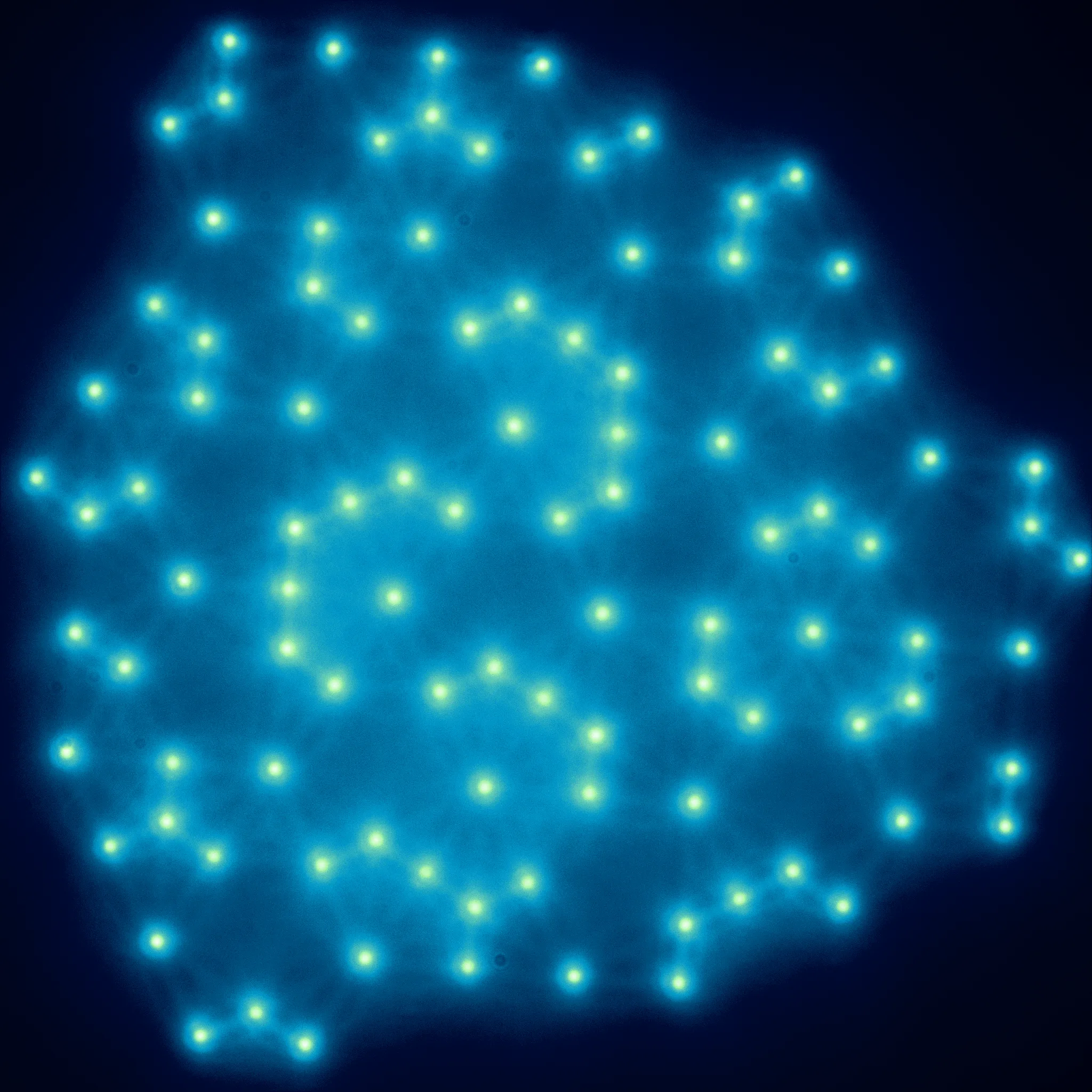
Tile a floor with identical triangles, and you get a boring repeating pattern. But what if you want the pattern to never repeat, yet use just one tile? For a long time, mathematicians were sure it couldn't be done: you'd need at least two different shapes. The famous Penrose mosaic is a case in point: rhombi with acute and obtuse angles arrange into an infinitely varied but strictly ordered pattern. However, in 2024, a remarkable shape was found — the 'einstein' (from the German for 'one stone'). It's a polygon with a rather whimsical outline, resembling a hat or a shirt. It can cover the infinite plane without gaps and without repetition.
Now, a team of scientists has for the first time turned this mathematical abstraction into a real material. They created a microscopic cavity filled with light and matter, and used a laser to burn a pattern of identical 'einstein tiles' into it. At each vertex of such a tile, a tiny blob of light emerged — a polariton condensate, akin to a droplet of laser emission. These droplets began to pulse and interact with each other, like musicians in an orchestra tuning their rhythm to their neighbors. But because of the unusual arrangement of the 'musicians,' their collective melody turned out to be completely new.
When the physicists looked at the energy distribution in this glowing pattern, they saw distinct hexagonal patterns reminiscent of graphene's structure (a carbon film one atom thick). But the most interesting discovery came from measuring phases — how much the 'beats' of different condensates are shifted. In a regular periodic lattice, all droplets oscillate either in sync or in strict alternating order. In a Penrose mosaic, the picture is more complex but still predictable. But in the 'einstein' mosaic, the phases arranged into a completely new, unexpected pattern, as if the orchestra played a melody that cannot be written with standard notation. This discovery shows that identical non-repeating tiles can be used to create programmable light materials with unique properties.
Original abstract
as written by the authors arXiv:2605.13206
A plethora of unconventional localization phenomena and fractal features of linear spectrum observed in quasiperiodic structures have been accompanied by a long-standing quest for the geometrical elements and structures that permit tilings of the plane, but only in a non-periodic manner. Until 2024, it was believed that such quasiperiodic structures, or quasicrystals, could only be composed of at least two different tiles. Surprisingly, a newly discovered class of quasicrystals requires only one elementary monotile. However, its physical realization and study of propagating coherent excitations in this novel setting remained elusive. Here we optically sculpt aperiodic quasicrystals composed of "einstein" monotiles in an inorganic microcavity and observe nontrivial relative phases of the exciton-polariton condensates nonresonantly excited at the vertices of each monotile. Utilizing energy-resolved tomography in momentum-space, we reveal the formation of distinct Bragg peaks with six-fold symmetry and Dirac-like spectral fingerprints, intrinsic to the underlying graphene-like structure, while interferometric phase reconstruction shows a nontrivial synchronization pattern distinct from both periodic triangular lattices and Penrose quasicrystals. Our work demonstrates that monotiles can be converted into a programmable driven-dissipative artificial material, where long-range coherence coexists with enforced geometric aperiodicity, producing synchronization and spectral responses distinct from both periodic and conventional quasicrystalline tilings.
The 'einstein' shape was found by amateur mathematician David Smith from England. He cut tiles out of paper and spent hours arranging them until he discovered that one of the shapes never forms a repeating pattern.
In Greg Egan's novel 'Distress', alien mathematics is based on patterns that never repeat — much like these new quasicrystals made from a single tile.