One Tile to Rule Them All express
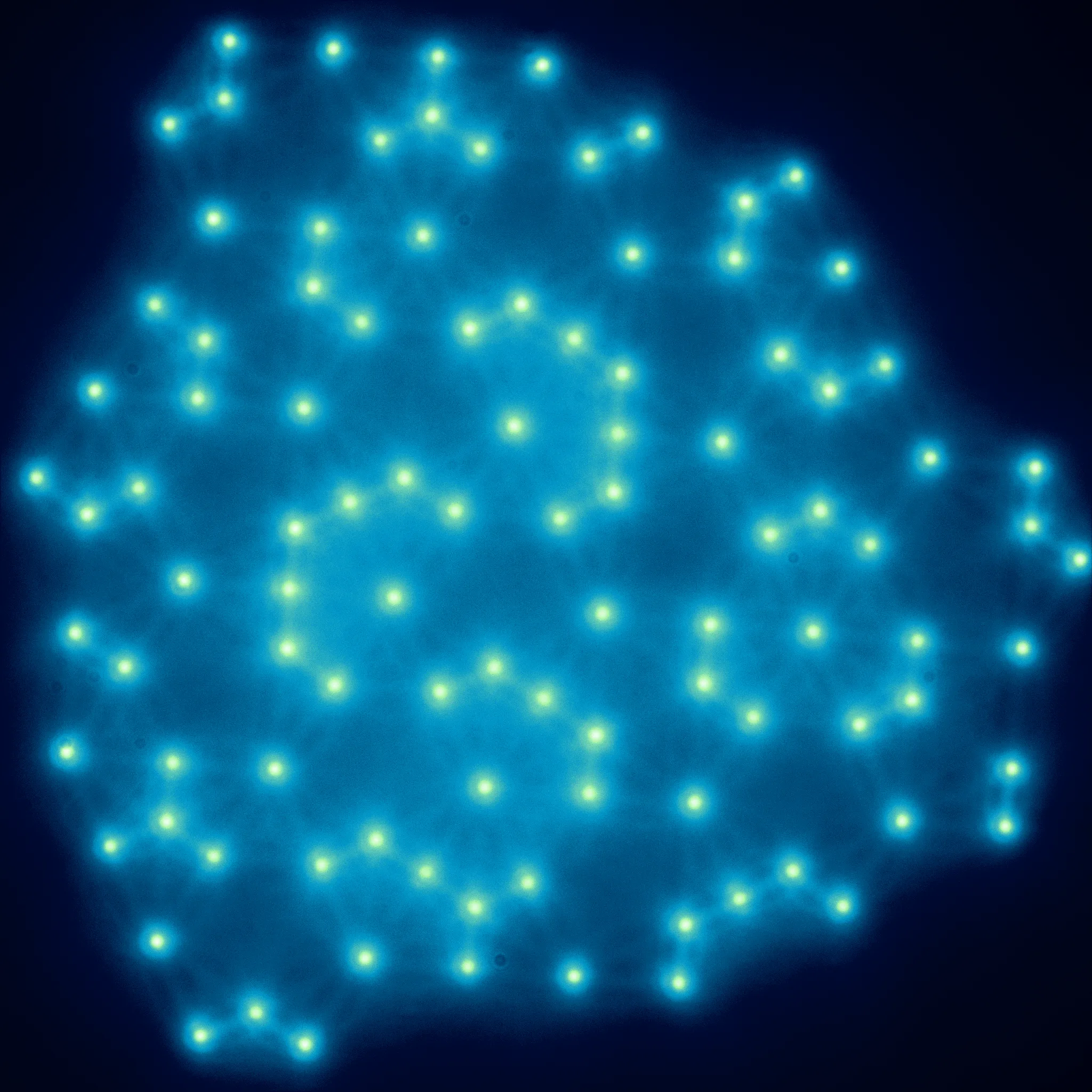
Tile a floor with identical triangles, and you get a boring repeating pattern. But what if you want the pattern to never repeat, yet use just one tile? For a long time, mathematicians were sure it couldn't be done: you'd need at least two different shapes. The famous Penrose mosaic is a case in point: rhombi with acute and obtuse angles arrange into an infinitely varied but strictly ordered pattern. However, in 2024, a remarkable shape was found — the 'einstein' (from the German for 'one stone'). It's a polygon with a rather whimsical outline, resembling a hat or a shirt. It can cover the infinite plane without gaps and without repetition.
Now, a team of scientists has for the first time turned this mathematical abstraction into a real material. They created a microscopic cavity filled with light and matter, and used a laser to burn a pattern of identical 'einstein tiles' into it. At each vertex of such a tile, a tiny blob of light emerged — a polariton condensate, akin to a droplet of laser emission. These droplets began to pulse and interact with each other, like musicians in an orchestra tuning their rhythm to their neighbors. But because of the unusual arrangement of the 'musicians,' their collective melody turned out to be completely new.
When the physicists looked at the energy distribution in this glowing pattern, they saw distinct hexagonal patterns reminiscent of graphene's structure (a carbon film one atom thick). But the most interesting discovery came from measuring phases — how much the 'beats' of different condensates are shifted. In a regular periodic lattice, all droplets oscillate either in sync or in strict alternating order. In a Penrose mosaic, the picture is more complex but still predictable. But in the 'einstein' mosaic, the phases arranged into a completely new, unexpected pattern, as if the orchestra played a melody that cannot be written with standard notation. This discovery shows that identical non-repeating tiles can be used to create programmable light materials with unique properties.
The 'einstein' shape was found by amateur mathematician David Smith from England. He cut tiles out of paper and spent hours arranging them until he discovered that one of the shapes never forms a repeating pattern.
In Greg Egan's novel 'Distress', alien mathematics is based on patterns that never repeat — much like these new quasicrystals made from a single tile.