The Birth of the Universe Through a Wormhole ✛ ✦
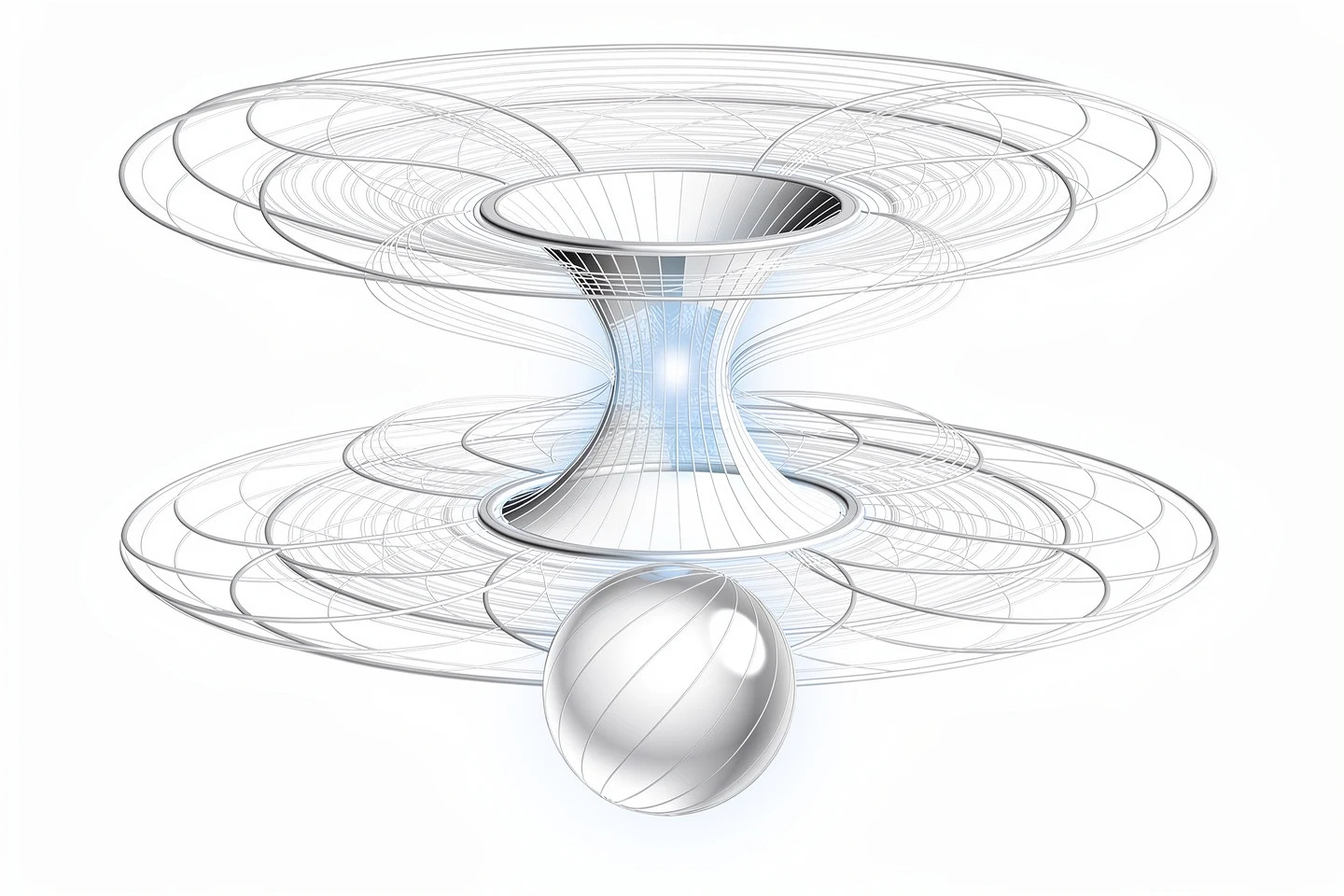
Like a wormhole in an apple, a wormhole, a microscopic tunnel in the curved fabric of space, could have served as a passage for a newborn universe. This transition replaces the baffling point of singularity with a smooth birth from 'nothing,' an idea developed by Stephen Hawking. In the throat of the tunnel, inflation, a rapid expansion, is triggered by the field that gives mass to particles, along with axion fields. This scenario naturally explains the uniformity of the cosmos, and quantum theory and the Standard Model of particles fit into it without breaking. Traces of this process are sought in the cosmic microwave background — ancient light from the Big Bang. The most surprising conclusion: the Big Bang wasn't an explosion at all, but a quiet tunnel transition.
In imaginary time, the geometry of a wormhole resembles a wine glass: a narrow 'stem' connecting two expanding regions. When transitioning to real time, the glass's throat becomes the birth point of a hot, rapidly expanding universe.
The idea of a tunnel from 'nothing' echoes the plot of 'Interstellar,' where heroes travel through a wormhole, but here the tunnel becomes a scientific scenario for the origin of the entire cosmos.