Before the Big Bang: Wormholes at the Dawn of the Universe ✛ ✦
Context
The problem of initial conditions for the Big Bang remains one of the key puzzles in quantum field theory and gravity. While inflation successfully explains the observed large-scale structure, it doesn't answer what triggered the expansion. The no-boundary proposal by Hartle and Hawking was an elegant step forward, but it encountered phenomenological difficulties. New studies suggest that wormholes — topological tunnels in spacetime — may naturally define the initial state.
Methods
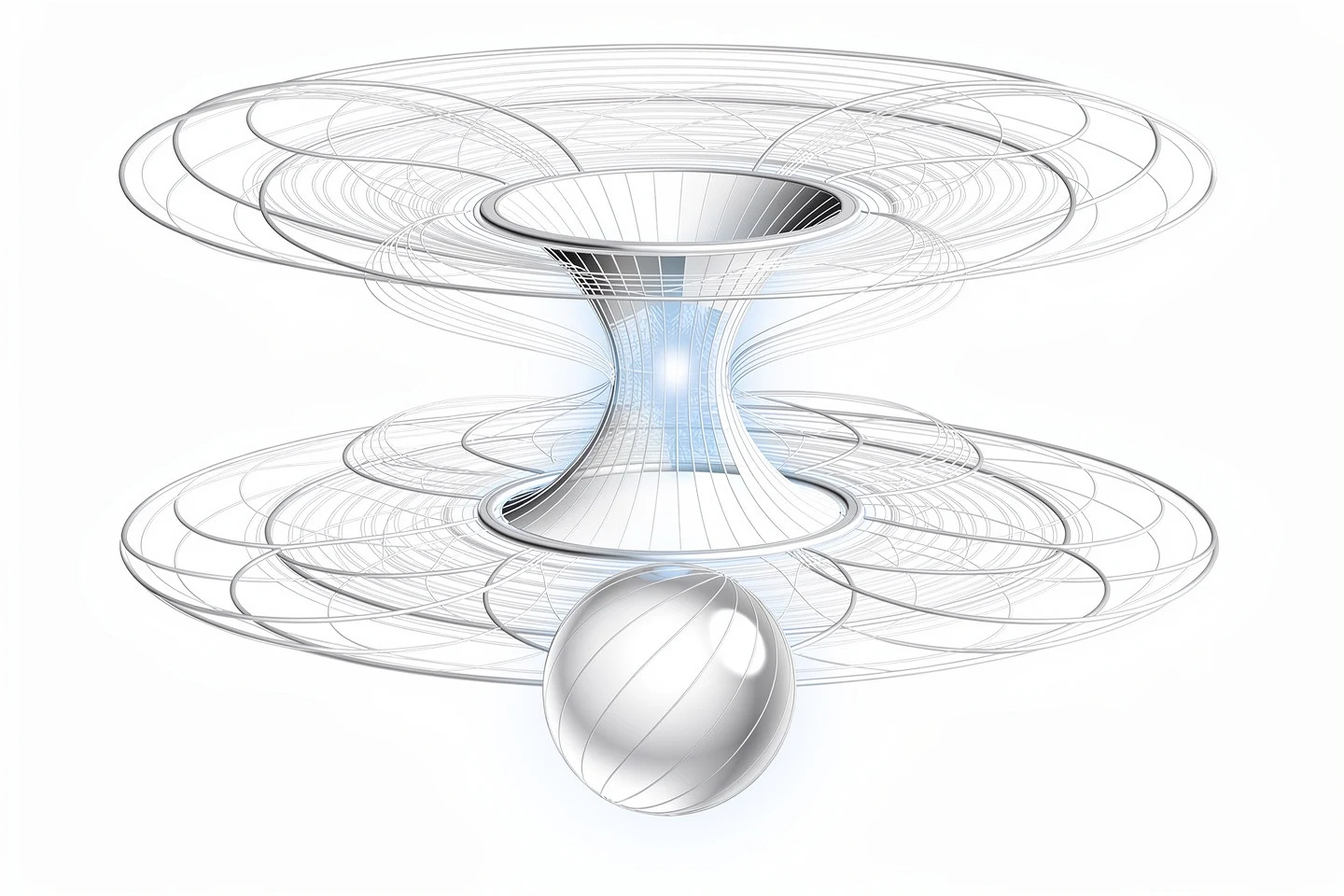
To describe the quantum birth of the Universe, the formalism of the Euclidean path integral was used, where the dominant contribution comes from saddle-point configurations — classical solutions of Einstein's equations in imaginary time. The model included the Standard Model of particle physics, with the Higgs field acting as the inflaton, along with additional sectors: radiation and axion fields. Analytical and numerical solutions with a throat were constructed — the so-called 'wine-glass' wormholes (wormholes with a characteristic scale-factor profile). After the analytic continuation of time τ → it, such geometries transition into an expanding Lorentzian Universe.
Results
It turned out that wormholes are stable and dominant saddle-point contributions for realistic parameter values. The nucleation probability of the Universe in a particular state is determined by the ratio of transition amplitudes, and the contribution of wine-glass wormholes naturally provides the initial conditions for inflation: zero velocity of the scalar field and accelerated expansion with a minimum scale factor. This resolves the fine-tuning problem characteristic of the no-boundary model. The spacetime curvature near the throat is regulated by the balance between gravitational attraction and the repulsive effect of axion fields, keeping the geometry regular and singularity-free.
Implications
This approach links fundamental quantum cosmology with phenomenology: changing the weights of initial states could manifest in the statistics of the cosmic microwave background and the distribution of large-scale structure. This opens a path to testing the hypothesis of multiple topological channels for the Universe's birth and to discriminating between scenarios using observational data.
Future development
The next step is to develop a unified program that incorporates all regular saddle-point contributions — both no-boundary and wormhole types — within a single formalism. Plans include refining the integration contours in the complex plane, analyzing the stability of all solution classes, and developing pipelines to compare predictions with cosmological observations.
Impact
The results impact quantum cosmology, inflation theory, and particle physics, connecting low-energy models to the ultraviolet completion of quantum gravity.
Next steps
Immediate next steps involve computing fluctuations around the saddle points for all topological classes and deriving concrete predictions for the spectrum of the cosmic microwave background.
Key open problems
The wormhole scenario is directly connected to the unification of quantum theory and gravity, as well as to explaining the very mechanism of inflation without resorting to ad hoc initial conditions.
The knowledge machine's view
This section is addressed to the author of the paper and their colleagues. Neighbouring works were found by meaning-based search across our archive, not by word overlap. We do not review: we show the field around the work.
What the work does
The paper examines a model of quantum birth of the Universe from a pair of wormholes joined into a single state. It uses the Euclidean path-integral formalism, where saddle-point configurations of the 'wine glass' type dominate. It is shown that such wormholes are stable and dominate under realistic parameters, and after analytic continuation they provide initial conditions for inflation without fine-tuning.
Where its strength is
The strength of the work is that it offers a concrete mechanism linking topological structures to the onset of inflation and resolves the initial-conditions problem that plagued the Hartle–Hawking scenario. This provides a foundation for further study of quantum cosmology with testable consequences.
Where it could go next
- It might be interesting to see how the proposed scenario relates to the birth of the Universe via vacuum decay, which also considers alternative initial states and their impact on inflation.based on: Dark Start: How Vacuum Decay Birthed the Big Bang arXiv:2606.06587v1
- A closely related work also treats wormholes as a way to reconcile quantum and classical aspects of the Universe's birth; comparing the approaches could help clarify the role of topology in selecting the initial state.based on: Universes in Wine Glasses: How Wormholes Reconciled the Irreconcilable arXiv:2605.10548v1
- It would be interesting to connect the obtained results with models where quantum chaos influences the onset of inflation, to understand how general the mechanism that sets the initial conditions is.based on: How Quantum Chaos Gives Rise to Inflation arXiv:2608.01165v1
Worth trying
- Investigate how including vacuum decay within the proposed model changes the nucleation probabilities of the Universe.
- Compare predictions for the cosmic microwave background spectrum with models where the initial state is set by quantum chaos.
- Consider the possibility of forming primordial black holes from initial inhomogeneities generated by wormholes.
Why this may matter
If wormholes indeed play a role in selecting the initial state, this could offer a new way to test quantum gravity through observational data, such as the statistics of the cosmic microwave background or the distribution of large-scale structure.
Nearby works in our archive
- Tiny Black Holes That Survived the Universe's Youthsimilarity 0.66
- How Tiny Black Holes Are Born from a Slowed-Down Expansionsimilarity 0.65
- How to Ignite the Big Bangsimilarity 0.65
- Universes in Wine Glasses: How Wormholes Reconciled the Irreconcilablesimilarity 0.64
- Dark Start: How Vacuum Decay Birthed the Big Bangsimilarity 0.64
- Tiny Black Holes Don’t Warp the Cosmossimilarity 0.64
- How Quantum Chaos Gives Rise to Inflationsimilarity 0.63
The closest work in the archive sits at 0.66 by meaning — the usual level for our corpus.
Original abstract
as written by the authors arXiv:2605.13777v2
This essay discusses recent progress on Euclidean wormholes as candidate contributions to the Universe's initial quantum state. The comparison with the Hartle-Hawking no-boundary proposal highlights both a conceptual affinity and genuine advance: wormholes retain the relevance of Euclidean-saddles as encoders of properties of cosmological wavefunctions, while they broaden the class of regular saddles that are physically relevant for inflating universes and are capable of resolving issues that plague the no-boundary proposal. The principal achievement of the wormhole program is to enlarge the semiclassical initial-condition land-scape in a way that is physically rich, conforms with Holographic expectations and as such becomes increasingly relevant for early-universe model building, within UV complete theories of quantum gravity.
Euclidean wormholes are named after the shape of a 'wine glass': their geometry in imaginary time has a narrow throat connecting two asymptotically anti-de Sitter regions. Under analytic continuation, the throat becomes the moment of birth of a hot Universe with accelerated expansion.
The image of a tunnel connecting 'nothing' to our Universe echoes the sci-fi idea of a wormhole as a portal (as in 'Interstellar'), but here it finds a rigorous mathematical embodiment in quantum cosmology.
Key numbers
- Exponent n for radiation: 4
- Exponent n for axion field: 6
- Required number of e-folds of inflation: >60
- Number of new topological classes of saddle points: at least 3