Universe from a Wine Glass: How Wormholes Ignite Inflation ✛ ✦
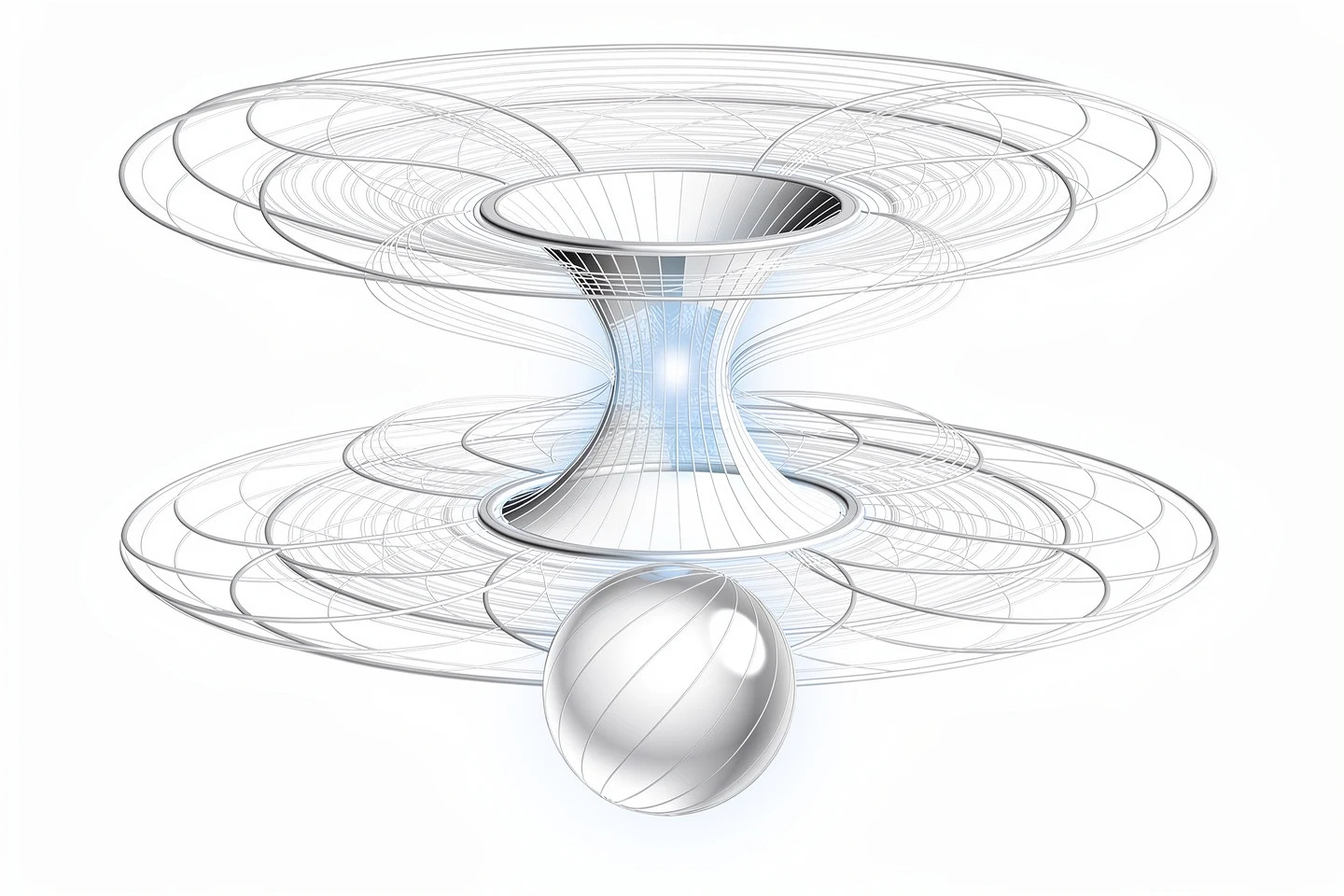
First thing that comes to mind when thinking about the birth of the Universe is an explosion. But modern cosmology paints a more refined picture: birth through the neck of a wine glass. This geometry is not a sommelier's fantasy, but a rigorous form of Euclidean wormhole that connects two anti-de Sitter worlds. According to new research, it is precisely in such a topological funnel that our Universe could have been born, and the start of the Big Bang was immediately taken over by inflationary expansion.
For decades, cosmologists sought a mechanism that sets the starting conditions for expansion. The no-boundary proposal, put forth by Hawking and Hartle within a quantum framework, elegantly removed the singularity but predicted too small a probability for an inflationary Universe to emerge. The new approach allows topologically nontrivial solutions — saddle points of the gravitational path integral in imaginary time. Among them, stable configurations with a throat appeared: the so-called 'wine glasses.' Upon analytic continuation to real time, the throat becomes the moment of nucleation with zero scalar field velocity and minimal scale factor — ideal conditions for inflation.
The Standard Model of particle physics plays a key role: the Higgs field acts as the inflaton, and an additional axion sector provides repulsion that prevents the geometry from collapsing. The curvature of spacetime near the throat is governed by a delicate balance between gravitational attraction and the counter-pressure of axion modes — the art of cosmic glassblowing, where the slightest imbalance shatters the whole structure. This eliminates the need for fine-tuning of initial parameters that plagues simpler models.
What's more, nucleation probabilities for different topological channels can be computed quantitatively. The varying weights of initial states potentially leave an imprint in the statistics of the cosmic microwave background and large-scale structure — the throat's shape dictates not only whether inflation occurs, but also its duration, and hence the future pattern of galaxies. This opens the door to observational testing of the scenario. Extending the idea calls for a unified framework that encompasses all regular saddle-point contributions — both no-boundary and wormhole types. Then, by comparing predictions with data from cosmological observatories, we might for the first time glimpse the imprint of quantum birth right in the sky.
The geometry of a wormhole is likened to a wine glass: in Euclidean time, it resembles a narrow neck between two anti-de Sitter abysses. When switched to real time, the neck becomes the starting point of hot expansion — like champagne bursting from a bottle.
The image of a tunnel connecting 'nothing' to our Universe echoes the fictional portals of 'Interstellar,' but here it gains rigorous mathematical flesh in quantum cosmology.