A Dark Matter Map Without a Safety Net express
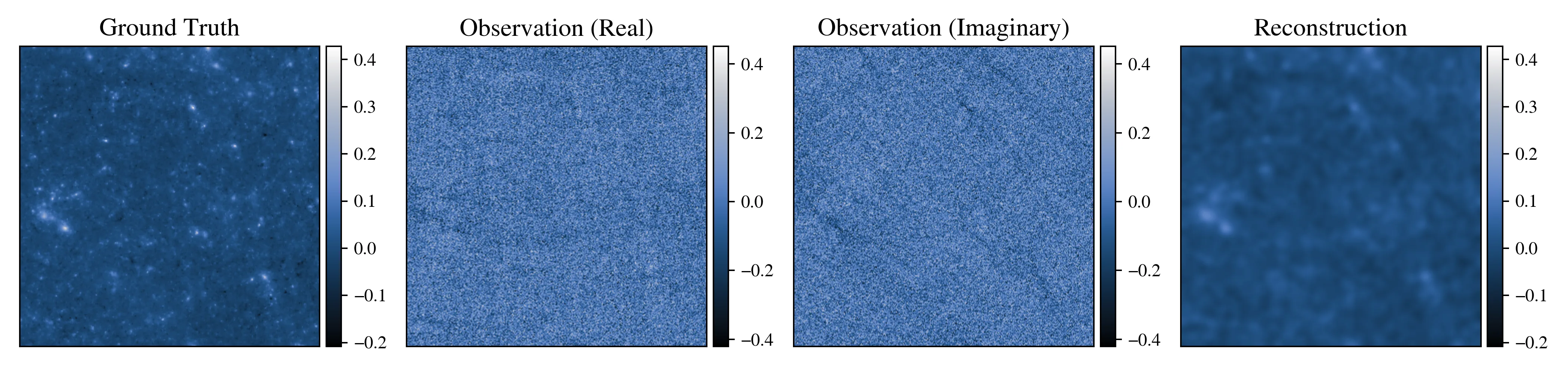
A camera takes a snapshot, but the sensor is noisy, the optics blur, and some pixels are overexposed. Reconstructing the original picture is like guessing a melody from a scratched record: there are many possibilities, and which one is true is unclear. In science, such problems are called inverse problems, and they're everywhere — from medical scanners to radio telescopes. It's especially hard when there's nothing to compare the 'correct' picture against: in astronomy, for instance, we can't fly up to a distant galaxy and check whether we've correctly drawn the clumps of invisible matter.
The new method sidesteps this trouble with a clever trick. First, it 'shakes' the data, using their internal symmetries, as if we flipped and rotated a photo to see which details are random and which repeat. This yields a rough estimate: where on the map we're confident, and where we're just guessing. Then a mathematical procedure comes in, calibrating these estimates not against a reference (there is none) but against the data itself.
The method was tested on mapping dark matter via weak gravitational lensing. Massive clumps of matter curve spacetime and slightly distort the shapes of distant galaxies, like ripples on water changing the look of pebbles on the bottom. From these distortions, invisible mass is reconstructed, but without a reliable way to estimate error, it's easy to mistake wishful thinking for reality. The new approach provides an honest map of uncertainties and does not rely on cosmological models that themselves could be wrong.
In the end, astronomers get a tool that doesn't lie even when no one knows the truth.
Original abstract
as written by the authors arXiv:2605.18655
Inverse problems are ubiquitous in modern scientific studies and involve recovering an underlying signal from noisy observations often transformed by a measurement operator. These problems are frequently ill-posed, particularly in imaging, leading to multiple plausible solutions and considerable uncertainty in reconstructed images. In fields like the physical and biological sciences, accurate uncertainty quantification (UQ) is critical for trustworthy scientific analyses and confident diagnoses. Current UQ methods for imaging often fall short; they can be inaccurate, or require unavailable or difficult-to-acquire ground truth data for calibration, which can introduce hidden biases due to distribution shifts between calibration and observed data. We introduce a UQ approach that leverages equivariant bootstrapping to generate heuristic coverages by exploiting data symmetries. We then refine these coverages through a conformal prediction calibration step, while crucially employing a self-supervised approach to avoid the need for ground truth calibration data. We demonstrate this method with weak lensing mass-mapping, where we aim to reconstruct the convergence field from shear measurements of distant galaxies weakly-lensed by gravitational fields. Mass-mapping in particular benefits from the self-supervised approach, as simulating calibration data is expensive and relies on specific cosmological models that could introduce biases in downstream cosmological inference tasks.
Weak gravitational lensing distorts galaxy shapes by only a couple of percent — roughly like slightly squashing a round coin with your fingers.
In Pavel Amnuel's novel 'Darkness', astronomers try to map dark matter but face the fact that any reconstruction depends fatally on initial assumptions — exactly the problem this new self-calibrating method solves.