Quantum Generator: Images Without Training express
Conventional neural networks learn from thousands of examples, burning hours and gigawatts. Physicists have found a quantum workaround. As early as Max Planck showed the discreteness of energy, today this allows generation without training. The method builds an energy landscape: each point on it is a possible image or phrase, and the final one is the lowest valley. Just as a massive star warps spacetime and guides planets, this minimum attracts the system like gravity. Quantum properties, superposition from Erwin Schrödinger and entanglement, allow simultaneous exploration of possibilities and merging them into a coherent image. The system aims for minimal disorder, yielding a clear result. It's like a black hole: once within its gravitational pull, it won't produce inconsistencies. The framework is borrowed from the Standard Model of physics. As Richard Feynman foresaw, quantum laws transform computation. Here, billions of parameters aren't fitted — the answer is extracted from the depths of reality, where all images already exist in probabilistic form.
Original abstract
as written by the authors arXiv:2605.25986
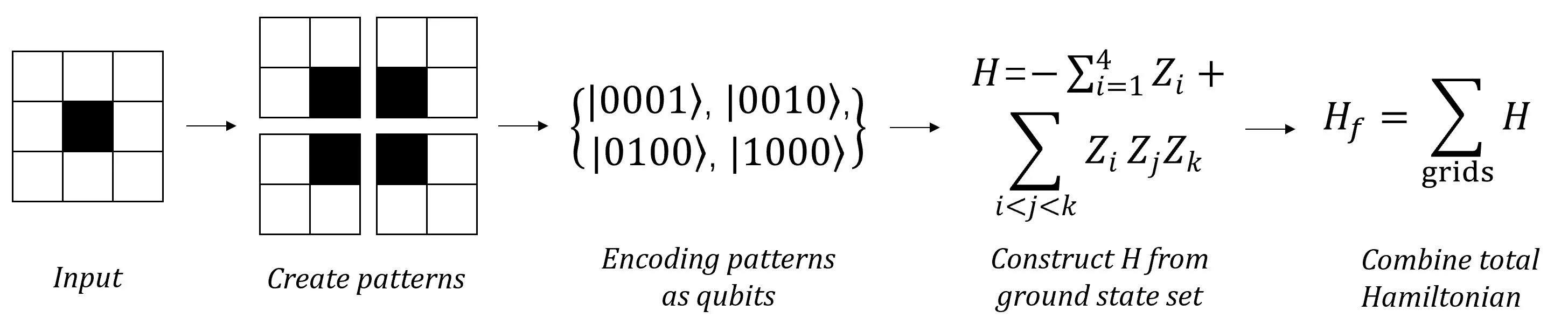
We propose a training-free quantum generative paradigm, which is fundamentally different from current generative models, which demand substantial computational power, face practical scalability limits, and often function as opaque black boxes, despite their remarkable success. We enable image and text generation without parameter training, by constructing a local parent Hamiltonian whose ground state encodes the target distribution and then solving the global Hamiltonian. Rooted directly in quantum mechanical principles, this approach establishes a new pathway for generative modeling that leverages superposition and entanglement to maintain global consistency.
The quantum generator doesn't invent an image: it finds it in a cloud of probabilities, much like Schrödinger's cat, which exists in all states at once.
In Philip K. Dick's Ubik, a spray materializes thoughts. This new method also draws images from abstractions, bypassing training.